

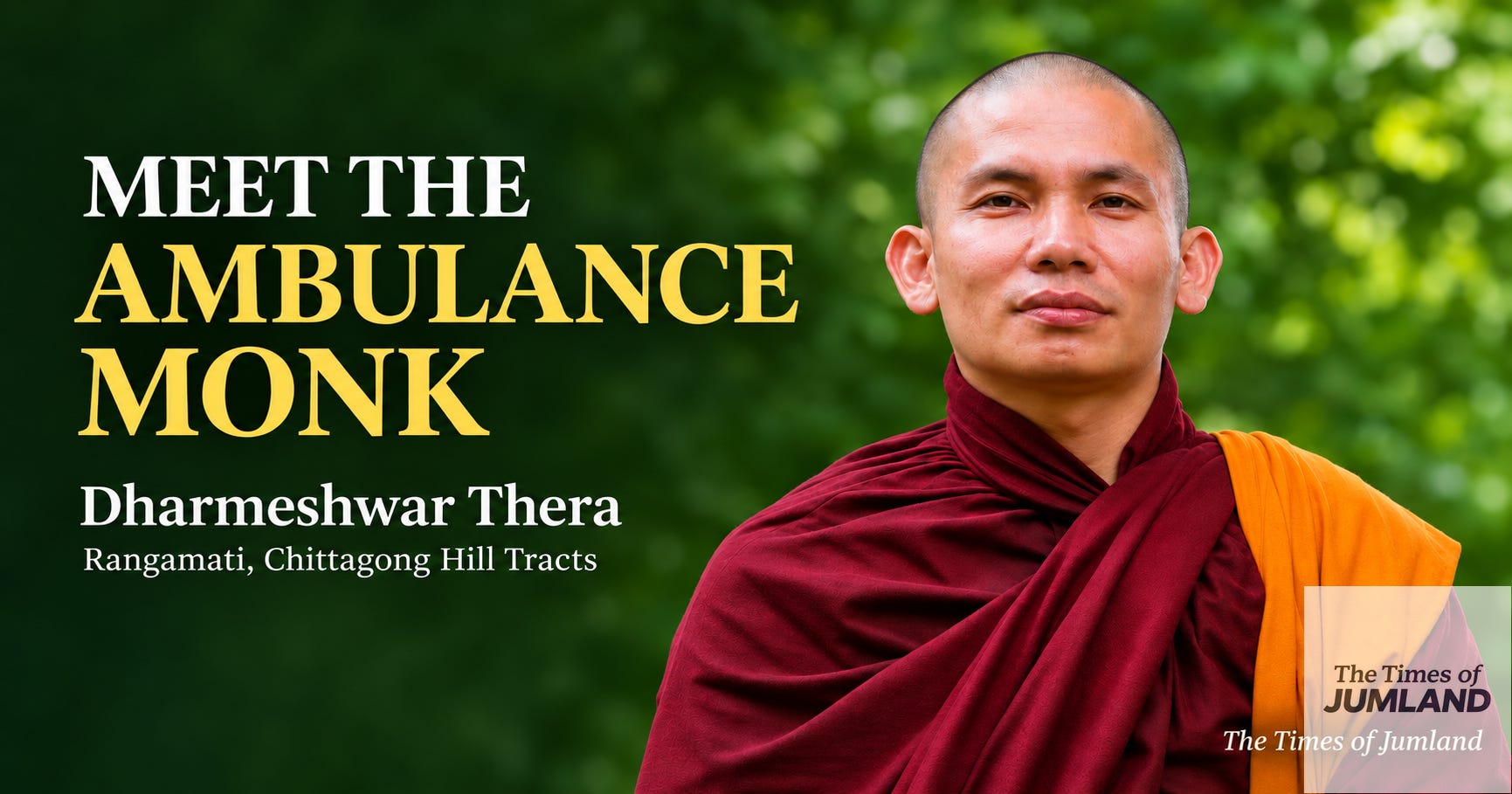
An ambulance purchased through community contributions to honour Buddhist monk Dharmeshwar Thera was inaugurated at Ananda Vihara on 30 October 2026. A separate health centre established through his personal donation is scheduled to open in Baradam, Baghaichhari, on 3 November.
The two initiatives bring a public healthcare purpose to events marking his recognition as a Mahathera, a senior monastic designation. The ambulance is intended to help patients reach medical care, while the health centre aims to assist financially vulnerable families in Baradam and neighbouring villages.
The ambulance inauguration took place during Ananda Vihara’s 92nd Kathina robe-offering ceremony. According to the ceremony announcement, supporters purchased the vehicle through collective contributions and cooperation in Dharmeshwar Thera’s honour.
Prajnananda Mahathera inaugurated the ambulance in the presence of monks and lay supporters. The announcement identifies him as the fifth Sangharaj of the Parbatya Bhikkhu Sangha and abbot of Ananda Vihara and Shakyamuni Buddhist Vihara.
Photographs from the occasion show monks and community members gathered around the white ambulance beneath a decorated canopy. The vehicle bears Ananda Vihara’s name and was adorned with flowers and balloons for the ceremony.
The purchase gives the community’s tribute a practical purpose beyond the religious gathering. The vehicle is intended to serve patients and their families, turning supporters’ contributions into a resource for people seeking treatment.
Dharmeshwar Thera serves as deputy abbot of Ananda Vihara in Rangamati and abbot of Dhammankur Buddhist Vihara in Baradam, a village in Rangamati district’s Baghaichhari upazila.
The Second Sangharaj Sugatapriya Health Service Centre in Baradam has been established through his own donation, according to an invitation announcing its opening. This funding is separate from the collective contributions used to purchase the ambulance.
The invitation describes the centre as a small hospital intended to help poor and financially vulnerable residents. It specifically identifies people unable to afford necessary treatment among those the initiative aims to assist.
A day-long free medical camp is scheduled for the opening on 3 November. Doctors from Rangamati and Dhaka are expected to participate, offering residents an opportunity to receive medical care without consultation charges during the announced camp.
The programme links the recognition of a senior monk with an effort to meet local healthcare needs. The centre is intended to provide a place to seek treatment within the community, while the ambulance can help patients travel for care.
A community account accompanying the invitation describes earlier development work associated with Dharmeshwar Thera’s leadership in Baradam. It credits his planning and encouragement with helping residents construct a two-storey monastery at Dhammankur Buddhist Vihara.
Local people financed the construction, according to the account. Residents also contributed voluntary labour to develop a large field beside the monastery.
Their involvement places the latest initiatives within a wider pattern of community participation. The monastery projects drew on local funding and labour, while the ambulance brought supporters together around a shared public-service goal.
The same account states that Dharmeshwar Thera earned a master’s degree in Buddhist studies in Sri Lanka. It also describes visits to several countries through which he broadened his knowledge of Buddhist culture, traditions and philosophy.
The programme in Baradam includes a memorial gathering for Sangharaj Sugatapriya Mahasthavira and a Kathina robe-offering ceremony scheduled for 5 November.
Shraddhalankar Mahathera, identified in the invitation as deputy Sangharaj of Parbatya Bhikkhu Sangha Bangladesh, is scheduled to preside over that gathering. Residents of Baradam and surrounding communities have been invited to attend.
The ambulance inaugurated on 30 October and the health centre scheduled to open on 3 November represent distinct contributions towards a common purpose. Supporters have honoured Dharmeshwar Thera with a vehicle for patients, while his personal donation supports a medical facility for the community.
Together, the initiatives show how a religious occasion can encourage practical assistance for ordinary families—helping a sick person reach hospital and creating another place for people to seek care.
Sources and Further Reading:
Purna Lal Chakma — Dharmeshwar Bhikkhu Sets a Higher Standard for Serving People in the CHT.