

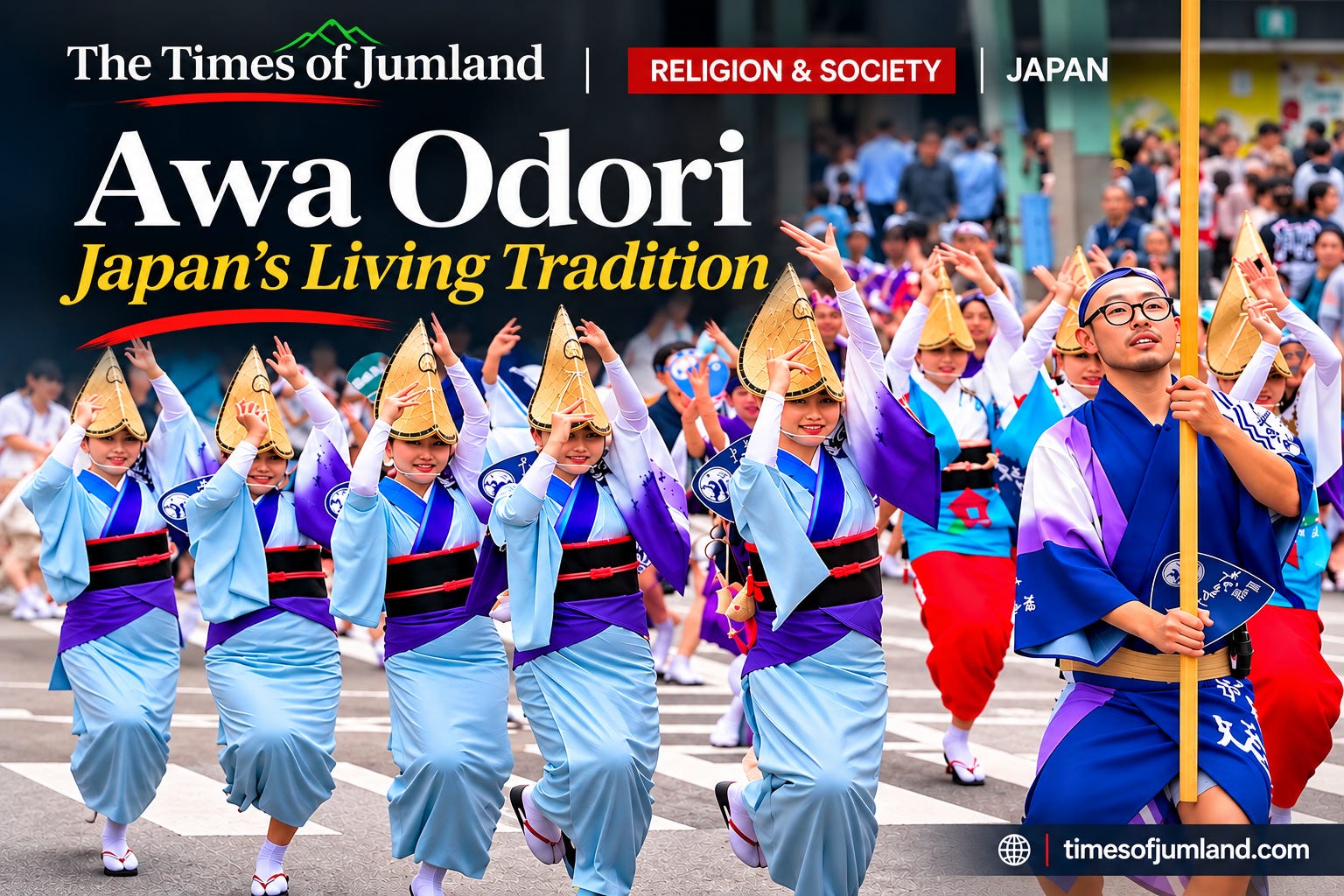
A group of Japanese dancers moves through a crowded street, raising their hands in graceful movements. Women wear traditional straw hats and colorful costumes, while spectators watch from both sides of the road. The scene is part of Awa Odori, one of Japan’s most recognizable traditional dances.
To many spectators, it is simply a joyful summer festival. But behind the music, costumes and dancing lies a history closely connected to religion, local communities and the Japanese way of remembering the past.
Awa Odori originated in Tokushima, on the island of Shikoku, and has a history stretching back more than 400 years. Its exact beginnings remain debated, but one explanation connects it to Bon Odori, the traditional dances performed during Japan’s Obon season.
Obon is an important observance influenced by Buddhism and older Japanese beliefs about ancestral spirits. During this period, families remember deceased relatives, visit graves and make offerings. Traditional belief holds that the spirits of ancestors return to visit their families for a short time.
Bon Odori developed as part of these summer traditions. Over generations, the dances became important community events, bringing families and neighbours together through music and celebration.
Awa Odori also developed through local history. Another theory connects its beginnings to celebrations surrounding the construction of Tokushima Castle in the late sixteenth century. Traditional folk performances and the activities of merchants also influenced the dance.
Today, Awa Odori has grown far beyond Tokushima. Performances take place in Tokyo and other parts of Japan, attracting people of different ages and backgrounds. The main Tokushima festival is held every August from the 12th to the 15th.
The dancers usually perform in organized groups known as ren. Their movements follow the rhythm of traditional instruments, including drums, flutes and shamisen. Women often wear distinctive pointed straw hats called amigasa, while other dancers wear happi coats or colorful festival clothing.
What makes this tradition interesting is the relationship between religion and everyday life in Japan. People can participate in a festival with Buddhist historical connections without necessarily treating the performance as a religious ceremony.
Some participants may value its religious history, while others join because of family tradition, friendship, music or local pride. The same celebration can therefore hold different meanings for different people.
This is one way Japanese traditions have survived across generations. Religious customs have become part of community life while retaining connections to their historical origins.
Awa Odori also shows that cultural identity does not always depend on personal religious belief. People can preserve a tradition, teach its movements to children and celebrate its history without sharing exactly the same religious convictions.
Japan’s festivals are more than entertainment. They preserve memories of earlier generations and create opportunities for communities to gather in public spaces.
The dancers may perform for the joy of dancing, but the tradition carries centuries of history. In Japan, religion and culture have often grown together, leaving customs that remain meaningful long after their original religious purposes have changed.