

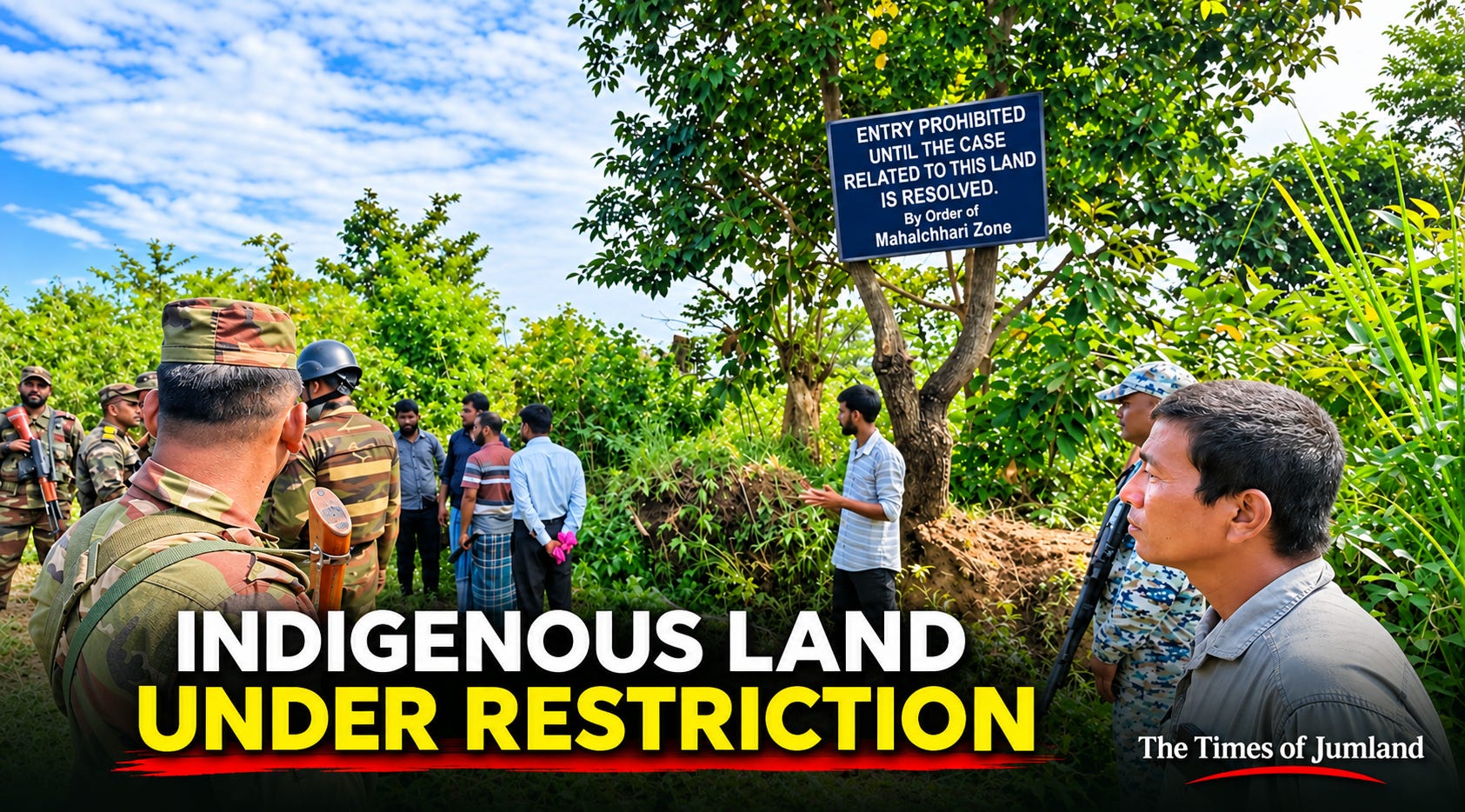
KHAGRACHHARI, Bangladesh — Indigenous Jumma families in Bangladesh’s Chittagong Hill Tracts (CHT) have expressed renewed fears of losing their ancestral land after army personnel reportedly erected a no-entry signboard on disputed property in Joysen Para, Mahalchhari, on November 10.
The restriction affects land claimed by two Indigenous Chakma residents, Jyotish Chandra Chakma and Sadhan Bhushan Chakma, in Maischari Union of Khagrachhari district. Both reportedly possess land records and have longstanding claims to the property.
According to accounts of the incident, approximately 18 to 20 soldiers arrived in the village on Tuesday morning and installed the signboard under the direction of Mahalchhari Zone Commander Lieutenant Colonel Mohammad Al Jabir Asif and a local army camp commander.
A photograph taken at the scene shows armed uniformed personnel and civilians standing beside a signboard attached to a tree.
The notice, issued in the name of Mahalchhari Zone, states that public entry is prohibited until the case concerning the land is resolved.
The move has alarmed Indigenous residents, who fear the restriction could prevent the landowners from returning to their property and eventually lead to the loss of land their families have claimed for generations.
The affected families say they have repeatedly faced obstacles when attempting to cultivate the disputed land and establish gardens. They allege that military personnel have prevented them from exercising their land rights while the ownership dispute remains unresolved.
The latest incident has revived memories of a violent confrontation in the same village more than four years ago.
On July 5, 2022, Bengali settlers were accused of attacking Indigenous residents and setting fire to their homes during a dispute over land ownership in Joysen Para.
The International Chittagong Hill Tracts Commission reported that 37 Jumma houses were burned and several Indigenous residents injured. The incident attracted national attention and prompted demands for an independent investigation and protection of the affected families.
The commission also raised concerns about the response of security forces during the violence and called for accountability and justice for the victims.
The land dispute, however, began long before the 2022 attack.
At the time, local Indigenous leaders maintained that the disputed property belonged to Chakma families who had possessed settlement documents dating back to the Pakistan period.
A July 2022 report by Prothom Alo quoted Lemuchhari Mouza Headman Dinendra Chakma as saying that approximately 20 acres of disputed land belonged to three Indigenous families, including Jyotish Chandra Chakma’s family.
The recurrence of Jyotish Chandra Chakma’s name in the latest dispute highlights the longstanding struggle over land ownership in the village.
Following the 2022 violence, an army camp was established in the area. Indigenous residents subsequently complained that they were unable to return freely to the disputed land or resume their agricultural activities.
The affected landowners later sought legal remedies through the courts in Khagrachhari.
Local accounts indicate that the Indigenous landowners obtained a favourable court ruling. However, the latest no-entry notice refers to a case awaiting resolution, leaving questions about the status of the legal proceedings and the grounds for the restriction.
The signboard does not identify a court order, case number or the legal provision under which Mahalchhari Zone has prohibited public access.
For the affected Indigenous families, the restriction has become another obstacle in their efforts to secure possession and use of their land.
Residents have expressed concern that prolonged restrictions could leave the disputed property beyond their control, even while they continue pursuing their ownership claims through legal channels.
The incident reflects the wider struggle over land rights in the Chittagong Hill Tracts, where Indigenous Jumma communities have faced decades of displacement, competing ownership claims and difficulties recovering ancestral property.
State-sponsored Bengali settlement in the region during the late 1970s and 1980s significantly altered land ownership and demographic patterns, contributing to disputes that continue to affect Indigenous communities.
Land rights became a central issue in the political conflict that led to the signing of the Chittagong Hill Tracts Accord in 1997.
Nearly three decades after the agreement, many Indigenous families continue to face unresolved disputes over land that they claim as their traditional or legally recorded property.
For the Jumma people, land is not merely an economic resource. It provides agricultural livelihoods, supports traditional community institutions and connects families to the places where their ancestors lived.
Losing access to land can therefore threaten the economic security and cultural continuity of entire communities.
The situation in Joysen Para also raises questions about the role of military authorities in civilian land disputes and whether access restrictions can be imposed without a specific judicial order.
Residents are demanding protection of their land rights, an end to interference with lawful agricultural activities and a fair resolution of the dispute.
They also want authorities to ensure that Indigenous families are not displaced from land they have occupied or legally claimed for generations.
Four years after the burning of Indigenous homes in Joysen Para, the latest restriction has renewed fears that the affected families could once again be prevented from returning to their land.
For the Indigenous landowners, the demand remains straightforward: recognition of their lawful rights, protection from further displacement and the freedom to live and cultivate their land without fear.