

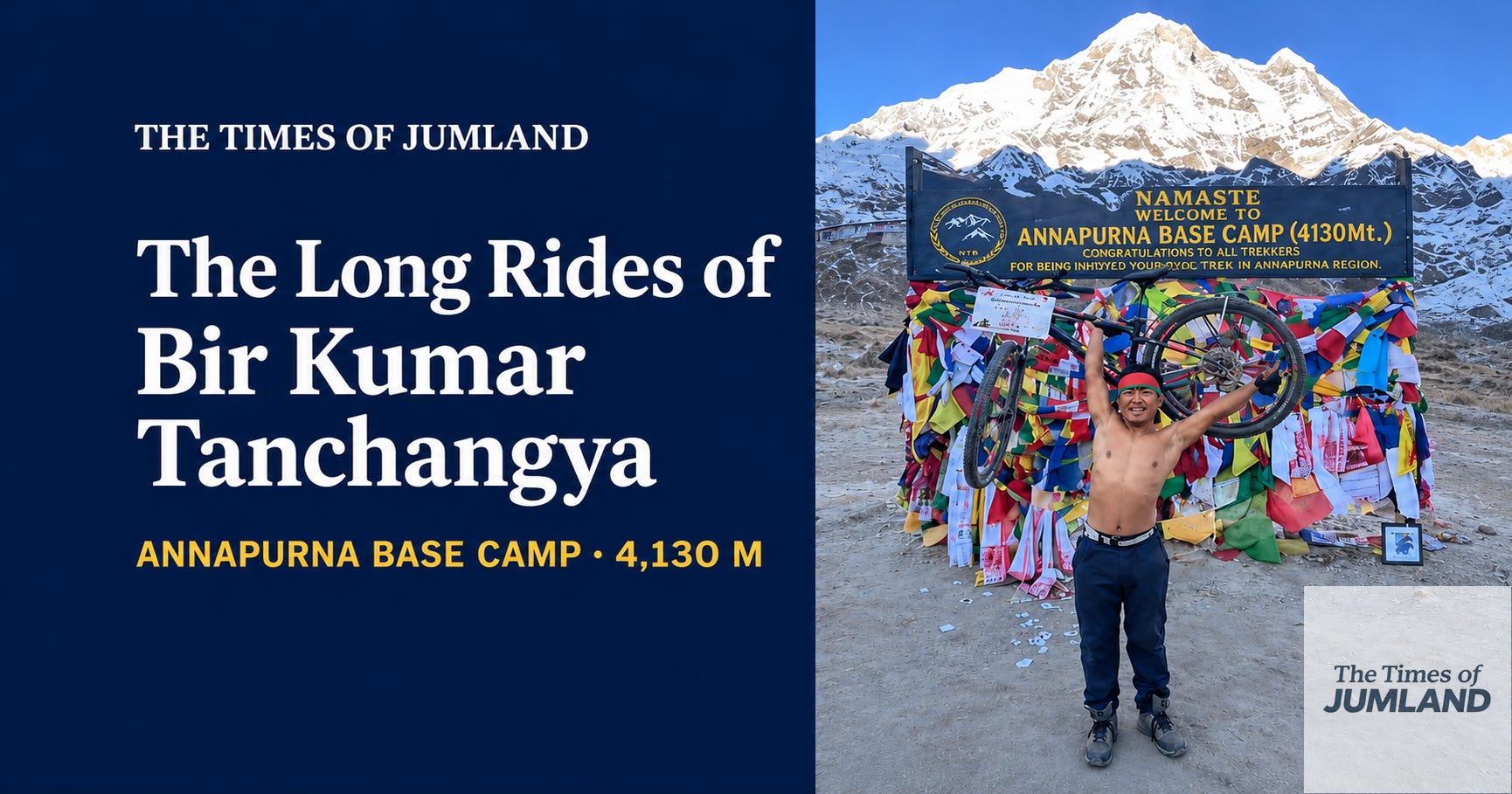
At Annapurna Base Camp, Bir Kumar Tanchangya raises his bicycle above his head. Behind him are prayer flags, a snowy mountain and a sign marking the base camp at 4,130 metres. Earlier in the expedition, there had been stretches of mountain trail where he had to carry the bicycle on his shoulders. At Annapurna, he lifted it in celebration.
The journey began on the shore of the Bay of Bengal in August 2026. Its history goes back further, to a childhood in Kaptai and a wish to visit every district of Bangladesh by bicycle. Bir Kumar fulfilled that wish, rode through 10 Indian states and then set out from Cox’s Bazar to take his bicycle into the Himalayas. Along the way, he used his journeys to promote voluntary blood donation and environmental protection.
The roads out of Kaptai
Bir Kumar grew up in Kukyachharipara, in Wagga Union of Kaptai upazila, Rangamati. His father was a farmer. Bir Kumar enjoyed cycling from childhood and went on to study computer science and engineering at Dhaka International University. By his mid-twenties, he was using the bicycle to see parts of Bangladesh he had long wanted to visit.
One of his earliest documented long rides began on 24 December 2022 in Teknaf, near the southern end of Bangladesh. He reached Tetulia in the far north on 4 January 2023, 11 days later. That journey took him from one end of the country to the other. His next ride would take him into every district.
On 8 June 2023, Bir Kumar left home with Tk 2,000 raised from family and friends. He rode from Rangamati through Chattogram and Feni, then headed towards Sylhet. His route took him through districts in Dhaka, Rangpur and Rajshahi divisions before he looped back through Khulna and Barishal. In each district, he stopped outside the circuit house to take a photograph. He returned to Rangamati on 18 July, having visited all 64 districts in 40 days.
He carried placards urging people to donate blood, protect trees and take global warming seriously. He met local cycling groups and encouraged young people to take up cycling. Those efforts had a base in Kaptai, where he founded Kaptai Blood Bank and Wagga Volunteer. The causes he worked on at home became part of what he talked about on the road.
Ten Indian states and nights in a tent
Bir Kumar entered India through Bongaon on 17 December 2023 and began his ride from Kolkata two days later. From West Bengal, he travelled through Jharkhand, Odisha, Chhattisgarh, Telangana, Andhra Pradesh, Karnataka, Tamil Nadu and Kerala before reaching Goa. By late February 2024, he reported covering about 5,700 kilometres across 10 states.
Where he slept depended on what was available at the end of the day. He pitched his tent at temples, churches, petrol stations, transport stations and community centres. Some people offered him a place in their homes. He had hoped to see more of India, but his visa limited how long he could stay. On 12 March 2024, he returned to Kaptai.
From the Bay of Bengal to Nepal
On 16 August 2026, Bir Kumar began his Sea to Himalayas – Expedition for Awareness at Kabita Chattar Beach in Cox’s Bazar. Before riding out, he collected plastic waste on the beach. The formal departure was recorded at 8:39 a.m. He had four objectives in Nepal: Everest Base Camp, Annapurna Base Camp, the Annapurna Circuit and the Manaslu Circuit.
Reaching the starting line had required repeated trips to arrange visas, permits and clearances. Bir Kumar credited cyclist Rakibul Islam and mountaineer Babar Ali with helping him prepare. Babar later recalled that Bir Kumar had set out with limited funds and without a sponsor.
From Cox’s Bazar, Bir Kumar rode north to Banglabandha in Panchagarh, crossed into India and passed through Siliguri before entering Nepal. In Kathmandu, he obtained permits for the mountain leg. By the time he reached Namche Bazaar, the gateway to the Everest region, he said he had covered more than 1,372 kilometres from Cox’s Bazar.
The Everest region on foot and on wheels
Before Bir Kumar left Bangladesh, retired police official Naba Bikram Kishore Tripura joked that on the mountain trails the bicycle might end up riding on him. In the Khumbu Valley, rough ground, rain and snow made parts of the route impossible to ride. On some stretches, Bir Kumar carried the bicycle on his shoulder or back.
On 19 September, at Chhukung Ri, he held up the Bangladesh flag and sang the national anthem. Three days later, at 2:15 p.m. Nepal time, he reached Everest Base Camp. From there, he continued through the region into October, adding Kala Patthar and two more high passes to the stops he had already recorded.
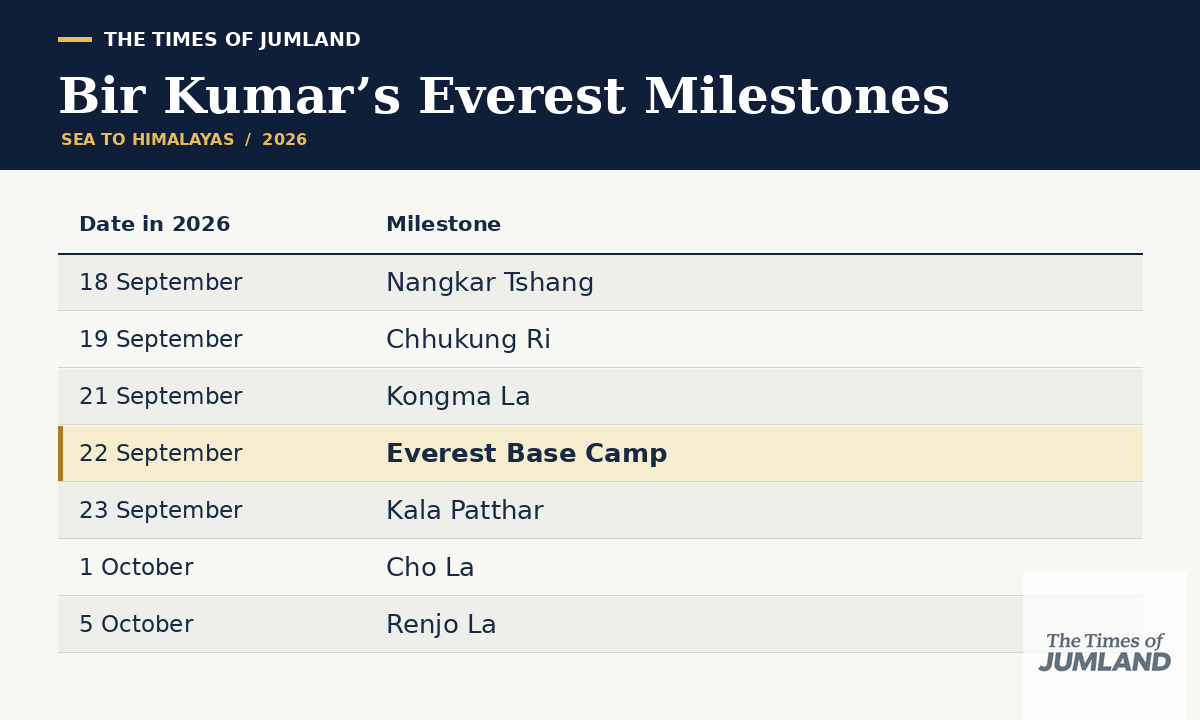
By 8 October 2026, Bir Kumar had also reached Gokyo Ri at 5,357 metres. His expedition certificate, dated that day, records the ascent alongside Everest Base Camp, Kala Patthar, Chhukung Ri and the three passes of Kongma La, Cho La and Renjo La.
Thorong La and the last of his funds
On 4 November, Bir Kumar crossed the snow-covered Thorong La pass on the Annapurna Circuit at 5,416 metres, according to a Facebook post recounting a phone call with him from the trail. He was still working his way towards Annapurna Base Camp, another of the goals he had set before leaving Cox’s Bazar.
During the call, Bir Kumar said that the money he had brought from Bangladesh was nearly gone. He appealed for financial help to continue the expedition. After months on the road, the prospect of reaching his next destination depended on whether he could afford to keep going.
The bicycle at Annapurna
The video from Annapurna Base Camp shows Bir Kumar standing with his bicycle in front of the sign at 4,130 metres. The footage is the latest scene in this account. The date of his arrival at the camp and the outcome of the Manaslu leg remain to be confirmed.
In 2023, Bir Kumar stopped outside a circuit house in each district to take a photograph. Those pictures recorded how far he had travelled from Kaptai. The frame at Annapurna belongs to that same record. This time, the landmark is a base camp sign, and the bicycle he had carried over stretches of the Himalayas is held above his head.