

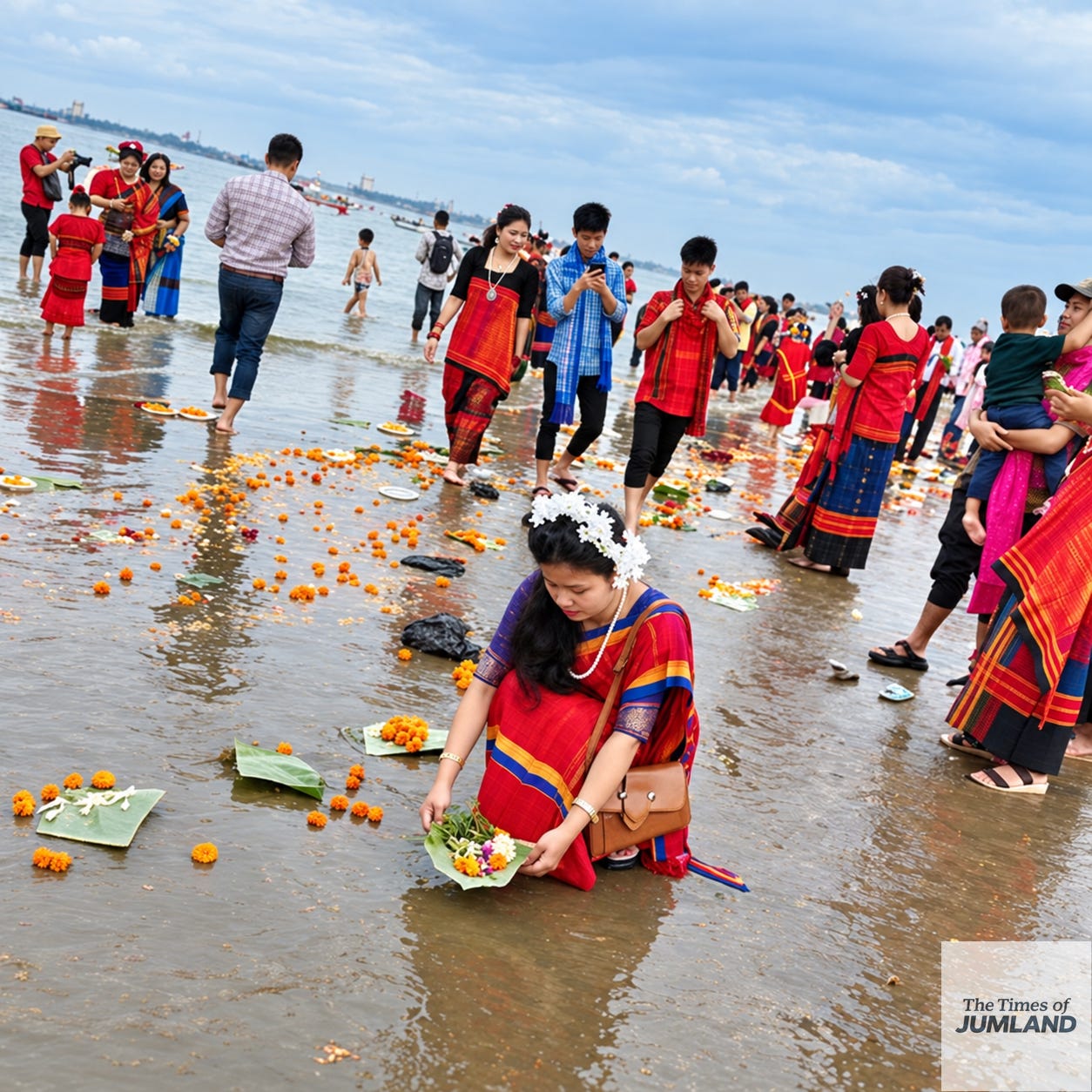
Why did Chakma children once feed chickens before celebrating the New Year? Why did families place flowers beside rivers, light candles near animal shelters and prepare a vegetable dish that guests were expected to eat in several different homes? These customs reveal a lesser-known history of Chakma Biju, a traditional festival deeply connected with nature, family, spiritual beliefs and community life.
Every April, photographs of young Chakma women and men offering flowers to rivers spread across social media. They wear traditional clothing, gather beside the water and welcome the New Year. These beautiful photographs have become the most recognizable images of Biju in the Chittagong Hill Tracts of southeastern Bangladesh.
But the photographs reveal only part of the celebration. Biju is much older and culturally more complex than the flower-offering ceremonies and public festivals commonly seen today. Its traditions contain memories of agricultural life, respect for elders, reverence for water, hospitality, religious beliefs and the relationships that once connected entire villages.
Chakma Biju is the traditional New Year festival of the Chakma people, celebrated annually in mid-April. It marks the end of the old year and the beginning of the new one through three principal observances: Phul Biju, Mul Biju and Gojjepojje. The festival combines family gatherings, traditional food, religious practices and customs reflecting the Chakma people’s relationship with nature.
Chakma Biju is widely regarded as an ancient festival, with roots believed to extend back thousands of years. Its traditions are closely connected with jhum cultivation, seasonal change, reverence for nature and hopes for a prosperous agricultural year. Although its exact historical beginning has not been established through surviving written records, Biju has been preserved across generations through oral traditions, cultural practices and literature, including references in the Chakma ballad Radhamon-Dhanpudi.
Phul Biju, the first day, is associated with flowers, cleaning homes and offerings at rivers and other water sources. Mul Biju, the second day, centres on family gatherings, visiting neighbours and sharing traditional food, especially pajon. Gojjepojje marks the New Year through blessings, religious observances, respect for elders and rest. Customs and their timing may vary between Chakma communities, but together these observances represent the festival’s cultural and social significance.
Chakma Biju is celebrated not only in Bangladesh but also among Chakma communities in northeastern India, including Mizoram and Tripura. Despite differences in local practices, its importance remains similar: families welcome the new year through religious observances, food, community visits and traditional expressions of goodwill.
The first day, Phul Biju, is closely associated with flowers. In many contemporary celebrations, people gather at rivers or lakes early in the morning and release flowers onto the water. Public flower-offering ceremonies attract photographers, journalists and large numbers of young participants.
However, historical accounts describe an older form of worship that was not necessarily centred on releasing flowers into flowing water. Instead, people placed flowers, leaves and candles beside rivers, streams, wells and other sources of water, offering prayers for wellbeing and protection.
In a Prothom Alo report examining how Indigenous New Year celebrations have changed, journalist Buddhyajyoti Chakma recorded elders’ descriptions of worship associated with Gongima, understood as a water goddess. Families sought forgiveness for the misfortunes of the departing year and blessings for the coming one.
This is an important distinction. Water was not simply a convenient place for a colourful ceremony. For earlier generations, rivers and streams provided drinking water, opportunities for bathing and fishing, and essential resources for household and agricultural life. Their importance was spiritual as well as practical.
A detailed cultural essay published by Bonik Barta in 2021 describes wildflowers traditionally offered beside water sources. These included locally known varieties such as bhatjhura, turing, rebek and kuruk, sometimes arranged on banana leaves or other broad leaves. Such details preserve the names of plants that may be unfamiliar to younger Chakmas growing up away from the hills.
The difference between an offering beside a river and a modern flower-floating procession does not make one authentic and the other meaningless. Traditions evolve, and public ceremonies can acquire new significance over time. Understanding earlier practices, however, allows people to recognize what changed and why the original observances mattered.
The history of Chakma Biju also reveals something important about Chakma religious life. Today, the Chakmas are predominantly Theravada Buddhists, and Buddhist monasteries play a significant role in New Year celebrations. Yet older Biju traditions include reverence for water, nature and household protective figures alongside Buddhist worship.
Descriptions of household offerings to Ma Lakkhi or Lakshmi, the Hindu goddess, prayers associated with Gongima (a water goddess), and acts of devotion before Buddha images suggest that Chakma religious life has contained different layers of belief. Historical accounts document these practices, although their forms and prevalence may have differed between villages and generations.
Such practices deserve documentation rather than embarrassment or dismissal. The religious history of a community cannot be understood solely through the doctrines it follows today. Local rituals may preserve memories of earlier beliefs, agricultural concerns and relationships with the natural environment.
Another important aspect of Phul Biju was the emphasis placed on cleanliness and renewal. Families cleaned houses, washed clothing and decorated doorways and courtyards with flowers. These preparations had practical value, but they also reflected the desire to enter the new year with a refreshed household and a peaceful mind.
Traditional accounts describe younger people collecting water to bathe elderly relatives and respected members of the village. They would greet the elders, offer respect and seek their blessings. The custom expressed an understanding that old age carried dignity and that younger generations owed care to those who had guided them.
Some families observed the bathing of elders during Phul Biju, while other accounts associate it with the first day of the new year. Such differences are a reminder that the history of Biju is preserved through many communities rather than one universal handbook.
Older descriptions also mention the bathing of Buddha images and offerings at Buddhist monasteries. In these practices, cleansing and renewal were connected with religious devotion. The coexistence of household rituals and monastery observances illustrates how Biju developed as both a social and spiritual celebration.
Perhaps one of the least-discussed Chakma Biju traditions involved domestic animals. Historical accounts describe children and other family members providing food for chickens, ducks, cattle and goats. Some decorated cattle with flowers, while others scattered grain in household courtyards for poultry.
In one account recorded by Prothom Alo, children went from house to house giving grain to chickens. Household animals were also released and fed as part of the festival preparations. The practice reflected the idea that the New Year celebration included the animals that shared people’s everyday lives.
In a traditional agricultural household, cattle and poultry were economically important. Caring for animals during the New Year connected domestic wellbeing with the wider living environment. The festival recognized relationships that extended beyond human family members.
It is difficult to know how widespread every such custom once was or how many villages continue to observe it. What is clear is that these practices have been documented, and they add an important dimension to our understanding of Biju.
The second day, Mul Biju, is generally the centre of the social festivities. Homes become places of hospitality, families prepare special dishes and people visit relatives, neighbours and friends. The most celebrated food of the day is pajon, a mixed preparation of vegetables and other ingredients.
Pajon is sometimes described simply as a vegetable curry, but that description hardly explains its cultural importance. Its preparation reflects knowledge of the edible plants available in the hills, seasonal food resources, preservation methods and the relationship between household cooking and community gatherings.
Traditional ingredients may include bamboo shoots, wild greens, forest vegetables, different varieties of tubers, hill-grown potatoes, jackfruit seeds and dried fish. Cultural accounts also mention locally named ingredients such as tara, bedagi, hathol dingyi and bigol biji. The particular combination depends on location, availability and family preference.
Preparing pajon traditionally involved gathering ingredients from several environments, including jhum fields, household gardens, forests and local markets. Knowing which plants could be eaten, where they grew and how they should be prepared was itself a form of traditional knowledge, often passed from older family members to younger ones through everyday work.
There is no universally fixed number of vegetables required for pajon. The Chakma Autonomous District Council in Mizoram describes pajon-ton as containing at least seven vegetable ingredients. Other family traditions refer to twenty-two, thirty-two or even more varieties. The number is therefore better understood as reflecting diversity and local custom than a rigid rule applicable to every household.
A 2016 Daily Star report documented the perspectives of Chakma women preparing pajon. One described the importance of particular seasonal hill vegetables, while an elderly woman emphasized that adding more varieties improved the dish. Their accounts illustrate how knowledge about ingredients is transmitted within families.
These differences are part of pajon’s significance. Two households may prepare the dish using different combinations, yet both recognize it as essential to Biju. Its cultural identity rests on seasonal ingredients, collective preparation and shared consumption rather than one standardized recipe.
Pajon also carries a traditional belief about health. According to a widely repeated custom, people should eat pajon from at least seven different households during Biju to remain protected from illness in the coming year. This is a cultural belief, not a medically established way to prevent disease.
The social meaning of this tradition is particularly revealing. To eat pajon from several households, people must leave their own homes, walk through the neighbourhood and maintain relationships with others. A custom associated with wellbeing also encourages people to participate in community life.
Older accounts describe a festival in which people did not need formal invitations to enter another household. A visitor could arrive, be welcomed and share food. Purna Chakma, writing about Biju in Prothom Alo in 2021, observed that this open hospitality was changing as formal invitations became more common.
That change may appear small, but it raises a larger question about community life. The older practice depended on relationships in which neighbours expected to meet and share food. Modern celebrations, especially in towns and cities, may require more formal arrangements.
Traditional Biju food extends beyond pajon. Cultural accounts describe rice cakes and sweets known by names such as bora pide, binni hoga, kola pide and sannya pide. Households prepare them using combinations of sticky rice, rice flour, banana leaves, palm juice or molasses, depending on the recipe.
Traditional rice-based drinks also appear in accounts of the festival. The Chakma Autonomous District Council records beverages such as hanji and jogorah, along with distilled preparations. Their use varies by household and social setting, and these drinks form part of the broader history of Chakma food culture.
What makes these foods culturally significant is not simply their flavour. Each requires ingredients, tools and skills passed between generations. Preserving the recipes means recording the preparation methods, traditional names and occasions on which the dishes were served.
The final phase of Biju welcomes the New Year. Gojjepojje is commonly associated with rest, good wishes and religious or household observances. Families may visit monasteries, offer food to monks, observe Buddhist precepts and listen to religious teachings.
Traditional accounts also describe households preparing good meals on the first day of the year. According to one belief, beginning the year with sufficient food would bring abundance during the months ahead. Such customs expressed hopes for prosperity in a society where agricultural success and household security could never be taken for granted.
Another lesser-known practice involved lighting lamps or candles around the homestead. Accounts mention lights being placed near the main house posts, bathing areas, storehouses and animal shelters, not merely in the rooms occupied by the family.
Some descriptions also refer to offerings associated with rice-storage vessels or household protective figures. These observances show how concerns about food, prosperity and the safety of a household were woven into the New Year celebration.
Chakma Biju is also closely connected to the agricultural calendar. The festival arrives at the transition between the end of the traditional year and a new seasonal cycle. In the hills, this period is associated with preparation for jhum cultivation, including the management of fields and the expectation of coming rainfall.
The festival therefore developed within a way of life in which the condition of forests, water sources, soil and seasonal crops directly affected family welfare. Its rituals cannot be fully understood without considering that environmental setting.
Biju was also a season of games, songs and entertainment. Traditional Chakma games recorded in cultural histories include ghila khara, nadeng khara, gudu khara and boli khara. Their names preserve forms of recreation that were once familiar in village life.
Ghila khara is especially interesting. It uses hard seeds from a wild climbing plant, with players or teams attempting to strike targets in a sequence of rounds. The game is connected with Chakma cultural traditions and the celebrated Radhamon-Dhanpudi narrative.
Nadeng khara involves spinning tops. Players attempt to strike an opponent’s spinning top with their own. Other traditional competitions included wrestling and team games, bringing together participants and spectators from different age groups.
Some of these games continue among neighbouring Indigenous communities, even where they have become less common among Chakmas. Their survival is not merely about entertainment. The rules, local terminology and associated stories form part of the community’s intangible cultural heritage.
Traditional songs are another important source of historical memory. Biju songs describe celebration, friendship and village life, while older Chakma musical traditions connect the festival with seasonal change and shared experiences.
But not every song about Biju expresses happiness. A cultural essay published in Bonik Barta in 2021 referred to a Chakma song expressing the sorrow of families separated during the armed conflict in the Chittagong Hill Tracts and their longing to celebrate Biju together again.
During decades of conflict, many Indigenous families fled their homes, and large numbers sought refuge across the border in India. For people separated from their villages and relatives, the festival could become a painful reminder of the life they had lost.
The earlier construction of the Kaptai Dam had already transformed the lives of many Chakma families through displacement and the inundation of ancestral settlements. In later decades, conflict and insecurity created further disruptions to village life.
These histories matter when considering cultural continuity. Traditional festivals are sustained through places, relationships and repeated gatherings. When families are displaced, houses disappear or communities become scattered, the circumstances that supported those traditions are altered.
A festival may survive after migration, but its form inevitably changes. A Chakma family in Dhaka, Kolkata, Mizoram or Tokyo may celebrate Biju with familiar food and traditional clothing. Yet gathering wild ingredients, visiting numerous village households or performing ceremonies at ancestral water sources may no longer be possible.
This does not make diaspora celebrations less meaningful. Cultural programmes and community gatherings allow people to maintain relationships across distance. They may also introduce Chakma traditions to children who have never lived in the Chittagong Hill Tracts.
However, public celebration and cultural transmission are not exactly the same thing. A young person may recognize the pinon and hadi worn by Chakma women but know little about how the garments are woven or what their traditional patterns represent.
A child may eat pajon without knowing the names of its original hill ingredients. Someone may enjoy a Biju song without understanding the Chakma words, or watch a flower-offering ceremony without knowing about the older beliefs associated with Gongima.
There is also a difference between remembering that a custom existed and understanding how it worked. Recording the name of ghila khara is useful, but preserving the rules, equipment and stories associated with the game provides much deeper knowledge.
The same is true of food. A photograph of pajon tells future generations what it looked like, but a record of the ingredients, local names, preparation methods and family variations tells them how people lived.
An archive of Chakma Biju traditions should therefore include more than attractive festival photographs. It should preserve elders’ explanations, regional differences, old recipes, traditional songs, local plant names, village games and the memories of people who participated in earlier celebrations.
Care is needed when recording such traditions. Not all Chakma villages followed identical customs, and historical accounts sometimes disagree about ritual timing or religious meaning. These differences should be documented rather than forced into one standardized narrative.
The development of modern celebrations is itself an important part of history. Since the late twentieth century, the collective term Boisabi has become widely associated with the New Year festivals of several Indigenous communities in the Chittagong Hill Tracts.
The word brings together the names of Tripura Baisuk, Marma Sangrai and Chakma Biju. Joint celebrations have provided opportunities for cultural solidarity, although each community retains its own traditions. Tanchangya and other Indigenous peoples also observe related New Year festivals under their own names.
Public processions, organized flower ceremonies and cultural programmes have increased the visibility of these celebrations. Yet cultural workers interviewed by Prothom Alo have distinguished earlier household-centred observances from the more organized public events common today.
Neither form should automatically be judged superior. Large public celebrations can strengthen cultural pride and introduce traditions to wider audiences. Household observances, meanwhile, preserve relationships and meanings that may be difficult to communicate from a stage.
The challenge is to ensure that the public image of Biju does not replace knowledge of its history. Beautiful photographs can encourage interest, but they cannot explain customs unless someone records the stories behind them.
Imagine a Chakma descendant born a hundred years from now discovering an old photograph of a family placing flowers beside a stream. Without an explanation, the person might assume it was simply a New Year decoration. A description of Gongima, the offerings and the family’s relationship with that water source would reveal a much richer history.
The same descendant might discover an image of children feeding chickens or a grandmother preparing pajon with unfamiliar forest plants. What appears ordinary today could become an invaluable record of a way of life that no longer exists in the same form.
That is why preserving the history of Chakma Biju must involve both celebration and documentation. Families, researchers, photographers and cultural organizations can all contribute by recording memories with accurate names, dates, locations and explanations.
Older people who understand these traditions possess knowledge that books and photographs alone cannot replace. Their memories should be heard while there is still an opportunity to ask questions, compare accounts and preserve the differences between communities.
Chakma Biju is not simply a festival of flowers, food and traditional clothing. It is a record of how generations of Chakmas related to rivers, forests, agriculture, animals, neighbours, elders and spiritual beliefs.
It also carries memories of displacement, separation and the longing to return home. Those experiences have made Biju both a celebration of identity and a connection to places and people left behind.
The future of the festival does not depend on preserving every custom unchanged. Cultures must adapt as their societies change. But adaptation should not require forgetting the origins and meanings of the traditions that shaped them.
The photographs of Biju may survive for centuries. Whether future generations understand what those photographs represent depends on the knowledge we preserve today. The flowers will return every April, but the stories behind them will survive only if someone remembers to tell them.
Sources and Further Reading:
Buddhyajyoti Chakma, পাহাড়ে ‘বৈসাবি’ উৎসবের একাল-সেকাল, Prothom Alo. https://www.prothomalo.com/bangladesh/district/4jmmdb67sd
বিজু উৎসবের সাতকাহন, Bonik Barta, April 14, 2021. https://www.bonikbarta.com/magazine/221/PMoRIca3tkFtEf3e
Purna Chakma, ফুল বিজু, মূল বিজু আর গোজ্যেপোজ্যে দিনের কথা, Prothom Alo, April 13, 2021.
Chakma Autonomous District Council, Mizoram, Culture & Tradition. https://www.cadc.gov.in/cc/culture-tradition/
Tribeni Chakma, Pajon Aroma in the Hills for Biju, The Daily Star, April 12, 2016. https://www.thedailystar.net/frontpage/pachon-aroma-the-hills-biju-1208302
Tanay Dewan, চাংমাটারা — চাকমা জাতির সংক্ষিপ্ত ইতিহাস, reproduced by Jumjournal.
Jumjournal, চাকমা জাতি, sections on traditional games, cultural practices and displacement.