

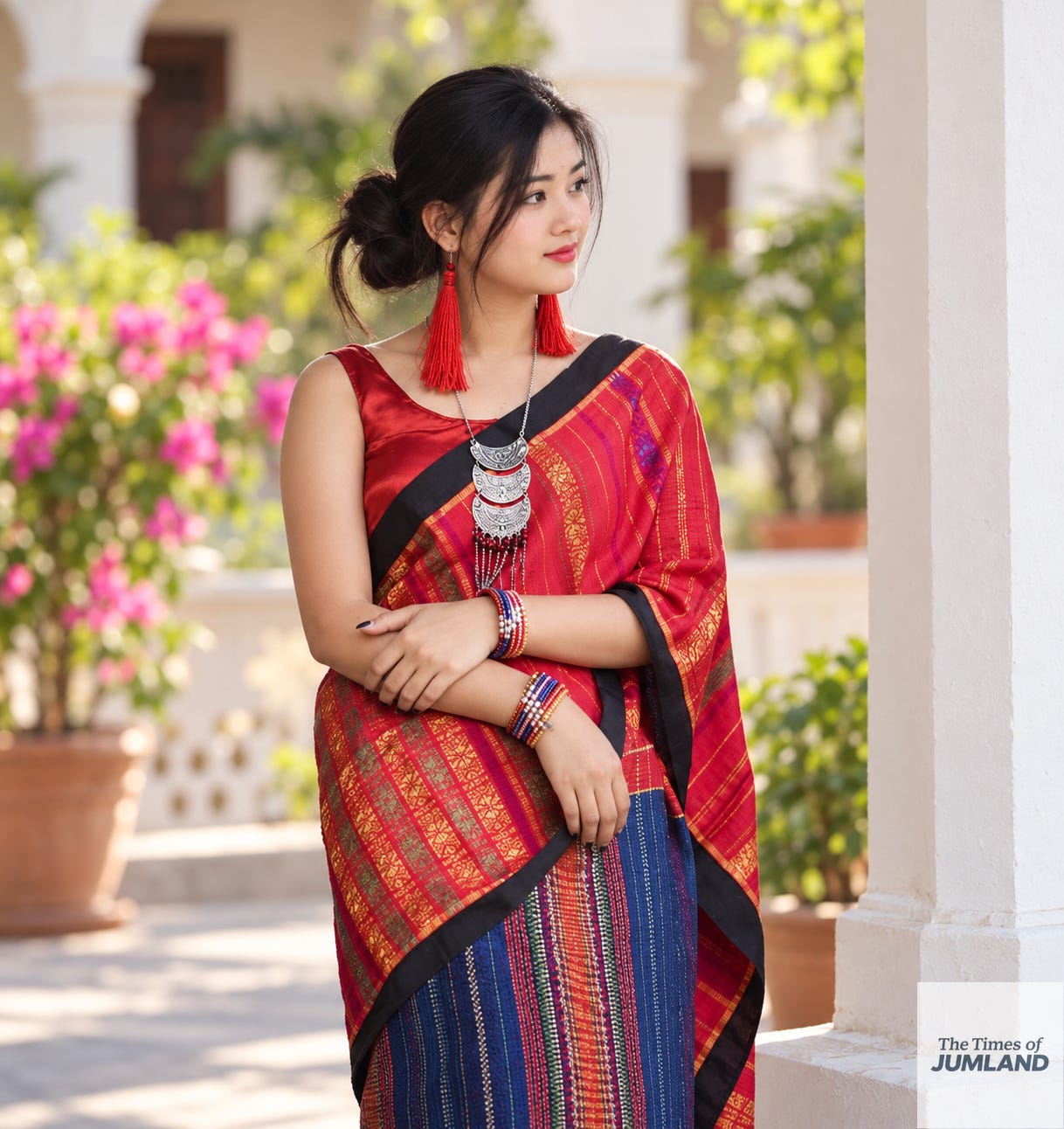
A traditional Chakma pinon contains a patterned panel known as the sabugi. It may look like a decorative strip, but its placement and construction help distinguish the garment from an ordinary wrapped cloth. This easily overlooked detail opens a larger story.
There is another remarkable object called the alam: a piece of woven cloth that preserves designs for future use. Long before photographs and printed pattern books, Chakma women recorded their artistic knowledge directly in thread. Both reveal why pinon and hadi deserve attention beyond their colours.
The Chakmas are an Indigenous people of the Chittagong Hill Tracts in southeastern Bangladesh, with communities also living in northeastern India. Pinon and hadi are among their best-known traditional garments, especially visible during Biju, weddings and cultural gatherings. They emerged from everyday life and skilled weaving.
Pinon and hadi are two separate pieces of clothing, not one continuous sari. The pinon is a rectangular lower garment wrapped around the waist, generally extending towards the ankles. The hadi is an upper cloth arranged across the chest and shoulder. Their appearance depends on the draping.
Seen from the front, a worn pinon forms a long wraparound skirt, while the hadi may cross the upper body diagonally. From behind, part of the hadi can hang down the back, displaying patterns hidden from the front. These distinctions clarify Chakma dress.
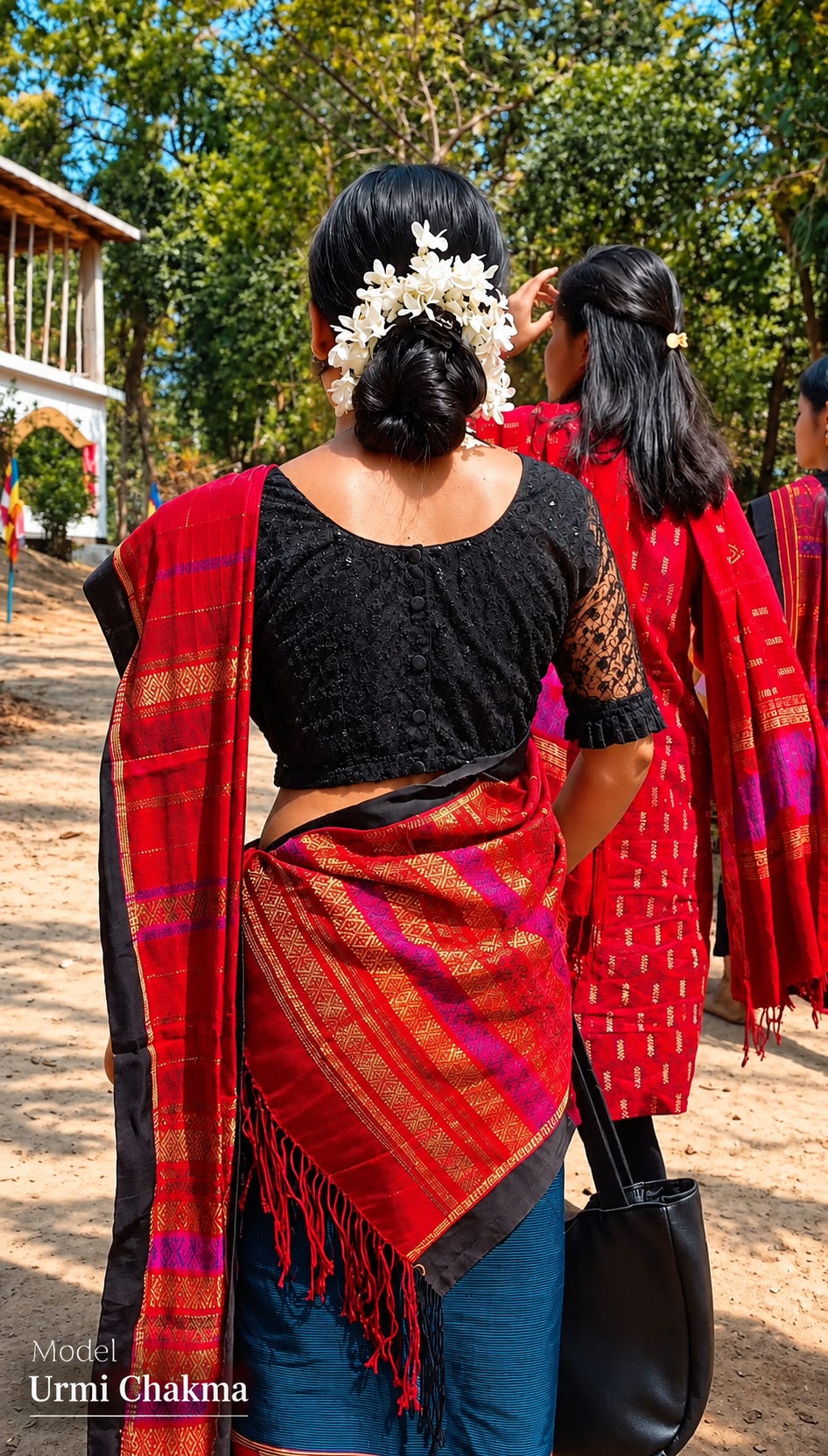
The appearance is not identical in every family or generation. Older descriptions record the hadi being worn without a modern blouse; today a blouse is commonly worn underneath. Different folds, colours and arrangements also exist. They remain two separate garments.
Historical weaving records describe a traditional pinon as black or very dark, with fine blue and red bands near its upper and lower edges. The bands form part of its familiar appearance, but they are not the sabugi. The horizontal bands are different from the vertical panel.
The sabugi, also spelled chabugi or saabugih, is an intricate border woven along one side of the pinon. When the garment is worn in the arrangement documented by Manjulika Chakma and Niaz Zaman, the cloth is wrapped from left to right and the sabugi falls on the wearer’s left.
In a flat illustration, the same panel may be presented in the centre so that its motifs are easy to inspect. That is not necessarily its position when worn. The Chakma Autonomous District Council identifies this patterned feature as essential to a traditional pinon.
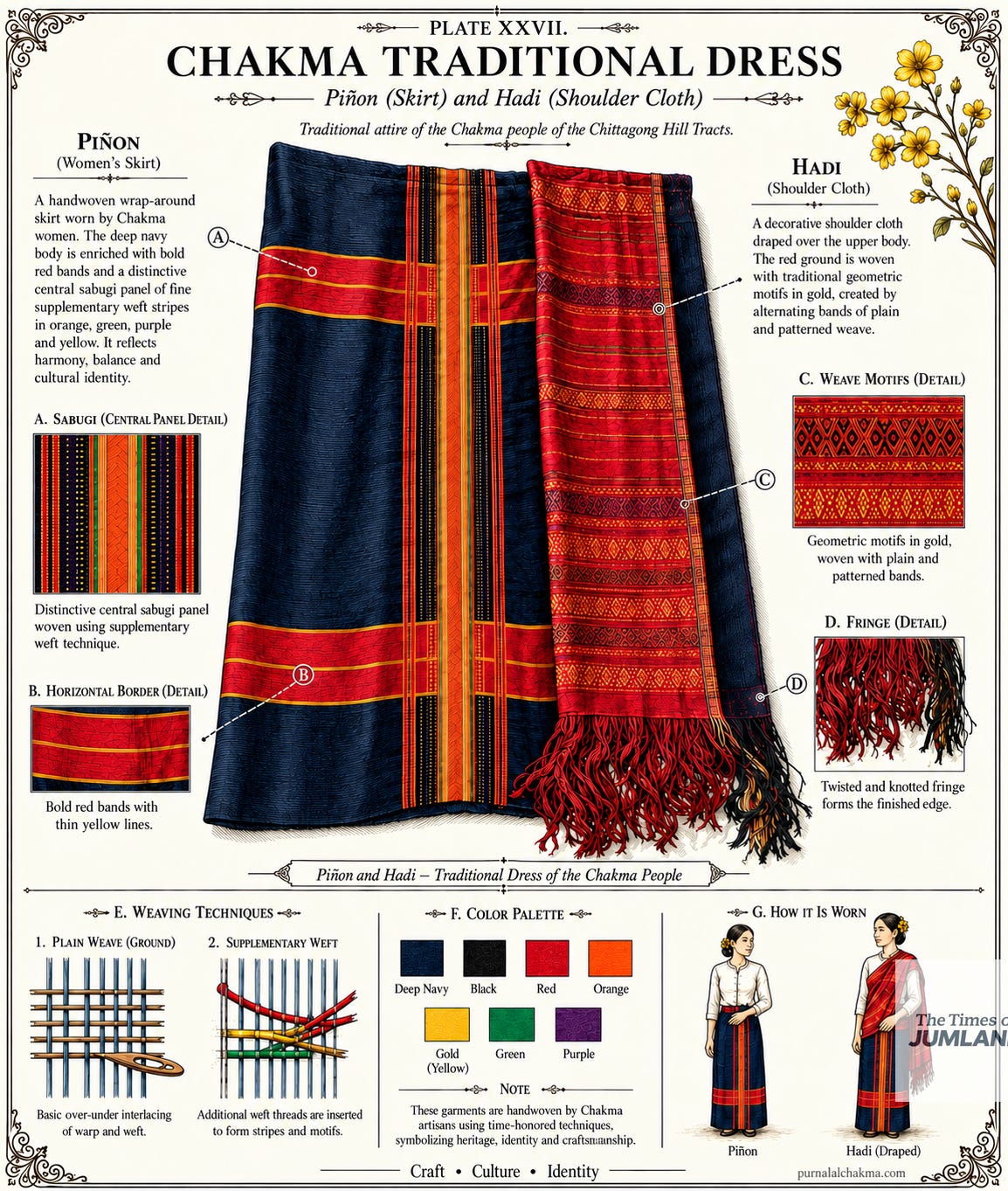
The hadi usually offers greater scope for elaborate decoration. Woven motifs can appear across the chest, over the shoulder or down the back, depending on the design and drape. Seen together, the garments demonstrate how a piece of cloth acquires identity through its construction, pattern and the way it is worn.
Chakma clothing has never consisted of only one ceremonial outfit. Textile documentation also records the siloom, a loose upper garment associated with working in jhum fields or gathering forest materials, and the khabang, a head covering. Clothing also served everyday needs.
Before factory-made textiles became widely accessible, producing clothing was an important household activity. Women wove for ordinary use as well as for special occasions. A finely made pinon or hadi reflected artistic skill, but a garment could also carry the memory of the person who prepared its threads and worked its patterns.
The alam is especially important because it explains how patterns survived. It is a woven sampler containing multiple motifs that weavers could study while making new garments. Rather than relying solely on memory, a woman could consult the cloth to reproduce a difficult design or combine familiar patterns in a different way.
A 2009 presentation on backstrap weaving described three older alams at the Tribal Museum in Rangamati, containing 115, 97 and 68 patterns. The same presentation recorded an alam made by Pancholata Khisa with 101 designs. One sampler could preserve extraordinary artistic knowledge.
An alam was more than a display of beautiful motifs. Its threads recorded instructions that an experienced weaver could interpret: which colours to introduce, how a shape repeats and how a design is built into cloth. In that sense, it functioned as a working archive rather than simply an heirloom.
Many motifs took inspiration from the natural world. Textile accounts describe designs named after flowers, animals and other familiar forms, translated into geometric arrangements suitable for a loom. Their names help preserve a relationship between creative expression and the environment, although not every motif has a fixed religious or symbolic meaning.
Historically, girls could learn weaving from mothers, grandmothers and other skilled women in the household. They began by observing thread preparation and simple patterns before attempting more intricate work. An alam could serve both as a reference for instruction and as evidence of a learner’s growing ability.
Weaving skill was also linked to social expectations. Older accounts associate a young woman’s ability to weave with suitability for marriage and household responsibilities. The distinction matters: women created remarkable textiles, but the work could also be time-consuming and expected rather than freely chosen.
The materials for traditional cloth were once produced close to home. Chakma families grew cotton in jhum fields alongside food crops, connecting textile production directly to agriculture. The Chakma Autonomous District Council records that cotton also featured in tribute arrangements involving the Chakma ruler and outside authorities during earlier historical periods.
Turning harvested cotton into thread involved several stages. Families removed it from the pods, cleaned it and dried it in sunlight. The seeds were then separated from the fibres, which were softened and prepared for spinning. Poor preparation could affect the final cloth.
Accounts describe cotton fibres being rolled around small pieces of bamboo and worked with a rod called pech before being spun with a charka, or spinning wheel. Making even yarn demanded experience. A woman could not simply begin weaving a complicated hadi the moment cotton was picked from the field.
Colour required another kind of knowledge. Textile research records natural dyes prepared from roots, bark and leaves. Indigo was used for blue, while turmeric and other materials helped produce yellow. Other plants supplied red and black, with treatments to fix the dye.
The traditional palette therefore emerged from experimentation with local resources as well as artistic choice. Preparing coloured yarn linked household craft with knowledge of the surrounding hills. Today, ready-dyed commercial threads offer more convenience and variety, but older dyeing methods are less commonly part of everyday production.
Once the yarn was ready, the weaver prepared her bain or bein, the traditional Chakma backstrap loom. The collection of loom equipment is known as sozpodor, with variant spellings in English accounts. Although built largely from simple materials such as bamboo and wood, the loom depends on precise arrangement and skilled coordination.
One end of the weaving system is attached to a fixed support, while a strap sits around the weaver’s back or waist. Her position helps control the tension of the lengthwise threads. The loom is therefore not merely a frame holding yarn; the weaver’s body is an active part of the mechanism.
Before weaving, the lengthwise threads must be arranged correctly, a preparatory process recorded as bain bajat in Chakma. During weaving, the artisan separates selected threads, passes another thread through the opening and tightens it against the growing cloth. A repeated sequence slowly produces the fabric.
Tools such as the biyong and thurchuma have specialized functions in that sequence. Their names belong to a vocabulary developed through practical work, not casual ornamentation. When people stop learning a craft, the words used to describe its movements and instruments can become unfamiliar too.
Decorative weaving is especially demanding. To reproduce motifs from an alam, the artisan must select coloured threads in the correct order while maintaining tension and keeping the cloth even. The resulting pattern can appear effortless to someone who has never watched a loom in operation.
The hours behind each garment were rarely separate from other responsibilities. Weaving could be fitted around childcare, cooking, cultivation and household work. The knowledge passed between women was therefore both artistic and practical, shaped by the conditions in which they lived rather than by a formal school curriculum.
Traditional weaving also entered religious life. Cultural accounts describe the tangon, a long textile offered at Buddhist monasteries. During some Kathina Chivara Dana observances, community members prepare yarn and weave cloth for monks’ robes within a limited ceremonial period. These textiles preserve related skills and communal practices.
As outside textiles and ready-made clothing spread, everyday dress changed. Saris, blouses and other garments became increasingly common, particularly in towns and schools. The transition differed between places and families. The older garments did not disappear, but their use became more closely associated with festivals, weddings and expressions of cultural identity.
Modern pinon and hadi may feature brighter colours, new arrangements and materials different from those described in older sources. That need not represent cultural decline. Chakma weavers have long combined patterns and exercised individual creativity; even the alam allowed designs to be reused and adapted rather than copied without change.
What deserves attention is the distinction between changing a design and losing the skill behind it. A person may recognize pinon and hadi at a festival without knowing the name of the sabugi, how an alam is read or why the loom demands such careful preparation. Visibility cannot transmit that knowledge.
This matters especially to Chakma families living away from the Chittagong Hill Tracts. Traditional dress can offer children born overseas a visible connection to their ancestors. Yet a photograph of a relative in pinon and hadi tells only part of the story unless someone explains who wove the garment and what its patterns represent.
An older pinon in a family collection may preserve weaving techniques no longer familiar to its owners. Recording the maker’s name, village, approximate date and pattern terminology could transform it into a historical source. An alam deserves even greater care because it may contain dozens of designs that future weavers would otherwise struggle to reconstruct.
Good documentation should include close-up photographs of the cloth, the names of motifs in the Chakma language and demonstrations by knowledgeable artisans. Comparing old garments with current examples would also reveal changes in technique and style. Such records should be made with the owners’ and makers’ permission, and without inventing meanings for patterns.
Preserving the craft does not mean every Chakma woman must weave or wear traditional dress daily. Those expectations would repeat burdens that earlier generations sometimes carried. The goal is to keep skills accessible, recognize the knowledge of artisans and give younger people the choice to learn what their ancestors created.
Pinon and hadi tell a history that extends far beyond clothing. Their threads connect jhum cultivation, natural dyes, family education, women’s labour and artistic imagination. The sabugi reveals a defining feature of the lower garment, while the alam reveals a method of carrying elaborate designs across generations.
A century from now, a young Chakma researcher may find an old alam but know nothing about the woman who made it. Without her name, the language of the motifs or a record of the technique, the cloth will have lost part of its meaning. Preservation begins in the present.
The beauty of pinon and hadi deserves celebration, but the deeper inheritance lies in the knowledge woven into them. A garment can survive in a wardrobe or a museum long after its maker is gone. Whether the craftsmanship survives depends on the stories, names and skills that people choose to pass on.
Sources and Further Reading:
Chakma Autonomous District Council, Culture & Tradition. https://cadc.chakma.in/culture-tradition/
Manjulika Chakma and Niaz Zaman, Traditions of Backstrap Weaving in Bangladesh, Regional Conference and Workshop, Dhaka, March 2009. https://studylib.net/doc/9416112/the-traditions-of-backstrap-weaving-21-march-ed
Tanjena Mahbub, S. M. Minhus and Tao Hui, Fashion of Indigenous People in Bangladesh: Exploring Traditional Clothing Process of Chakma Tribe, Journal of Textile Science & Fashion Technology, 2021. https://irispublishers.com/jtsft/fulltext/fashion-of-indigenous-people-in-bangladesh-exploring-traditional-clothing-process-of-chakma.ID.000705.php
Farida Shaikh, Back to Beautiful Basics, The Daily Star, May 14, 2010. https://www.thedailystar.net/news-detail-138451