

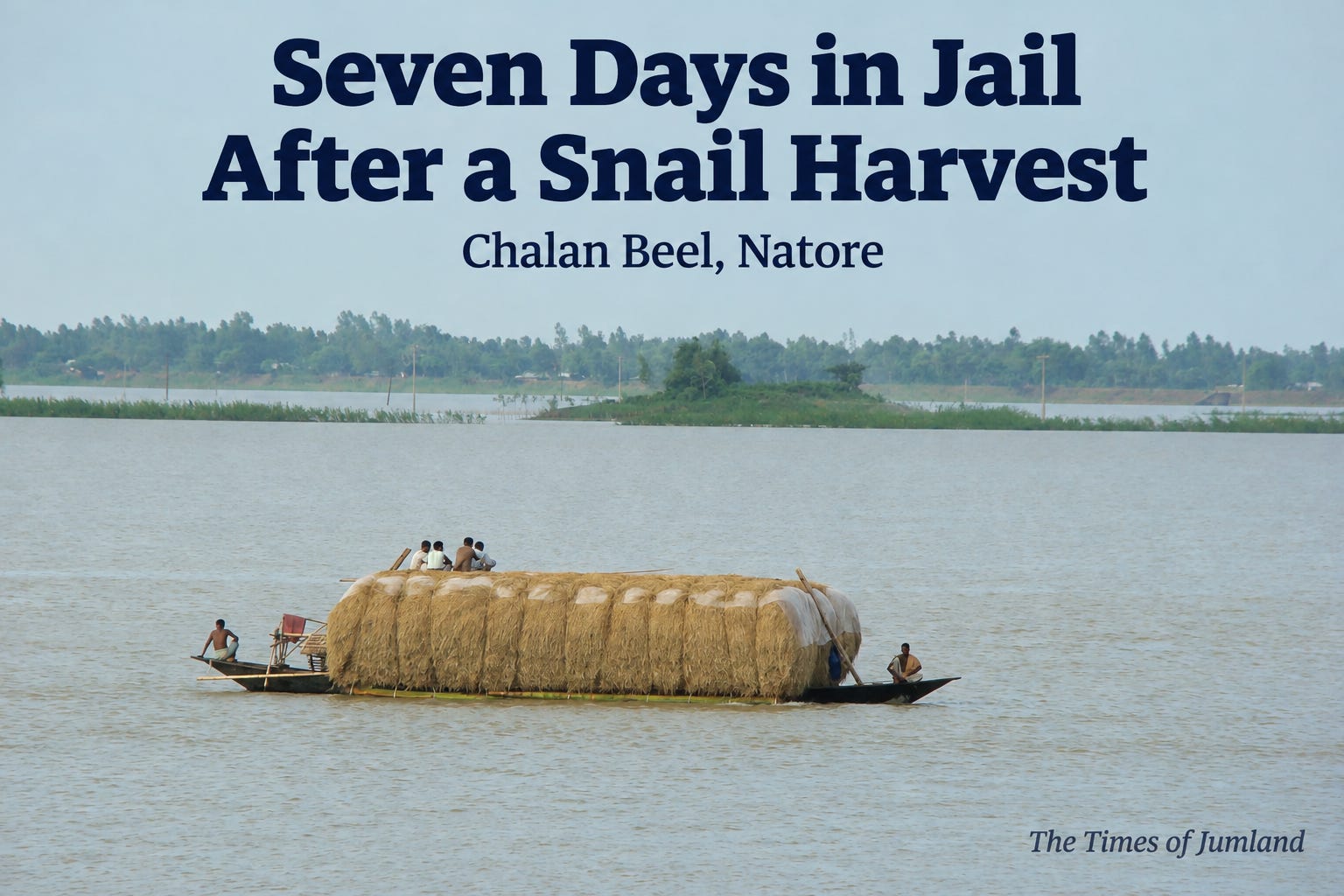

Swapan Ekka and Sukhchan Oraon each received a seven-day jail sentence after an operation targeting the collection of snails and mussels in Chalan Beel. Officials said they recovered about 3,500 kilograms of snails. That figure covers the entire operation. The published accounts give no breakdown of what was recovered from either man.
Three people were sentenced in all. The case drew a protest in Natore and was raised in Parliament by Oraon lawmaker Anna Minj.
Why the sentences drew a protest
The mobile court operation took place on November 4 in Singra upazila, Natore. Assistant Commissioner for Land Nishat Anjum told BD24Live that the three people sentenced were traders and that the operation was carried out to protect the wetland’s biodiversity. Officials released the recovered snails back into the wetland.
Hill Voice reported that a group of Indigenous people had travelled from Dinajpur to gather snails. It named Ekka and Oraon as two of the people sentenced and reported that other members of the group were released after giving written undertakings.
Four days after the raid, the Natore district branch of the National Indigenous Council held a protest. Speakers said their communities had long gathered snails from wetlands for food. They called for the two men’s release or prompt legal action in their cases, and asked the authorities to respect customary food gathering.
The protest explains why the sentences caused anger. The published accounts leave one question about the raid unanswered. What evidence did the mobile court use to determine that each person was gathering or handling snails for sale? The written orders and the men’s own accounts could help answer that question.
Could it happen in the Hill Tracts?
For readers in the Chittagong Hill Tracts, consider a family gathering bamboo shoots for a meal. If authorities impose a conservation restriction in that area, how would an officer determine whether the family was gathering food for home or harvesting it for sale? Would people who gather food there have a say in how the rules are drawn up?
In Chalan Beel, officials have given the public a figure for what they recovered. The people sentenced to jail are owed an equally specific account of what the court found against each of them.