

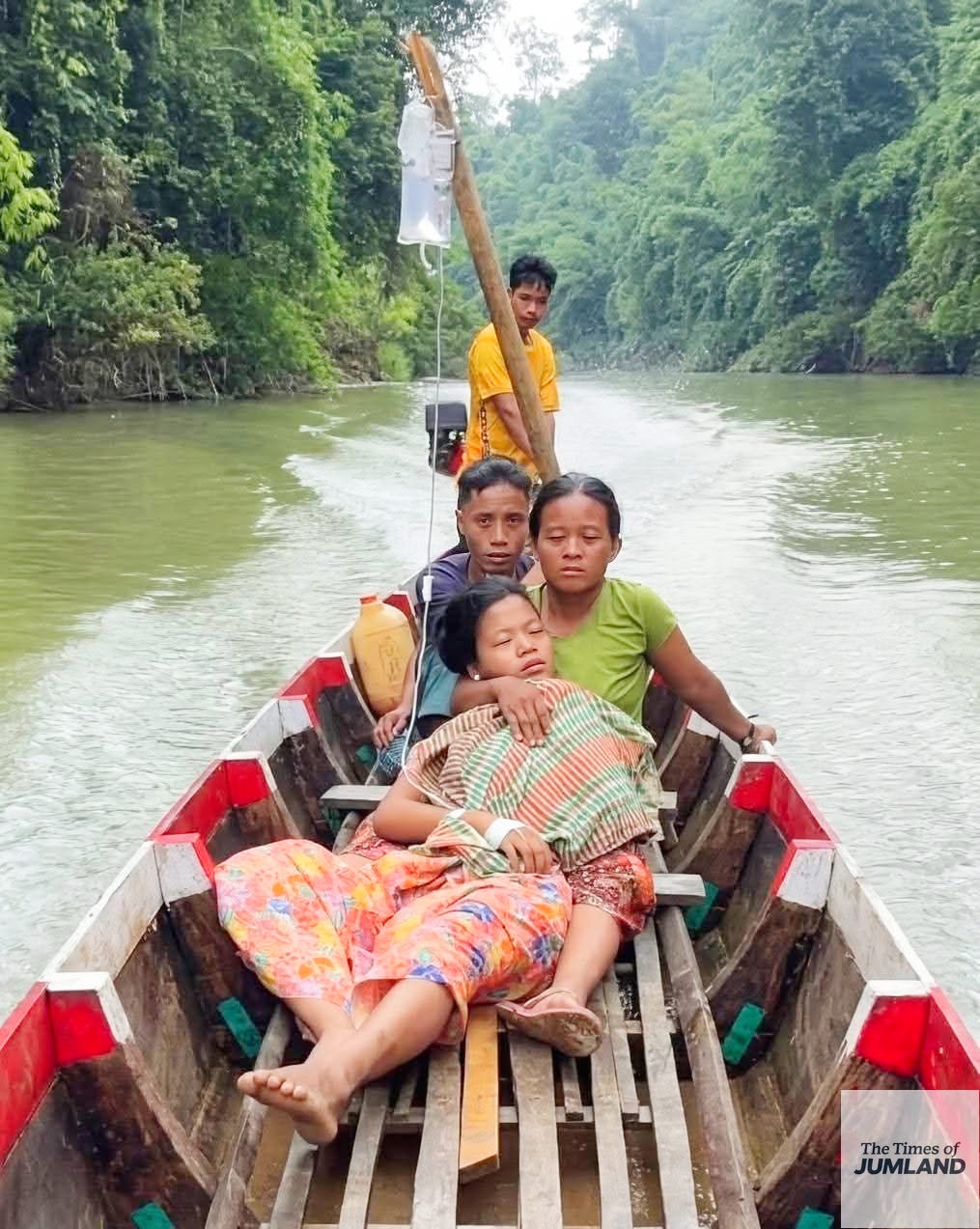
For a visitor, the river is scenery. For the woman lying inside this narrow wooden boat, it is the route towards medical care.
Another passenger supports her body. An intravenous fluid bag hangs from a bamboo pole. Green hills rise around them, framing a scene that might otherwise appear peaceful. But look inside the boat, and the meaning of the landscape changes.
The account accompanying the photograph identifies the woman as a patient being transported for treatment from a village in Thanchi, Bandarban. Her diagnosis, the photograph’s date and the outcome have not been independently established. Her individual story should not be invented. The wider difficulty of reaching healthcare in the Chittagong Hill Tracts, however, is well documented.
Those who claim to understand the hills should consider what such a journey demands. Before reaching a doctor, a family may have to find a boat, arrange money and support an ill relative through a difficult passage. Illness brings enough fear without uncertainty over whether help can be reached in time.
For Indigenous Jumma communities in remote villages, distance is measured in more than kilometres. It is measured in travelling hours, transport costs, river conditions and the availability of someone able to help.
UNICEF described these practical barriers in April 2023. Health workers travelling from Thanchi to vaccinate children could spend between one and four hours on the Sangu River, followed by another two or three hours walking. Their dedication deserves recognition. Their journeys also demonstrate why healthcare must reach remote communities rather than depend entirely on patients reaching distant facilities.
Women face particular difficulties. A February 2024 account published by the United Nations describes how poor roads, transport problems and financial constraints restrict access to reproductive healthcare in Bandarban. Flooding can make those barriers worse. A medical emergency does not pause while a family waits for safer conditions or finds money for the journey.
Difficult geography is real. So is the responsibility to build services around it. The harder a community is to reach, the more carefully its healthcare needs must be planned for.
That is why development cannot be judged only by military camps, checkpoints, buildings, roads, or the value of announced projects. It must also be judged by what happens when someone becomes seriously ill in a village far from the administrative centre.
Is a trained health worker available? Are essential medicines in stock? Can a patient travel safely at night? Can the family afford transport? Will the receiving facility provide the care they need?
These are measures of whether development reaches people.
The photograph also reveals care and determination. Someone supports the patient. Someone operates the boat. People are doing what they can to bring another person to help. Their solidarity deserves a dependable public service system beside it.
Jumma communities must have a meaningful voice in shaping that system. Residents understand seasonal dangers, difficult routes, language barriers and costs that outside planners may overlook. Their knowledge should influence where services are placed and how resources are spent.
Depending on local needs, reliable emergency boat transport, regularly staffed facilities, mobile medical teams and trained local health workers could reduce the burden. These require sustained funding and clear responsibility, not attention that fades when a photograph disappears from public view.
People in the hills should not have to be pictured in distress before their needs become visible. Nor should their resilience become an excuse to expect them to manage without adequate support.
Look again at the woman in the boat. We do not know how her journey ended. But we can ask whether the next patient will have a safer, faster and more affordable way to reach treatment.
The beauty of the Chittagong Hill Tracts draws admiration. The lives of its people deserve the same attention.
A family’s determination should never have to make up for the absence of dependable healthcare.
Further reading sources:
UNICEF: Going mobile to reach Bangladesh’s zero-dose children
https://www.unicef.org/bangladesh/en/stories/going-mobile-reach-bangladeshs-zero-dose-children
United Nations / UNFPA: Securing reproductive healthcare in remote Bandarban
https://bangladesh.un.org/en/261637-%E2%80%98women-do-not-stop-giving-birth%E2%80%99-securing-srh-services-women-through-flash-flooding-remote