

On January 11, 2026, Japan’s Foreign Minister Toshimitsu Motegi visited Israel with a message that combined cooperation with caution. During talks with his Israeli counterpart, Gideon Sa’ar, Motegi strongly condemned Hamas’s October 7, 2023, terrorist attacks but also urged Israel to ensure civilian protection and humanitarian assistance in Gaza. He expressed serious concern over Israeli settlement expansion in the West Bank and called for an end to unilateral actions undermining a two-state solution.
Why is India moving closer to Israel while Japan appears more cautious? The answer is not simply political ideology or sympathy for one side of the Israeli-Palestinian conflict. It lies in what each country needs from Israel, what it fears from the Middle East and how its leaders calculate national security.
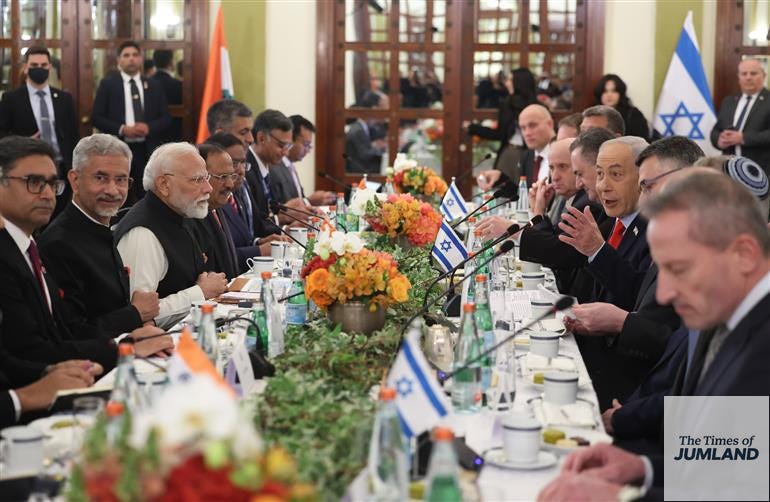
During Modi’s February 25–26 visit, India and Israel elevated their relationship to a Special Strategic Partnership for Peace, Innovation and Prosperity. Defence cooperation, cybersecurity, artificial intelligence, semiconductor technology and joint research featured prominently in their agreement. Both governments presented the relationship as an opportunity to strengthen their technological and security capabilities.
For India, Israel is not merely another diplomatic partner. It is a source of defence technology, specialized expertise and opportunities for joint military production. India faces security challenges involving Pakistan and China while seeking to reduce its dependence on foreign weapons suppliers. Cooperation with Israeli firms and research institutions offers New Delhi another route toward developing technologies and manufacturing capabilities at home.
The Stockholm International Peace Research Institute identified India as the world’s second-largest recipient of major arms during 2021–2025. Its research also documented India’s gradual diversification away from Russian suppliers, with Israel among its increasingly important defence partners. This helps explain why New Delhi considers its relationship with Jerusalem strategically valuable rather than merely symbolic.
Japan’s calculation begins from a different position. Tokyo already possesses substantial technological and industrial capabilities, and its principal security alliance is with the United States. Japan has reasons to cooperate with Israeli companies, especially in innovation and advanced technologies, but Israel does not occupy the same place in its national defence planning as it does in India’s.
More importantly, Japan cannot separate its Middle East diplomacy from the country’s dependence on imported energy.
According to Japan’s Ministry of Economy, Trade and Industry, more than 90 percent of the country’s crude oil imports come from the Middle East. Much of that supply depends on maritime routes vulnerable to regional conflict, particularly the Strait of Hormuz. When military tensions disrupt shipping, the consequences can reach Japanese consumers through higher fuel costs, transportation expenses and pressure on businesses.
This makes instability in the Middle East a direct economic concern for Tokyo. Japan therefore has strong incentives to preserve working relationships with Israel and the Arab Gulf states while encouraging diplomatic solutions to regional conflicts. Its caution reflects not only established foreign-policy principles but also a practical concern about energy security.
The contrast was visible in January when Foreign Minister Toshimitsu Motegi met Israeli Foreign Minister Gideon Sa’ar. Japan condemned Hamas’s terrorism and called for its disarmament, but it also emphasized humanitarian assistance in Gaza, opposition to settlement expansion and the importance of a two-state solution.
In June, Motegi again expressed concern over civilian casualties in Lebanon and Israeli settlement activities in the West Bank. At the same time, he condemned Hezbollah’s attacks on northern Israel. Japan’s position was not to abandon relations with Israel but to maintain diplomatic engagement while publicly addressing actions it considered destabilizing.
There is an important distinction here. Japan is not refusing cooperation with Israel. In September 2025, officials from both countries participated in the Japan-Israel Innovation Network, discussing economic relations and technological collaboration. Tokyo clearly recognizes the commercial value of Israeli innovation.
But commercial cooperation is different from placing a relationship at the centre of national security strategy. India’s approach gives defence and technological self-reliance greater prominence. Japan’s approach places considerable weight on diplomatic stability, economic relationships and the risks of regional escalation.
India also has limits. New Delhi maintains important relationships with Arab countries and has traditionally supported a negotiated two-state solution. Millions of Indians live and work in Gulf states, making regional stability an important economic and human concern. India’s stronger relationship with Israel does not mean it can disregard the interests of its other Middle Eastern partners.
The difference, therefore, should not be exaggerated into a simple choice between supporting and opposing Israel. Both India and Japan have incentives to deepen selected forms of cooperation with Israel. Both also have reasons to prevent a wider Middle Eastern conflict. What differs is the balance between their strategic opportunities and the risks they are willing to accept.
This raises an interesting question about Asia’s changing geopolitical position. India and Japan are themselves strengthening defence, economic and technological cooperation. Yet even close strategic partners do not necessarily pursue identical relationships with third countries. Their respective approaches to Israel demonstrate how geography, energy dependence and security requirements can produce different policies toward the same government.
For India, the central opportunity is access to advanced technology and defence cooperation that could strengthen national capabilities. For Japan, the opportunity lies in innovation and economic engagement, but it exists alongside a powerful interest in preventing regional instability.
The lesson reaches beyond Israel. Countries do not build foreign relationships solely because they share values, face common adversaries or maintain friendly governments. They also calculate what each partnership can deliver and what deeper involvement might cost.
India is drawing closer to Israel because it sees strategic capabilities it wants to develop. Japan is proceeding more cautiously because the consequences of Middle Eastern instability can directly affect its economy. The difference is not necessarily friendship versus distance. It reflects two national calculations of opportunity and risk.
Sources and Further Reading:
Government of India, India–Israel Joint Statement, February 26, 2026
https://www.pmindia.gov.in/en/news_updates/india-israel-joint-statement/
Japan Ministry of Foreign Affairs, Japan–Israel Foreign Ministers’ Meeting, January 11, 2026
https://www.mofa.go.jp/me_a/me1/il/pageite_000001_01451.html
Japan Ministry of Foreign Affairs, Japan–Israel Foreign Ministers’ Telephone Talk, June 16, 2026
https://www.mofa.go.jp/press/release/pressite_000001_02423.html
Stockholm International Peace Research Institute, Trends in International Arms Transfers, 2025
https://www.sipri.org/publications/2026/sipri-fact-sheets/trends-international-arms-transfers-2025
Japan Ministry of Economy, Trade and Industry, Press Conference on Energy Security, March 27, 2026
https://www.meti.go.jp/english/speeches/press_conferences/2026/0327001.html
Japan Ministry of Economy, Trade and Industry, Japan–Israel Innovation Network, September 8, 2025
https://www.meti.go.jp/english/press/2025/0908_002.html