

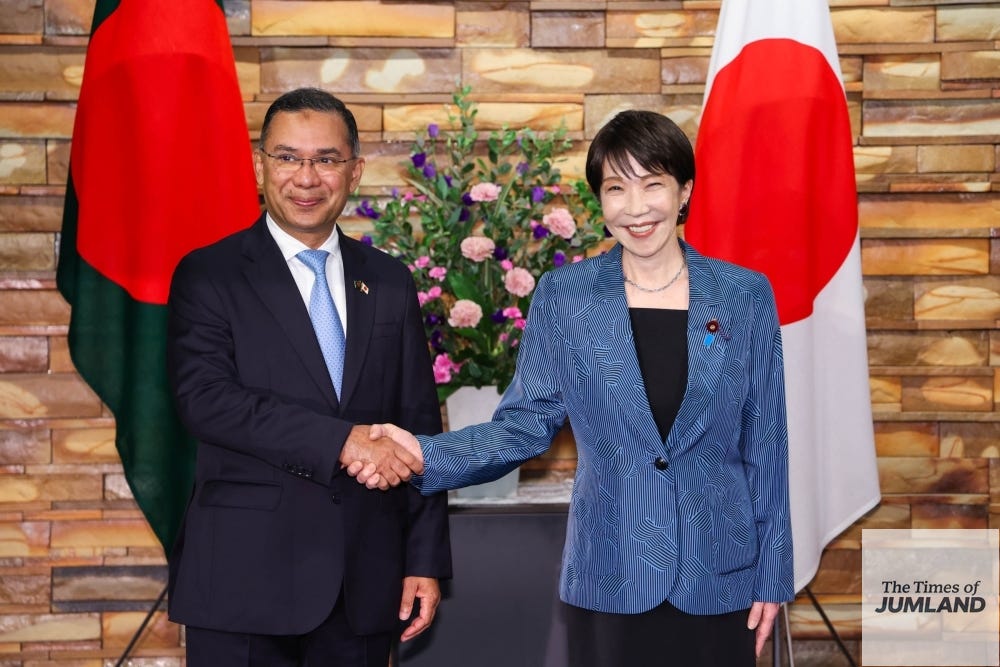
Japan and Bangladesh have signed a worker cooperation agreement ahead of Japan’s new employment and skills development system, while Prime Minister Sanae Takaichi’s post about her meeting with Bangladeshi Prime Minister Tarique Rahman drew hostile replies on X.
Japanese-language responses included demands to stop accepting Bangladeshi workers. Some users criticised foreign recruitment and the use of inexpensive labour. Others posted racist and anti-Muslim remarks or associated prospective migrants with crime without presenting supporting evidence.
The replies show opposition among users participating in the discussion. They do not establish that most Japanese people oppose Bangladeshi workers.
Japan’s Organization for Technical Intern Training announced on October 20 that a memorandum concerning the employment and skills development system had been signed with Bangladesh, dated October 17.
The Japanese text published by the Ministry of Health, Labour and Welfare records signatures in Tokyo on September 16 and in Dhaka on October 17. The agreement therefore predates the October 27 summit between the two prime ministers.
Cooperation initially runs for five years, with an automatic five-year extension unless either side gives written notice against renewal. Earlier termination is also permitted. The arrangement is therefore a renewable five-year framework rather than an unconditional ten-year commitment.
Japan’s Immigration Services Agency confirms that its new employment and skills development system, known as Ikusei Shuro, begins on April 1, 2027. This date marks the opening of the new programme, rather than the beginning of all Bangladeshi employment migration to Japan.
The memorandum establishes recruitment and oversight arrangements involving approved sending agencies. It confirms that participating workers receive protection under Japanese labour laws, including safeguards against dismissal or other disadvantage because of pregnancy or childbirth.
The document contains no commitment to recruit 100,000 Bangladeshis annually. Instead, it provides for industry-specific admission ceilings covering workers from participating countries, including Bangladesh.
Takaichi met Rahman in Tokyo on October 27. Japan’s Foreign Ministry confirmed the summit and published a joint statement covering investment, economic cooperation, security and people-to-people exchanges.
In her X post about the meeting, Takaichi discussed cooperation under the countries’ strategic partnership and described Bangladesh as an important partner in advancing a free and open Indo-Pacific. The post did not announce an annual worker recruitment quota.


Replies beneath it included direct demands to prevent Bangladeshi workers from entering Japan. One opposing comment displayed approximately 11,000 likes at the time of capture. Another user supported Japanese assistance for Bangladesh’s development while rejecting the admission of Bangladeshi workers.
Other responses questioned whether recruitment would attract qualified applicants or mainly provide inexpensive labour for businesses. Some urged the government to prioritise employment opportunities for people already living in Japan.
These policy objections appeared alongside discriminatory remarks. One reply made a blanket accusation that Muslims do not respect Japanese culture. Another disparaged people from Bangladesh, India and African countries.
Several users linked immigration to crime or argued that conditions in migrants’ countries of origin made them unsuitable for admission. The comments reviewed provided no evidence establishing those claims about prospective Bangladeshi workers.
The replies were displayed under X’s “Relevant” setting. They are not a representative sample of public opinion, and likes or reposts cannot establish the views of Japan’s population. Japanese-language posts also do not, by themselves, establish an account holder’s nationality.
Separate research nevertheless indicates growing opposition to further foreign admissions. A University of Tokyo survey conducted between January and March 2026 found that 56.3 per cent of respondents opposed accepting more foreigners, compared with 35.6 per cent in 2024.
The university reported increases across genders and generations, with a particularly large rise among younger respondents. The findings concern foreigners generally and do not establish majority opposition to Bangladeshi workers specifically.
Some replies framed Bangladeshi recruitment primarily through Islam, leaving the country’s religious and ethnic diversity outside the discussion. Bangladesh includes Hindu, Buddhist and Christian communities alongside its Muslim majority.
Related reading: Japan’s Muslim population and the immigration debate
Japan’s Foreign Ministry documents that religious diversity. Japanese government country information also recognises Chakma and other predominantly Buddhist minority communities in the Chittagong Hill Tracts.
The replies do not establish whether their authors know about these communities. Their religious framing nevertheless overlooks the fact that Bangladeshi nationality does not determine an individual worker’s faith, ethnicity or cultural practices.
Under the cooperation framework, workers must meet programme requirements and enter through approved arrangements. The agreement provides neither unrestricted entry nor a guaranteed annual recruitment quota.
Further reading sources:
Japan–Bangladesh employment cooperation memorandum, Japanese text — Ministry of Health, Labour and Welfare:
https://www.mhlw.go.jp/content/11800000/001761016.pdf
Official announcement of the memorandum — Organization for Technical Intern Training:
https://www.otit.go.jp/employment_for_skill_development/news/3aa922eb55fdbe3949f9c45b2def34e529b98f3e.html
Japan–Bangladesh summit meeting, October 27, 2026 — Ministry of Foreign Affairs:
https://www.mofa.go.jp/s_sa/sw/bd/pageite_000001_00004.html
Japan–Bangladesh Joint Statement:
https://www.mofa.go.jp/files/101107469.pdf
Employment and skills development system FAQ — Immigration Services Agency:
https://www.moj.go.jp/isa/applications/faq/ikusei_qa_00002.html
Survey on attitudes toward accepting foreigners — University of Tokyo:
https://csrda.iss.u-tokyo.ac.jp/socialresearch/pr/202608071400.html
Bangladesh country profile — Ministry of Foreign Affairs:
https://www.mofa.go.jp/mofaj/area/bangladesh/data.html