

Police should have a lawful opportunity to uncover a robbery plot before someone becomes its victim. Japan is right to consider carefully controlled remote access to devices used by organised criminal groups.
On October 16, 2026, Japan’s cabinet approved a bill to amend the Police Duties Execution Act. The proposal would allow investigators, under specific conditions, to obtain crime-related information from devices without first physically seizing them.
Its immediate target is tokuryu, anonymous and loosely organised criminal groups involved in robberies and fraud. Organisers can recruit strangers online, issue instructions and remain far from the scene. Arresting those carrying out a crime may leave the people directing it untouched.
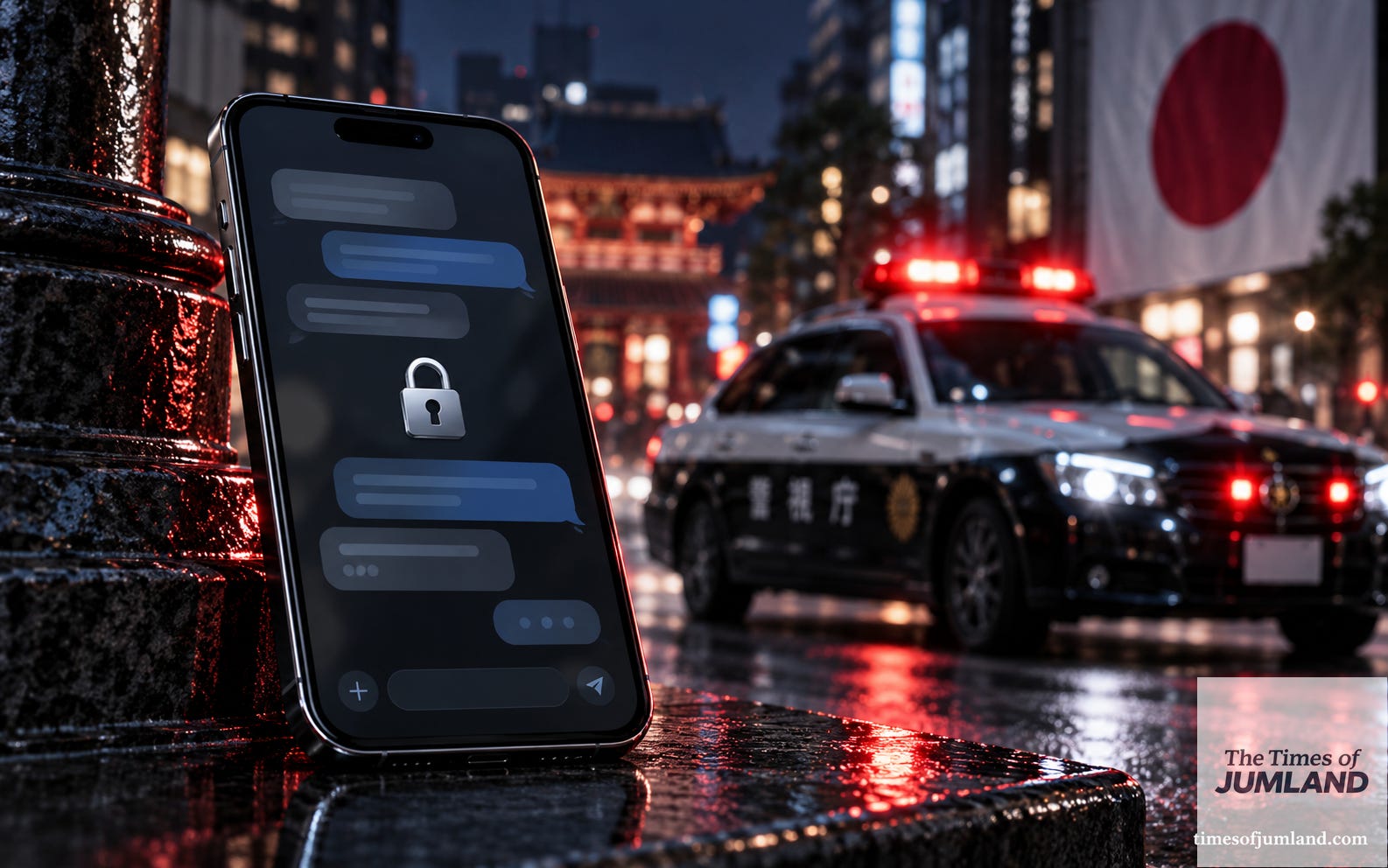
Japan’s proposal for police access to encrypted messages would address this investigative difficulty by allowing information to be obtained directly from targeted devices. The aim is to identify criminal plans and intended victims early enough to prevent further harm.
That objective deserves support. Criminals have adapted to digital communication, and police need lawful ways to respond. An arrest after a violent attack cannot reverse an injury or restore a life.
The broader principle also matters for counterterrorism. Japanese authorities identify jihadist organisations such as Islamic State and al-Qaeda as continuing international security concerns. Japan’s relative security offers no guarantee that future threats will pass it by.
The bill’s stated focus is organised crime. It should not be presented as evidence of a particular jihadist plot or an undisclosed government motive. Nevertheless, the argument for preparing before disaster strikes applies to both criminal violence and terrorism.
A country should not have to experience a tragedy before taking reasonable precautions. Japan’s safety is something to preserve through vigilance, capable institutions and timely action.
The proposed restrictions are central to making this measure credible. According to TBS’s reporting, police would need prior authorisation from a judge. Targeted devices must reasonably be identified as being used by people involved in serious crime, and obtaining the necessary information through other methods must be difficult.
Information collected outside the authorisation would have to be deleted. The device’s user would subsequently be notified once the serious crime had been prevented. Cabinet approval alone does not make these powers operational law.
Parliament should ensure that authorisations have clear boundaries, operations leave records that can be checked, and misuse carries consequences. These protections give the public stronger reasons to trust legitimate police work.
A smartphone may contain family conversations, workplace complaints or confidential testimony unrelated to an offence. Protecting that information matters. Religion, nationality and the use of an encrypted application cannot, by themselves, establish criminal intent.
Equally, concern for privacy should not obscure the rights of potential victims. Residents deserve protection from violent intimidation, organised fraud and criminals who exploit technology to conceal their instructions.
Supporting effective policing and demanding accountability are compatible positions. Carefully defined access, backed by judicial authorisation and meaningful supervision, offers a reasonable balance.
Japan is right to strengthen its ability to prevent serious crime. Parliament’s responsibility is to make those powers effective, precise and answerable to the law.
The best outcome is a crime prevented—and a victim who never has to discover how close danger came.
Further reading:
National Public Safety Commission: Official statement, October 16, 2026 (Japanese)
https://www.npsc.go.jp/pressconf_2026/10_16.htm
Jiji Press / Nippon.com: Overview of the remote-analysis bill (English)
https://www.nippon.com/en/news/yjj2026101600251/
TBS News DIG: Proposed conditions and safeguards (Japanese)
https://newsdig.tbs.co.jp/articles/-/3016054
National Police Agency: International terrorism assessment (Japanese)
https://www.npa.go.jp/hakusyo/r07/honbun/html/bb6611000.html