

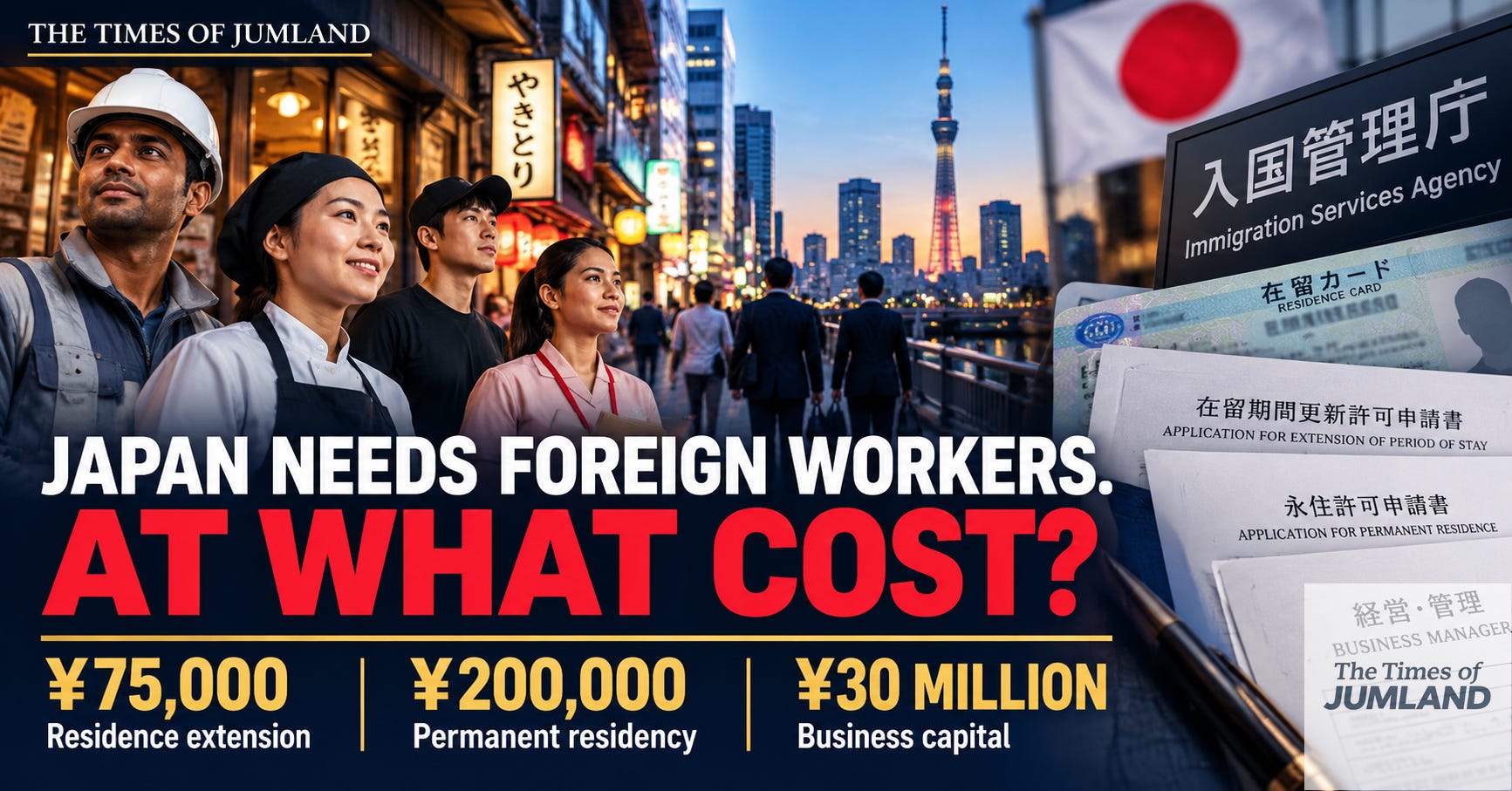
Japan increasingly depends on foreign workers to support its economy, yet living and doing business in the country is becoming more expensive for many of them. Since October 1, 2026, some residence-status extensions cost as much as ¥75,000, while the fee for obtaining permanent residency has risen twentyfold to ¥200,000. Foreign entrepreneurs also face a substantially higher capital requirement. Japan needs international workers, but is it making their long-term future unnecessarily difficult?
Consider a foreign worker who has spent years in Japan, pays taxes, contributes to pension and health insurance, and supports a family. Until recently, extending a residence status generally cost ¥6,000 at an immigration office. Under the new fee structure, a one-year extension costs ¥33,000, a three-year extension costs ¥64,000, and an extension of five years or longer costs ¥75,000.
These are fees for obtaining permission to extend a period of residence, not merely replacing a physical residence card. The amount depends on the period granted. Online applications are somewhat cheaper, and qualifying applicants may receive reductions or exemptions. Nevertheless, the increases are substantial.
For those hoping to settle permanently, the financial change is even more striking. The government fee for permanent residency approval has increased from ¥10,000 to ¥200,000. That is twenty times the previous amount.
Japan’s Immigration Services Agency says the increases will help fund immigration administration, improved services and measures supporting orderly immigration management. Governments have legitimate reasons to recover administrative costs. But the scale of the increases raises a question about how much of that burden should fall on foreign residents who already contribute through taxes and other payments.
The changes come as Japan’s foreign population continues to grow. Official statistics show that the number of foreign residents reached approximately 4.28 million in June 2026. The Ministry of Health, Labour and Welfare separately recorded approximately 2.57 million foreign workers in October 2025.
Foreign workers contribute to manufacturing, construction, agriculture, hospitality, technology and numerous other industries. As Japan’s population ages and labour shortages continue, recruiting people from overseas has become an increasingly important part of the country’s economic response.
Yet hiring foreign workers and making it possible for them to establish stable lives are not the same thing.
A worker who receives repeated one-year residence periods faces continuing renewal costs. A foreign family hoping to obtain permanent residency must now consider a considerably larger government fee alongside the application process itself. Financial pressure may be especially significant for lower-paid workers and households with several dependants.
The government has also tightened the criteria for permanent settlement. Revised guidelines announced on October 1, 2026, place greater emphasis on household income, pension arrangements, Japanese-language ability and knowledge of Japanese systems. Most provisions apply to applications from April 2027, although certain income-related assessments already affect some pending applications.
Financial independence and the ability to participate in Japanese society are reasonable considerations. But a person who earns a modest salary, pays taxes and follows the law may still find that the pathway to permanent settlement has become more demanding.
The position of foreign business owners deserves particular attention.
Japan introduced stricter requirements for the Business Manager residence status on October 16, 2025. Under the revised rules, the minimum business capital or investment requirement rose from ¥5 million to ¥30 million.
For a corporation, the requirement generally concerns paid-in capital or equivalent investment. For a sole proprietor, the assessment concerns qualifying funds invested in operating the business. This is not ¥30 million deposited with the Japanese government as a refundable immigration fee.
The new framework also generally requires at least one qualifying full-time employee, specified Japanese-language capability within the business and additional evidence of management qualifications and business viability.
Consider a foreign entrepreneur who wants to open a modest restaurant, grocery shop or trading business. Such businesses can provide employment, rent commercial premises, purchase supplies locally and contribute taxes. But a ¥30 million capital threshold places the Business Manager residence route beyond the means of many small entrepreneurs.
This does not mean every foreign shopkeeper must suddenly find ¥30 million. The rules concern the Business Manager residence category, and foreign nationals with other qualifying residence statuses are not automatically subject to the same immigration requirement.
Existing Business Manager residents also have transitional protection. Until October 16, 2028, renewal applications can be considered even if the applicant has not yet met all the new standards. Immigration authorities assess business conditions and prospects of compliance rather than refusing renewal solely because the new thresholds have not been reached.
Nevertheless, the long-term direction is clear: Japan is becoming more selective about which foreign entrepreneurs can obtain and retain business-related residence permission.
The government may argue that higher standards discourage businesses established primarily to obtain residence permission, ensure that enterprises are commercially viable and strengthen compliance with employment and tax obligations. Those are legitimate policy objectives.
But a small business does not automatically lack economic value because its owner cannot demonstrate ¥30 million in capital. A profitable neighbourhood shop employing local people may contribute to a community even if it operates on a considerably smaller scale.
This creates a wider question about Japan’s economic strategy. Does the country want foreign entrepreneurship at different levels, including family businesses and small shops, or primarily larger enterprises with substantial financial resources?
The distinction matters because economic contribution cannot always be measured by initial capital alone. Employment, customer demand, business survival, tax compliance and local investment also matter.
Japan’s immigration reforms therefore affect three different groups in connected ways: workers who must periodically extend their residence status, long-term residents seeking permanent settlement, and entrepreneurs hoping to establish or continue businesses.
These groups do not face identical rules, but all are affected by the predictability and affordability of Japan’s immigration system.
Japan has the right to set immigration standards and enforce its laws. It also has good reasons to encourage Japanese-language learning, financial responsibility and genuine business activity. The question is whether higher fees and financial thresholds are sufficiently balanced with the country’s economic needs.
For an engineer considering a career in Tokyo, a restaurant worker supporting a family in Osaka or a small entrepreneur hoping to establish a business, the ability to plan a stable future can be just as important as the opportunity to enter Japan in the first place.
Immigration policy should not be judged only by how many foreign workers enter the country. It should also be judged by whether those who contribute lawfully can understand the rules, meet reasonable requirements and make informed decisions about remaining.
The ultimate economic effects of these recent changes are not yet known. Whether they discourage workers and entrepreneurs, improve compliance or produce a mixture of outcomes will require careful assessment.
But Japan should not overlook the question created by its own policies.
If Japan increasingly needs foreign workers, their skills, their businesses and their taxes, it must also consider whether the rising cost of staying is consistent with the future it wants them to help build.
Sources and Further Reading:
Immigration Services Agency of Japan — Revision of Residence Permit Fees, October 1, 2026
https://www.moj.go.jp/isa/01_00644.html
Immigration Services Agency — Residence Status Extension and Change Fees
https://www.moj.go.jp/isa/applications/procedures/16-2.html
Immigration Services Agency — Permanent Residency Application Fees
https://www.moj.go.jp/isa/applications/procedures/16-4.html
Immigration Services Agency — Revised Business Manager Residence Requirements
https://www.moj.go.jp/isa/applications/resources/10_00237.html
Immigration Services Agency — Permanent Residency Guidelines, October 2026
https://www.moj.go.jp/isa/10_00279
Immigration Services Agency — Foreign Resident Statistics
https://www.moj.go.jp/isa/publications/press/13_00070.html
Ministry of Health, Labour and Welfare — Foreign Employment Statistics
https://www.mhlw.go.jp/stf/newpage_68794.html