
Tokyo Desk | November 18, 2026
When the waters of the Kaptai reservoir began swallowing villages in the Chittagong Hill Tracts, a young Manabendra Narayan Larma picked up two small pieces of earth from his family’s ancestral home. One came from a wall of their house, and the other from the ground.
He carefully wrapped them in paper and handed them to his elder sister, Jyotiprobha Larma, asking her to preserve them with great care. She wondered why her brother considered two ordinary pieces of earth so valuable.
Jyotiprobha kept them in a trunk. Decades later, she recalled that moment in her writing, explaining how she eventually understood her brother’s deep attachment to the land their family was about to lose.
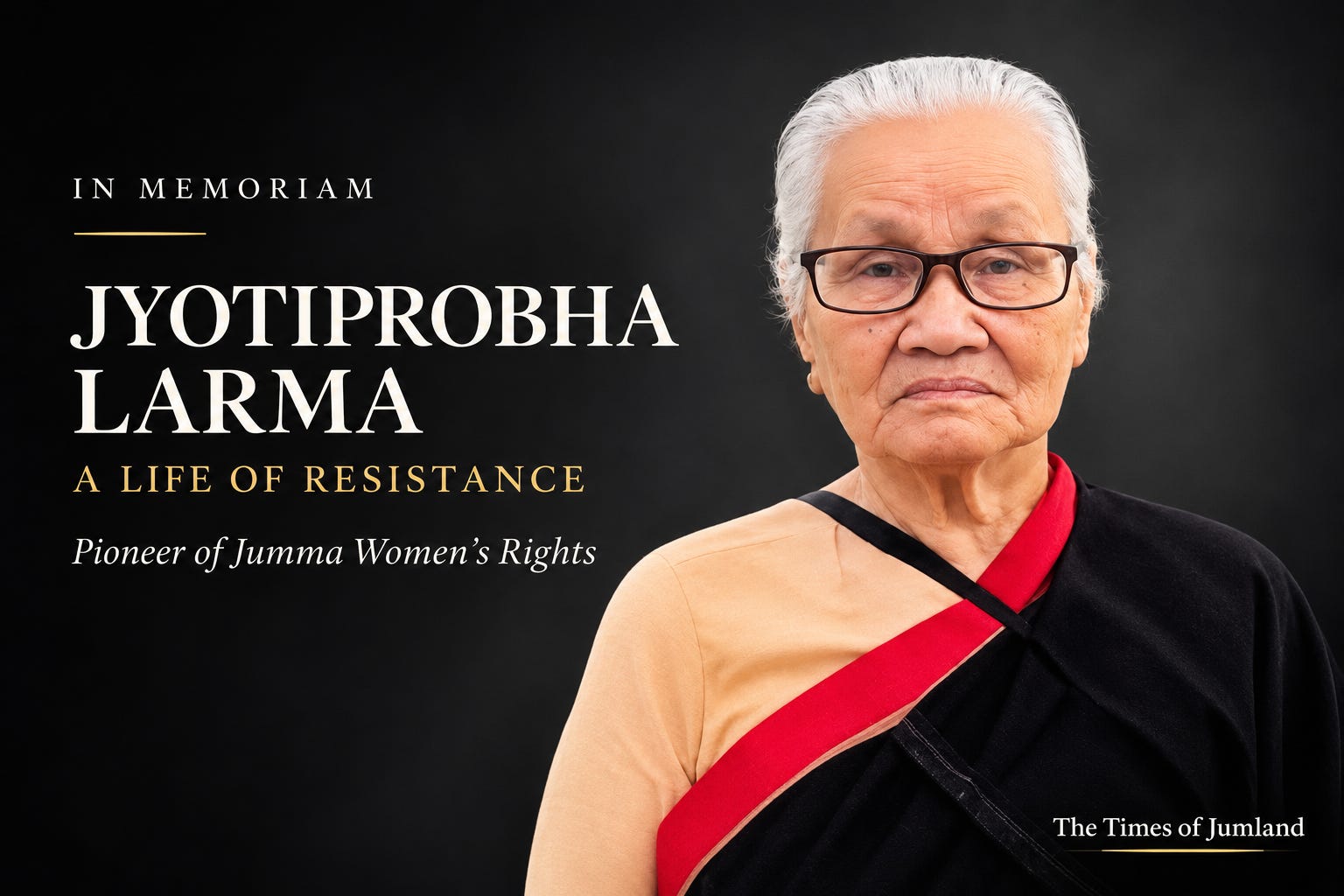
On Wednesday, November 18, 2026, Jyotiprobha Larma, affectionately known as Minu, died at a hospital in Chittagong, bringing to an end a remarkable life shaped by displacement, political struggle, family tragedy and a lifelong commitment to Indigenous women’s rights.
She died at approximately 6:30 a.m. after being admitted to the hospital on November 15 with age-related health problems. Her death marks the passing of one of the pioneering women who helped bring Jumma women into organized political and social movements in the Chittagong Hill Tracts.
Jyotiprobha was the eldest sister of Manabendra Narayan Larma, the founder of the Parbatya Chattagram Jana Samhati Samiti (PCJSS), and Jyotirindra Bodhipriya Larma, widely known as Santu Larma, the organization’s current president.
But her place in Jumma history extended far beyond her relationship with two prominent political leaders. She was a teacher, community health worker, writer and organizer who devoted much of her life to challenging inequality and encouraging Indigenous women to participate in decisions affecting their communities.
Born in 1935 in Chhoto Mahapurum, also known as Mawrum, in the Rangamati Hill District, Jyotiprobha grew up in a family that valued education. Her father, Chitta Kishore, helped establish a school in their village, while her mother was Subhashini Dewan.
She was the eldest of four children. Her younger brothers were Shubhendu Prabhas Larma, Manabendra Narayan Larma and Jyotirindra Bodhipriya Larma. Their family would later become closely associated with the political awakening of the Indigenous peoples of the Chittagong Hill Tracts.
At a time when education for girls was uncommon in many hill communities, Jyotiprobha became the first female student at Mahapurum Primary School. She studied there until the eighth grade, but limited educational opportunities prevented her from continuing her formal education.
The interruption did not end her determination to learn. Years later, after becoming a mother and establishing her working life, she returned to her studies. In 1980, she passed the Secondary School Certificate examination under the Comilla Education Board.
Her own experience showed the difficulties women faced in pursuing education, particularly in remote Indigenous communities. It also strengthened her belief that women should have opportunities to study, work and participate in society on equal terms with men.
In 1954, Jyotiprobha moved to Rangamati and began teaching at a Catholic mission school. She later completed teacher training in Rangamati and received rural medical training through a Village Aid program in Dhaka.
Her work eventually took her to Khagrachhari, where she became involved in women’s healthcare, community welfare, sports and social development activities. These experiences brought her into direct contact with Indigenous women who had limited access to education, medical treatment and opportunities outside their homes.
For Jyotiprobha, improving women’s lives meant more than providing basic services. She came to believe that women needed education, political awareness and a meaningful voice in determining the future of their communities.
Her family was soon to experience one of the greatest tragedies in the modern history of the Chittagong Hill Tracts. The construction of the Kaptai Dam in the early 1960s submerged vast areas of Indigenous land, destroying villages, farmland and ancestral settlements.
Approximately 100,000 people were displaced by the project, most of them Indigenous inhabitants of the region. Among the affected families was Jyotiprobha’s, whose ancestral home at Mahapurum disappeared beneath the rising waters.
The family was forced to rebuild its life elsewhere. Jyotiprobha subsequently lived and worked in the Panchhari area of Khagrachhari, where she continued teaching while remaining closely connected to the problems facing displaced Indigenous communities.
The experience left a lasting impression on her younger brother, Manabendra Narayan Larma, who would later become a leading figure in the Jumma struggle for political rights and self-determination.
In her memoir, Manju’r Kichhu Smriti Kichhu Kotha (Some Memories of Manju), Jyotiprobha recalled how her brother worried about the future of families whose homes and farmland were being submerged by the Kaptai reservoir.
She described how he spoke with village elders about what would happen when their land disappeared and how people would survive without the fields and homes that had supported them for generations.
Her recollections also reveal the close relationship between the siblings. While working as a teacher in Rangamati, she once helped her brother obtain money urgently needed for his examination fees at Chittagong College.
Their father had been unable to send the money in time, so Jyotiprobha arranged it overnight and helped her brother return to his studies. Such memories offer a personal picture of M. N. Larma before he became one of the most influential political leaders in Jumma history.
Following Bangladesh’s independence in 1971, Jyotiprobha became increasingly involved in the movement for the political rights and self-determination of the Jumma people.
She was among the early organizers of the Parbatya Chattagram Mahila Samiti, the Chittagong Hill Tracts Women’s Association, which formally emerged in 1975 as a women’s organization associated with the PCJSS.
She served as vice-president and later became president of the organization. Through its activities, she helped encourage women to become politically aware, organize themselves and take part in the wider movement for Indigenous rights.
This work was particularly important because Indigenous women faced discrimination on more than one level. Alongside the political and economic difficulties experienced by their communities, they also encountered social restrictions that limited their participation in education, leadership and public life.
Jyotiprobha believed that the struggle for Jumma rights could not achieve its full purpose while women remained excluded from political decisions. She argued that Indigenous women should stand alongside men in building their communities and shaping their future.
Her commitment to women’s equality was therefore closely connected to the larger political movement. She saw education, social dignity and political participation as essential parts of the struggle for Indigenous self-determination.
The year 1983 brought a devastating personal tragedy. On November 10, her younger brothers Manabendra Narayan Larma and Shubhendu Prabhas Larma were killed during the violent internal conflict within the Shanti Bahini, the armed wing of the PCJSS.
M. N. Larma’s assassination remains one of the most painful events in modern Jumma political history. His death deprived the movement of its founding leader at a time when the Indigenous peoples of the Chittagong Hill Tracts were struggling for recognition and political rights.
For Jyotiprobha, the tragedy was deeply personal. She lost two younger brothers in the internal conflict that had divided the movement to which her family had devoted so much of its life.
Rather than withdrawing from political activities, she became more deeply involved. In her later accounts, she explained that the deaths of her brothers strengthened her commitment to the PCJSS and the struggle for the rights of the Jumma people.
Three years later, in 1986, armed clashes between the Shanti Bahini and the Bangladesh Army in the Panchhari area forced Jyotiprobha to leave Bangladesh and seek refuge in India.
There, she lived among other displaced Indigenous families who had fled violence and insecurity in the Chittagong Hill Tracts. For people who had already lost their homes and livelihoods, refugee life brought fresh uncertainty about whether they would ever return to their ancestral homeland.
Exile did not end Jyotiprobha’s community work. She helped organize displaced Jumma families in refugee camps and served as a secretary in local refugee administration, assisting communities struggling to maintain their social organization far from home.
Her years in India became another important chapter in a life marked by displacement. She had already witnessed the destruction of her ancestral village, the loss of two brothers and the growing political conflict in the hills.
After the Chittagong Hill Tracts Accord was signed between the Bangladesh government and the PCJSS on December 2, 1997, Jyotiprobha returned to Bangladesh.
The agreement opened the way for the return and rehabilitation of Jumma refugees, although many of the political and land-related problems that had caused the conflict remained unresolved.
For Jyotiprobha, returning home did not mean her work was finished. She continued supporting women’s rights, political participation and the preservation of Indigenous identity, while remaining associated with the wider struggle for justice in the Chittagong Hill Tracts.
Her contributions received recognition beyond her own community. On October 20, 2017, she received the Bir Kanya Pritilata Memorial Award from the Pritilata Trust in Chittagong for her role in social and political struggles.
The award honored the memory of Pritilata Waddedar, the revolutionary woman who fought against British colonial rule. At the ceremony, Jyotiprobha spoke of Pritilata’s courage and sacrifice as an inspiration to people struggling for freedom and dignity.
She also connected Pritilata’s revolutionary example with the movement for Jumma self-determination. She believed that Pritilata’s courage could inspire Indigenous women to challenge injustice and take an active role in political and social struggles.
Other organizations, including Bangladesh Nari Progati Sangha and the Bangladesh Indigenous Peoples Forum, also recognized her contribution to women’s rights and community development.
Alongside her political and social activities, Jyotiprobha contributed to Jumma literature and historical memory. Her published works included Roudrojjwal Suryer Pratikkhay and Changma Pajjannar Fulbareng, reflecting her interest in the history, experiences and cultural identity of her people.
Her personal recollections of M. N. Larma remain especially valuable because they preserve details of his childhood, family life and political development that are often absent from conventional historical accounts.
Through her writing, the history of the Jumma movement becomes more than a record of political organizations, armed conflict and negotiations. It also becomes a history of families losing their land, women struggling for education and refugees trying to preserve their identity far from home.
Jyotiprobha believed that the struggle for equality between women and men would continue long after her own lifetime. She recognized that social change required patience, determination and the active participation of younger generations.
Speaking about the future of women’s rights, she once expressed her belief that she might not live to witness the end of inequality, but that a day would come when discrimination between women and men would disappear.
Her words reflected both the difficulties she had experienced and her confidence that future generations could build a more equal society. She encouraged Indigenous women to develop their abilities, participate in public life and refuse to accept a subordinate position.
Jyotiprobha’s death comes only eight days after the 43rd anniversary of M. N. Larma’s assassination. For many Jumma people, November is already a month of remembrance, and her passing brings another loss to a family closely associated with the political history of the Chittagong Hill Tracts.
Yet her life deserves to be remembered independently of the achievements and tragedies of her brothers. She belonged to a generation of Indigenous women who challenged social restrictions while living through displacement, armed conflict and years of political uncertainty.
She helped educate children when schooling in the hills was limited, worked to improve women’s health when medical services were difficult to access, and encouraged Indigenous women to organize when political leadership was largely dominated by men.
Following her death, the PCJSS, the Bangladesh Indigenous Peoples Forum’s Chittagong Hill Tracts branch and the M. N. Larma Memorial Foundation were among the organizations reported to have expressed condolences.
According to Hillbd24, arrangements were being made to bring her body from Chittagong through Rangamati to Khagrachhari for her final rites. She is survived by three sons, two daughters and other relatives.
Jyotiprobha lived through nearly a century of change in the Chittagong Hill Tracts, witnessing the region’s transformation under Pakistan, the creation of Bangladesh, the growth of the Jumma political movement and the long struggle for Indigenous rights.
Her experiences reflected the history of a generation that lost ancestral land to the Kaptai Dam, endured political violence and displacement, and continued searching for recognition, dignity and justice.
The two pieces of earth she preserved from her family’s ancestral home remain one of the most moving images in her recollections. They represented more than the physical soil of a village that disappeared beneath the water.
They carried the memory of a home, a family and a homeland whose loss helped shape the political consciousness of her brothers and the wider Jumma movement.
Jyotiprobha spent much of her life defending the rights of that homeland while insisting that Indigenous women deserved an equal place in determining its future.
Her passing closes a remarkable chapter in Jumma history. But the questions she devoted her life to—land, identity, dignity, political rights and equality between women and men—remain central to the future of the Chittagong Hill Tracts.
Jyotiprobha spent her life educating children, organizing Jumma women, supporting displaced families and defending Indigenous rights. Her contributions were not separate from the political struggle of the Jumma people. They were an important part of that struggle, and they deserve their own place in the history of the Chittagong Hill Tracts.