

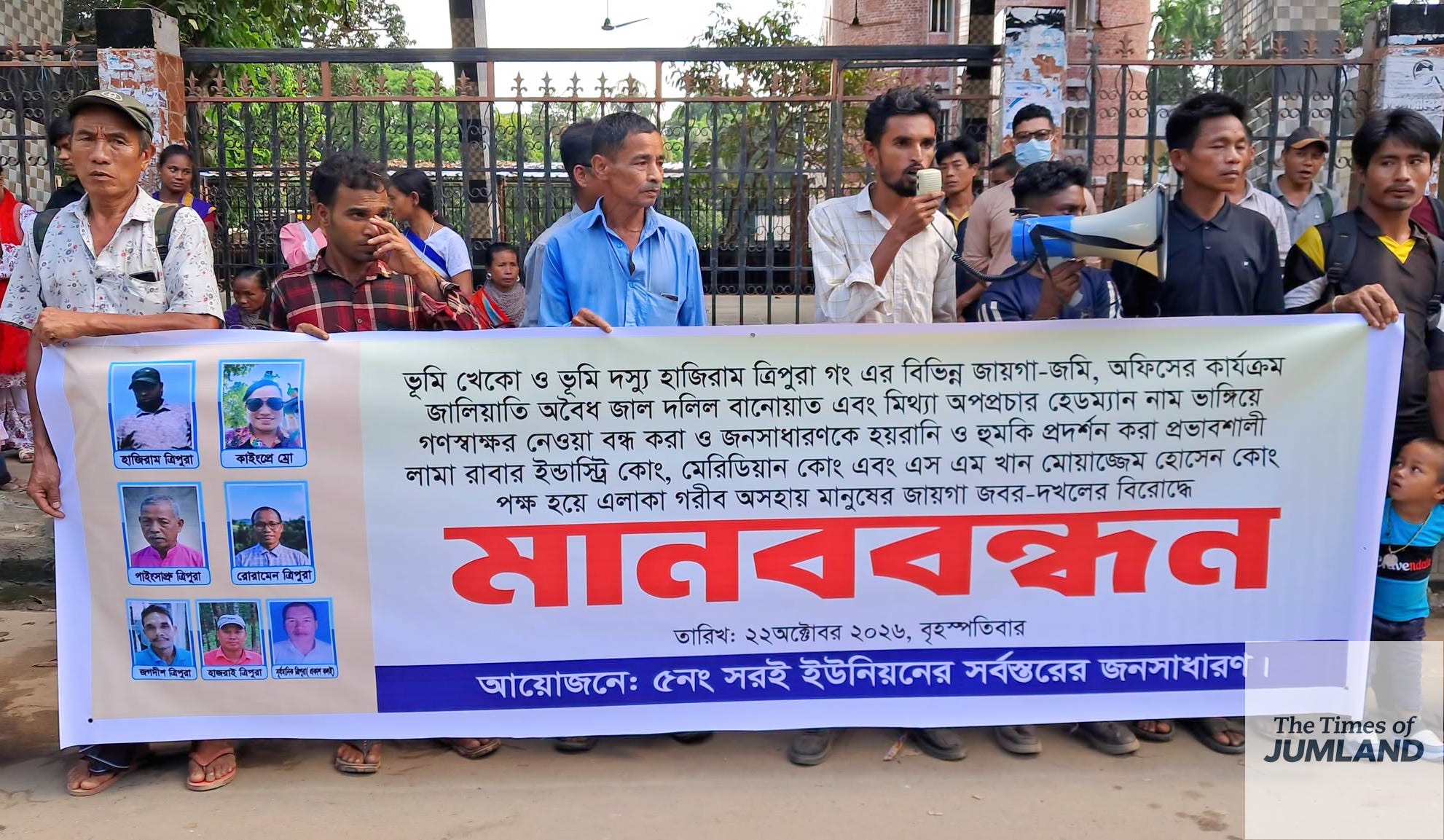
For residents who gathered outside Bandarban Press Club on October 22, the demand to reinstate a dismissed headman was inseparable from another concern: protecting the land they have occupied and cultivated for years.
The demonstrators, from Sarai Union in Lama, alleged that forged documents, intimidation and harassment were being used to dispossess local families. They called for the reinstatement of Yohan Tripura, the dismissed headman of Doluchhari Mouza, and invited journalists to visit the affected areas.
Their protest raises questions that deserve public answers. What evidence supports the competing land claims? Why was the headman removed? And how will the administration protect residents while those questions remain unresolved?
The allegations and the headman’s removal
According to Sufal Chakma’s Facebook account of the demonstration, dated October 22, the human chain took place that morning under a banner representing residents of the Sarai area. Speakers included Mohammad Iqbal, Roni Master and Chinghla Mong Marma, a karbari, or village head.
Speakers alleged that several local individuals were involved in preparing false land documents, collecting misleading signatures and threatening residents. They also alleged that these activities served commercial interests, naming Lama Rubber Industries, Meridian Company and an individual identified in the account as S. M. Moazzem Hossain Khan.
Their allegations described a process in which disputed documents were used to influence administrative action and take control of land occupied by local families. Some of that land, they claimed, was subsequently sold to commercial interests.
The demonstrators linked these concerns to the removal of Yohan Tripura. They argued that he lost his position because he supported residents’ legitimate land claims, alleging that false information and fabricated mass signatures had been submitted to the administration to secure his dismissal.
They further claimed that his absence created an opportunity for dispossession affecting hundreds of acres and that cases they described as false were being used to harass residents.
These allegations have not been independently verified for this article. Chakma’s account did not include responses from the named individuals, companies or relevant authorities. The disputed deeds, removal order and supporting complaints were not available for examination.
That makes the records central to any credible investigation. The administration should explain the grounds for the headman’s removal, identify the evidence it considered and clarify whether he had an opportunity to answer the complaints against him. The demand for reinstatement deserves a transparent review, rather than an unexplained acceptance or rejection.
A dispute with a wider history
Concerns surrounding land and commercial plantations in Lama have previously attracted international attention. On May 23, 2025, independent United Nations human rights experts wrote to Lama Rubber Industries about allegations concerning Indigenous land, environmental damage and the treatment of land defender Ringrong Mro.
The experts sought clarification from the company and expressed concern about the reported criminalisation of Indigenous community leaders and environmental defenders. They explicitly stated that they were not prejudging the accuracy of the allegations.
That communication does not establish the truth of the claims made at the October 22 protest. It does show that concerns involving the company and Indigenous land rights in Lama predate this demonstration and have received formal international attention.
The distinction matters. Earlier complaints provide context, but each disputed plot, document and administrative decision must be examined on its own evidence. Neither a company’s claim nor a resident’s account should escape scrutiny.
For families dependent on cultivation, the consequences extend beyond a disagreement over boundaries. Losing land can mean losing food production, income and the ability to remain in a community. An investigation must therefore consider both the competing records and the conditions facing the people living on the land.
Land rights require public accountability
A credible investigation should identify the disputed plots, establish their history of occupation and cultivation, and compare deeds, leases, transfer records and headman reports. Investigators should also examine whether the documents used in administrative decisions were properly checked.
Allegations of threats and harassment require separate attention. Residents must be able to submit evidence without intimidation, while the named individuals and companies must have a meaningful opportunity to present their records and explanations.
The invitation to journalists to visit the affected areas offers a practical starting point. Field reporting could establish which families occupy the land, what changes have occurred and whether the claims made at the press club correspond with conditions on the ground.
The administration’s responsibility is to establish those facts and explain its decisions. A public response should address the land allegations, the headman’s removal and the measures available to protect residents from intimidation while disputes are examined.
The October 22 protest is not a verdict against every person or company named. It is a demand for answers about land, administrative power and the security of local families.
Those answers must come through a process residents can trust. A family’s future should never depend on whose documents escape scrutiny or whose influence carries the greatest weight.
Sources and Further Reading:
Source for the demonstration: A Bengali Facebook post by Sufal Chakma, dated October 22, 2026. Additional background research and analysis by Purna Lal Chakma.
Related Bengali report on the October 22 demonstration
UN human rights experts’ communication to Lama Rubber Industries, May 23, 2025