

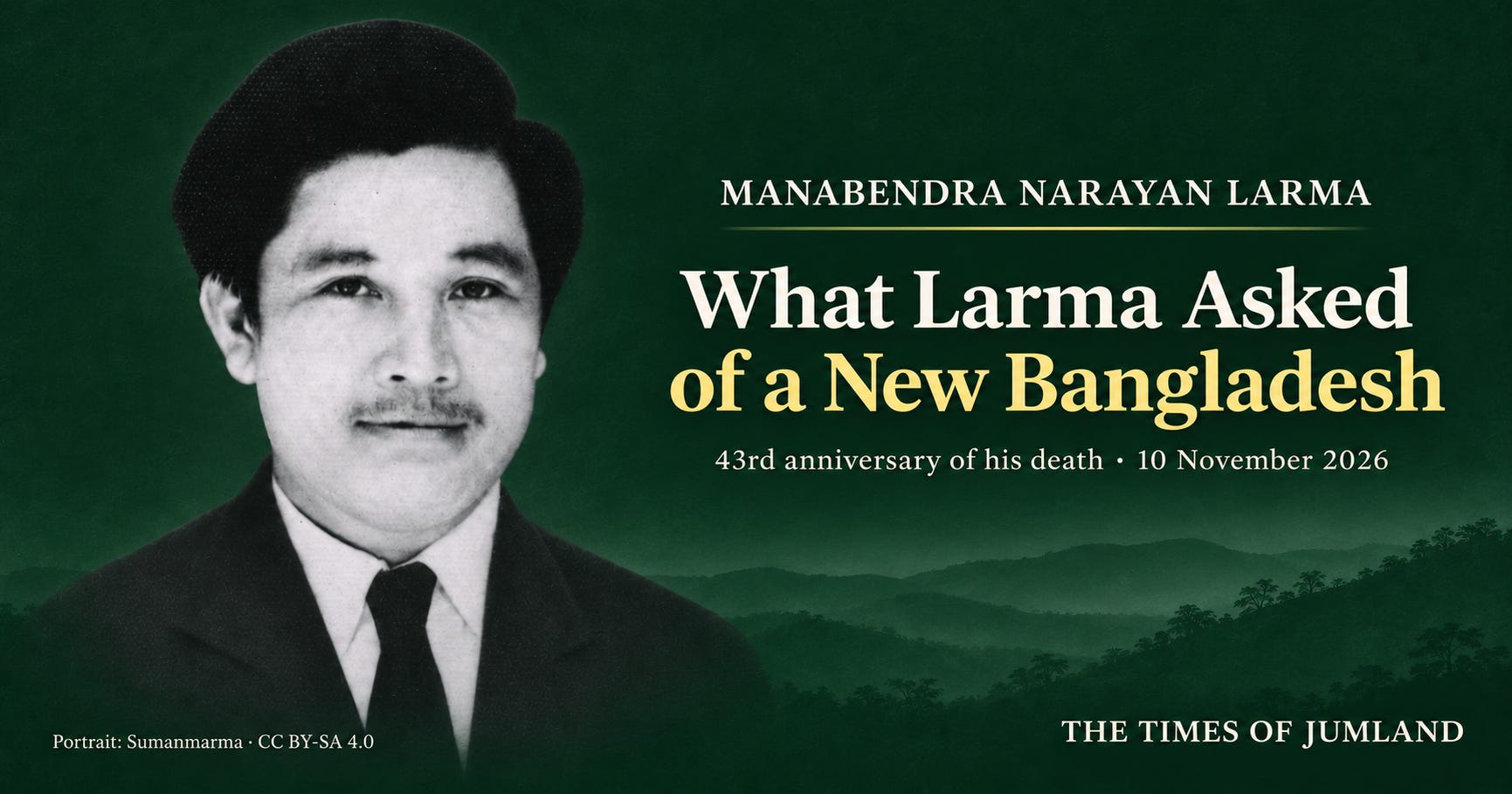
Today, 10 November 2026, marks the 43rd anniversary of the martyrdom of Manabendra Narayan Larma, known as M. N. Larma. To understand what he sought for the peoples of the Chittagong Hill Tracts, it helps to return to a debate in Bangladesh’s first Constituent Assembly.
On 31 October 1972, the assembly took up an amendment to the draft constitution’s citizenship article. Abdur Razzak Bhuiyan, an Awami League member elected from Dacca-XII in the 1970 Pakistan general election, proposed that citizens of the new country be known as Bengalis.
Kamal Hossain, Bangladesh’s law minister and chair of the Constitution Drafting Committee, supported the amendment. Larma then rose to speak. He told the assembly that the people he represented had lived alongside Bengalis, studied in Bengali and shared a country with them.
Then he said, “I am a Chakma.” The Speaker asked whether he wanted to be Bengali. Larma’s answer drew a distinction the amendment erased. He considered himself a citizen of Bangladesh.
His Chakma identity was his own, and it had been passed down through generations. If the state called him Bengali by law, he warned, the Chakma people’s existence as a distinct community would be at risk. The assembly adopted the amendment.
Months earlier, Larma had taken a four-point charter to Prime Minister Sheikh Mujibur Rahman. He wanted the Chittagong Hill Tracts to have a legislature of its own and constitutional safeguards for its system of administration.
The charter and the speech tell two parts of the same story. The speech was about the right of a people to name itself. The charter was about who would make decisions over its land, a question made urgent a decade earlier when the Kaptai Dam flooded villages and farmland across the hills.
What the dam took from the hills
Larma came from Mahapuram, a village near Rangamati. He became active in student politics in the 1950s and helped organise students from the Hill Tracts.
His early political life coincided with a project that would transform the region. The Pakistani government dammed the Karnaphuli River at Kaptai to generate electricity. The reservoir rose over settlements and some of the most productive farmland in the hills.
A land-rights study published by the International Work Group for Indigenous Affairs cites a government rehabilitation survey that counted more than 100,000 people displaced and about 54,000 acres of plough land submerged. Among the displaced were farming families and thousands of families without land of their own.
The fertile valleys accounted for a large share of the land suited to plough cultivation. A new place to live could be much easier to provide than a new way to make a living. Larma helped organise opposition to the project and campaigned for compensation and rehabilitation.
He was detained in February 1963 and released in March 1965. He later worked as a teacher, trained in law and won election as an independent to the East Pakistan Provincial Assembly in 1970.
By then he had worked in student organisations, experienced detention and won a mandate through an election. All three experiences mattered when independence opened a new political arena.
The dam helps explain the connection between the demands Larma later made for land and for political authority. Compensation was a response to what families had already lost.
A legislature of the region’s own would give the people of the hills a voice before the next decision about their land was made. The charter Larma took to Dhaka put that question before the new government.
The case Larma took to Sheikh Mujib
In February 1972, a Hill Tracts delegation presented a four-point charter to Prime Minister Sheikh Mujibur Rahman. Its central demand was regional autonomy with a separate legislature.
The charter also called for constitutional safeguards for the Chittagong Hill Tracts Regulation of 1900, including protection against changes to it, the continuation of the traditional chiefs’ offices and restrictions on settlement from outside the region. The 1972 Constitution left the delegation’s demand for autonomy unanswered.
The 1900 regulation came from British colonial rule. Its place in the charter makes sense when read alongside the demand for a legislature. The delegation wanted to retain existing protections while asking the new republic for a political institution through which the region could exercise a measure of self-government.
Together, the demands concerned who could settle in the region, which institutions would exercise authority there and how far Dhaka could change the rules on its own. These were decisions with direct consequences for the people who lived in the hills.
In his 1991 essay for the Jumma Sangbad Bulletin, Tatindra Lal Chakma described the delegation’s reception as a humiliation. In his account, Larma was so upset by the rejection that he could not hold back his tears.
The essay appeared in a special issue of the Jumma Sangbad Bulletin honouring Larma’s memory. The bulletin preserves a Jumma writer’s account of the encounter, published nearly two decades later. The assembly proceedings record the case Larma made in his own words.
The wording the assembly adopted went beyond a name in the citizenship article. Article 9 placed Bengali nationalism among the principles of the state and grounded it in a common language and culture and the struggle for independence.
That language made sense to lawmakers who saw the constitution as carrying forward the movement that had brought Bangladesh into being. For the peoples of the hills, it raised a different question. What standing would their own languages, histories and institutions have in the republic?
In October, Larma reminded his fellow members how closely the hill peoples lived with the Bengali-speaking majority. He had studied in Bengali himself. Living together and using a common language had never required his family to give up the name Chakma.
Yet the assembly took a word that described the identity of the majority and made it the designation for all citizens. For Larma, the question was whether a country born out of a struggle over language and identity would recognise that other peoples within its borders also had identities to protect.
From parliament to armed conflict
In 1972, Larma helped establish the Parbatya Chattagram Jana Samhati Samiti, or PCJSS. He sought to bring together Indigenous communities with different languages and histories under a shared political programme.
The movement used Jumma as a collective identity. Its organising task was to bring those communities together around interests they shared, including control over land and a greater say in the administration of the hills.
Larma won a seat in Bangladesh’s first general election in March 1973 and continued to press the hills’ demands in parliament. Outside parliament, the movement was also organising the Shanti Bahini, its armed wing.
The political break came after Sheikh Mujibur Rahman was assassinated in August 1975. Larma went underground as military rule took hold, and the conflict between the Shanti Bahini and state forces intensified.
In the late 1970s and early 1980s, a government-sponsored programme brought large numbers of Bengali settlers into the Hill Tracts. The programme changed the region’s population balance. Political scientist Bhumitra Chakma distinguishes it from earlier migration, including settlement in the aftermath of the 1971 war.
The conflict also exposed divisions within the Jumma movement. Rival factions of the PCJSS fought each other, and Larma was assassinated on 10 November 1983 in an attack that followed the split.
The bulletin remembers him as a leader who held to his principles while adapting his tactics. Read beside the account of his death, that tribute raises a question. How could communities that had built a political organisation to defend their common interests keep it together through years of war?
What returned to the negotiating table
On 2 December 1997, fourteen years after Larma’s death, the Bangladesh government and the PCJSS signed the Chittagong Hill Tracts Accord. The 1972 charter had asked for a legislature of the region’s own.
The accord provided for a Regional Council alongside the three Hill District Councils, with responsibilities defined within Bangladesh’s constitutional framework. It recognised the region’s distinctive character and set out measures to rehabilitate displaced people.
For a family defending a customary claim to land, one provision mattered especially. The accord called for a Land Commission to consider the laws, customs and usages of the Hill Tracts when settling disputes. A family could have its claim heard in terms that reflected how land was held in the hills.
Tatindra Lal Chakma was writing in 1991, six years before the accord. In the bulletin, he saw the founding of the PCJSS as a turning point. The ability of communities in the hills to organise in their own name was itself a gain worth defending.
That reading helps explain why the movement’s history matters beyond the terms of the eventual agreement. By 1997, the organisation Larma had helped build was able to sit across from the Bangladesh government and sign an agreement on the administration of the region.
The gap between an agreement and its implementation is visible in the accord’s own provisions. A council can exist on paper while the powers it is meant to exercise remain with other offices. A land commission can be set up while families are still waiting for disputes to be heard.
In its 2025 review, the International Work Group for Indigenous Affairs listed several unresolved issues. They included making the Land Commission functional, transferring powers to Hill Tracts institutions and rehabilitating internally displaced people. Progress on these commitments shows how much of the Accord has been put into practice.
On this anniversary, I return to the words Larma spoke before the assembly. He made his case in a language he shared with the members around him. He asked them to recognise a people whose name and history were their own.
The measure of his legacy lies in what that recognition allows a family in the hills to do. Can it defend a claim to its land? Can its representatives influence decisions before they are made?
Can its children grow up knowing that the country to which they belong makes room for the name by which they know themselves? That was the question Larma brought to the assembly, and it is still worth asking today.
Further Reading Sources:
Tatindra Lal Chakma. Essay on Manabendra Narayan Larma. Jumma Sangbad Bulletin, first year, Bulletin No. 5, 10 November 1991. Special issue commemorating 10 November 1983.
Bangladesh Constituent Assembly. Proceedings of 31 October 1972. English excerpt reproduced by the Kamal Hossain History Project as “Amendments to the Constitution Bill.” A Bengali transcript of Larma’s intervention is available through Jumjournal.
Parbatya Chattagram Jana Samhati Samiti. “Manabendra Narayan Larma” and “CHT Regulation 1900.”
Banglapedia. “Larma, Manabendra Narayan.”
Bhumitra Chakma. “Demographic Engineering: Population Resettlement in the Ethnoterritory of the Chittagong Hill Tracts, Bangladesh.” Modern Asian Studies.
International Work Group for Indigenous Affairs. Study on land rights in the Chittagong Hill Tracts, section on the Kaptai Hydroelectric Project. See also The Indigenous World 2025, Bangladesh chapter.
Chittagong Hill Tracts Accord. Dhaka, 2 December 1997. English text archived by United Nations Peacemaker.