

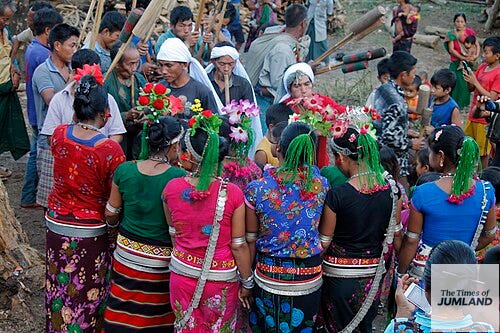

What happens when a community believes that its sacred book was lost before its ancestors could receive it? And what happens when, generations later, someone from that same community develops a writing system of its own?
These questions are central to understanding one of the most remarkable cultural traditions of the Mro Indigenous people of the Chittagong Hill Tracts. Their traditional Chiasotpoi festival is associated with a story about a cow that swallowed a sacred book written on banana leaves. For generations, the story helped explain a religious ceremony involving cattle sacrifice, bamboo music, dancing and communal feasting.
But the story did not end with the ceremony. In the early 1980s, a young Mro man named Menley Mro, also known as Kramadi Menle, developed a writing system and became associated with a new religious movement called Krama. The development changed how many Mro people understood their religion, cultural identity and traditional rituals.
The relationship between these events makes Chiasotpoi far more than an unusual Indigenous festival. It provides an opportunity to examine how mythology, religion, language and cultural identity can change within the history of a single community.
The Mro, also known as Mru, are among the Indigenous peoples of the Chittagong Hill Tracts in southeastern Bangladesh. Their communities are concentrated mainly in Bandarban, particularly in the hill areas of Alikadam, Thanchi, Ruma and neighbouring regions. Their language belongs to the Sino-Tibetan family and has developed within a society historically connected to mountain agriculture, forests and small village settlements.
For earlier generations, jhum cultivation was central to household life. Families depended on seasonal crops, domesticated animals and resources gathered from neighbouring forests. Traditional ceremonies reflected that environment, connecting religious beliefs with concerns about health, agricultural success and the wellbeing of the household.
Chiasotpoi, also written Chiasatpoy or Chia-chot Plai, is one of the best-documented traditional Mro ceremonies. It is commonly associated with the period following the jhum harvest, particularly between December and February. Its purpose, however, extends beyond marking the agricultural season.
Traditional accounts describe households organizing the ceremony to fulfil religious promises, seek relief from illness, express gratitude or pray for protection and prosperity. Such an event required resources, preparation and the participation of relatives and neighbours. It was therefore both a religious ceremony and an important occasion for community gathering.
Chiasotpoi should not be confused with the Mro New Year celebration. Although it is often called a festival, its religious meaning and customary arrangements differ from those of an annual New Year observance.
The ceremony’s name is commonly explained through Mro words associated with cattle, killing by spear and ceremonial celebration. English spellings vary because researchers, journalists and educators have represented Mro words using different transliteration systems.
To understand why a cow became central to the ceremony, it is necessary to examine the traditional story of Thurai, the creator in Mro mythology.
According to one widely recorded version, Thurai intended to give different peoples their religious teachings, rules for living and writing systems. Representatives were expected to receive these instructions, but the Mro representative arrived too late. The creator therefore arranged for the teachings to be delivered separately.
The religious knowledge intended for the Mro was written on banana leaves. A cow was entrusted with carrying the sacred writing to the community, beginning a journey that would explain the community’s later relationship with the animal.
During the journey, the cow became exhausted and hungry. It rested beneath a large tree before eventually eating the banana leaves containing the sacred text. When the animal reached the Mro people, it could no longer deliver the teachings entrusted to it.
Some versions say that the cow concealed its mistake and gave the community incorrect instructions, including misleading advice concerning agricultural work. When the truth became known, the creator ordered the animal to be punished for the loss of the sacred knowledge.
In this traditional narrative, the ceremonial sacrifice of cattle became associated with the punishment. The story also explained why the Mro people had not inherited their own written religious book.
Different versions include additional details, and not every storyteller recounts the events in precisely the same way. This is a characteristic of oral traditions, which may preserve a central narrative while changing individual elements between villages and generations.
The story should not be mistaken for a documented historical event. There is no evidence that a cow actually destroyed an ancient Mro manuscript. Its importance lies elsewhere: it reveals how a community explained the absence of inherited sacred writing and expressed its understanding of religious authority.
The legend also contains an interesting connection to agricultural life. In some versions, the Mro representative was late because people were occupied with harvesting crops. The loss of the sacred book was therefore linked not only to an animal but also to the demands of everyday work.
These details deserve attention because they show how religious narratives can reflect the circumstances in which a community lives. The story involves farming, communication, responsibility, divine instruction and the consequences of losing knowledge.
It would also be wrong to conclude that the Mro had no cultural knowledge simply because their traditional mythology described the loss of writing. Long before the development of a modern Mro alphabet, communities preserved language, historical memory, religious customs, agricultural techniques, music and social rules through oral teaching and practical experience.
The Chiasotpoi ceremony brought elements of that inherited knowledge into a shared public setting.
In 2004, researchers Md. Danesh Miah and M. S. H. Chowdhury published a study titled Traditional Forest Utilization Practice by the Mro Tribe in the Bandarban Region, Bangladesh. Their research examined how Mro households depended on forest products and how traditional plants were used in cultural ceremonies.
The researchers recorded that Chiasotpoi required elaborate preparations involving bamboo and other forest materials. Particular structures and decorations were made specifically for the ceremonial occasion, demonstrating knowledge of materials that could not be understood simply by watching the final performance.
Long bamboo poles called Limpu were decorated with tassels known as Seet. Some decorations were produced by carefully shaping the bamboo itself, while others were attached to the poles. A bamboo enclosure known as the Chek formed an important part of the ceremonial space.
These details might appear minor beside the more dramatic ritual involving cattle. Yet they reveal something important about Mro cultural heritage: traditional craftsmanship was inseparable from religious practice.
The ceremony depended upon knowledge of which plants to collect, how bamboo should be prepared and how particular objects should be constructed. Such skills were transmitted through participation rather than formal instruction.
A person who knew how to make the ceremonial bamboo decorations contributed to preserving a form of cultural knowledge. If the practice disappeared without documentation, the names and techniques associated with those objects could also become difficult to recover.
(Mro women perform the traditional Chiasotpoi dance in Bandarban, Bangladesh. Video: Masum-al-Hasan Rocky / Wikimedia Commons, 2019. CC BY-SA 4.0. Converted to MP4.)
Music played an equally important role. The researchers documented the use of the plung, a traditional bamboo mouth organ, together with drums known as tomma.
The plung is particularly distinctive. It is constructed using bamboo pipes of different lengths connected to a hollow gourd. The player blows air into the instrument and controls the tones through openings in the pipes, producing the music associated with ceremonial dancing.
Unlike a simple bamboo flute, the plung requires knowledge of several interconnected parts. Its construction involves selecting suitable bamboo, preparing the pipes and arranging them so the instrument produces the desired sounds.
Traditional accounts describe young men playing the plung while women participated in group dances. Performers wore ornaments and decorations that reflected Mro cultural aesthetics, including flowers, necklaces, silver jewellery and colourful garments.
Journalist Salek Khokon, writing about the ceremony in 2020, described young women preparing for the nighttime dancing while men gathered with long bamboo instruments. The performances continued through the night as participants moved around the ceremonial space.
The music was not merely entertainment added to a religious event. It formed part of the ceremony itself, bringing together participants and expressing cultural knowledge through sound, movement and cooperation.
The festival also required extensive hospitality. Relatives, neighbours and guests gathered at the host household, sometimes bringing gifts or traditional drinks. Food was prepared for participants, and the ceremony concluded with communal feasting.
The sacrifice of cattle remained central to the traditional rite. Historical descriptions record that animals were secured within a prepared ceremonial area and killed using spears, after which their meat was shared or prepared for the gathering.
Accounts differ concerning the number of animals involved. The 2004 academic study describes a ceremony involving one cow, while another published account describes several cattle, including an offering connected to a water source. These differences may reflect local customs, religious purposes or the scale of individual ceremonies.
The variation is important. No single observation should automatically be treated as a description of every Mro village. Indigenous communities are not culturally identical merely because they share a common name and language.
Animal sacrifice can raise ethical questions for contemporary readers, but the practice must be understood within its historical religious setting. Describing the Mro solely through the sacrifice would obscure the wider ceremony and reinforce a misleading picture of their culture.
Chiasotpoi involved religious belief, hospitality, traditional craftsmanship, music, dance and the transmission of social knowledge. The animal sacrifice was one part of an interconnected ceremonial tradition.
There was also a practical dimension to organizing the event. Cattle represented considerable economic value in an agricultural household, while hosting numerous visitors required food and other resources. The ceremony therefore involved financial commitment as well as religious responsibility.
For younger generations, participation offered opportunities to observe how their community organized collective events. They learned ceremonial arrangements, music, customary behaviour and the expectations associated with hospitality.
These social functions help explain why Chiasotpoi occupied an important place in traditional Mro life. Its significance cannot be measured only by the religious act that attracted the attention of outsiders.
Yet the ceremony’s history entered a new phase during the twentieth century.
For generations, the sacred-book legend had provided an explanation for the absence of an inherited Mro writing system. That situation began to change when Menley Mro developed an alphabet and introduced teachings associated with the Krama faith.
Accounts differ slightly concerning the precise timeline. Reports published in Bangladesh identify 1982 as the year the alphabet was developed, while other accounts describe its development and public introduction over several years in the early 1980s.
A more recent academic study by Takashi Shimosawa, titled The Social Significance of the Krama Faith and the Invention of the Mro Script, places Menley’s religious revelation and the introduction of the new religious movement in 1984.
These accounts need not be reduced to a single date without further investigation. The development of a writing system, the beginning of religious teaching and its subsequent adoption among followers are related but distinct historical developments.
What is firmly established is that the early 1980s marked a turning point in the modern cultural history of the Mro people.
The new writing system allowed the Mro language to be recorded using its own alphabet. The Krama faith introduced religious teachings and moral expectations that differed from older forms of spirit worship and animal sacrifice.
Shimosawa’s research describes how the movement emphasized moral discipline and the rejection of certain traditional practices. The study also examines how the new religion and alphabet responded to the social difficulties and stigmatization that Mro communities had experienced.
The significance of the movement therefore extended beyond religious belief. The creation of a writing system also offered a new means of recording ideas and expressing cultural identity.
For some Mro followers, the development had a direct consequence for the traditional cattle ceremony.
In the account published by Salek Khokon, followers of the Krama faith no longer regarded the old sacrifice as necessary. Because the community now possessed its own alphabet and religious teachings, they understood the original reason for punishing the cow as having ended.
This interpretation creates an extraordinary relationship between mythology and modern history. The traditional story concerned the loss of writing. The new religious movement was closely connected with its restoration through the creation of an alphabet.
The significance of this change should not be overstated. Not all Mro people adopted the Krama faith, and religious practices continued to differ between communities and households. Traditional beliefs, Buddhism and Christianity have also influenced Mro religious life.
It would therefore be inaccurate to declare that Chiasotpoi disappeared entirely when the new alphabet was introduced. What can be documented is a change in the religious interpretation and observance of the ceremony among followers of Krama.
This raises a question that extends far beyond the Mro community: when people abandon a traditional ritual because their beliefs have changed, what happens to the cultural knowledge associated with that ritual?
Religious change does not automatically destroy cultural identity. People may retain their language, family relationships, traditional clothing and historical memory while adopting different religious practices.
But some knowledge is closely connected to the occasions on which it was traditionally used. A musician may have fewer opportunities to perform ceremonial music if the ceremony becomes uncommon. A craftsperson may no longer be asked to prepare the bamboo structures that once accompanied it.
The same challenge applies to songs, dances and ceremonial vocabulary. Their survival depends on whether they continue to be taught, performed and recorded, even when the religious practices surrounding them change.
The plung provides a useful example. It belongs to Mro musical heritage regardless of whether every contemporary Mro family continues to observe the traditional cattle ceremony. Preserving the instrument requires more than keeping an example in a museum.
Future generations would also benefit from knowing how the instrument was made, which bamboo varieties were selected, how its pipes were arranged and what musical compositions were performed during particular ceremonies.
The same principle applies to the elaborate bamboo decorations described in the 2004 research. Knowing that the structures existed is useful, but recording the names Limpu, Seet and Chek, along with their methods of construction and ceremonial roles, preserves a deeper level of cultural knowledge.
The development of the Mro alphabet created new opportunities for precisely this kind of preservation.
The writing system achieved another milestone in 2014, when the Mro script was included in Unicode 7.0. This gave the alphabet a standardized digital representation, creating a technical foundation for using Mro characters in modern computing and electronic communication.
The importance of that development is easy to underestimate. A writing system that exists only in handwritten form faces different limitations from one that can be supported by digital technology. Unicode encoding makes it possible to represent the script consistently across compatible computer systems.
But having an encoded alphabet does not, by itself, guarantee that people will use it. Education, literacy materials, accessible technology and community participation are equally important.
Another milestone came in February 2022, when a grammar book titled Totong was introduced in Bandarban. The book was written by Younguang Mro and launched at an event attended by Mro religious representatives, language specialists and cultural figures.
According to the Dhaka Tribune, the author prepared the book using grammatical approaches familiar from Bengali and English. Community language specialists hoped that it would help address differences in spelling and written expression.
The publication represented an important step in developing educational resources for the Mro language. It also demonstrated that the creation of the alphabet in the 1980s was the beginning of a longer process rather than the completion of linguistic preservation.
The historical contrast is striking. In the traditional story, sacred writing was lost before the community could receive it. In documented modern history, Mro individuals developed an alphabet, organized religious teaching and began producing written educational materials.
But the new alphabet cannot preserve knowledge that nobody takes the time to record.
The history of Chiasotpoi illustrates this problem. Even with published studies, many details remain uncertain. Researchers have recorded different ceremonial arrangements, while the meanings of particular songs, dances and local practices may not be fully documented in accessible publications.
A century from now, a young Mro researcher might discover an old photograph showing women wearing flowers and ornaments beside men carrying long bamboo instruments. Without an accompanying explanation, the photograph would offer only a partial understanding of the event.
The researcher might not know whether the performance belonged to Chiasotpoi or another celebration, how the plung was constructed or what the songs meant. Even the names of the bamboo decorations might have been forgotten.
A written description in the Mro language, supplemented by photographs, recordings and explanations from community elders, would provide a much richer historical record.
The same is true of religious change. Future researchers should be able to understand why some families continued traditional ceremonies, why others adopted Krama and how different religious beliefs affected the transmission of music, language and customary practices.
Preservation does not require every ancient ritual to remain unchanged. Cultural communities have the right to reinterpret traditions, adopt new beliefs and decide how they wish to live.
What matters is whether those changes are accompanied by the preservation of historical knowledge, so future generations can understand what earlier practices meant and why they changed.
The history of Chiasotpoi is therefore not simply a story about a cow and a lost sacred book. It is also a story about agricultural life, religious authority, forest knowledge, ceremonial craftsmanship, music and the creation of a modern writing system.
The traditional legend belongs to mythology. The development of the Mro alphabet in the twentieth century belongs to documented history. Together, they reveal how a community’s understanding of its past can influence its response to change.
For the Mro people, the story of the lost sacred book has acquired a new meaning in an age when their own alphabet can be used to document their language and cultural traditions.
Their ancestors preserved knowledge through memory, music and oral teaching. The present generation has another opportunity: to preserve that inheritance in writing, photographs and recordings so that future Mro children will not have to search for their history in fragments left behind by outsiders.
Sources and Further Reading:
Md. Danesh Miah and M. S. H. Chowdhury, Traditional Forest Utilization Practice by the Mro Tribe in the Bandarban Region, Bangladesh, Schweizerische Zeitschrift für Forstwesen, Vol. 155, 2004, pp. 65–70.
https://doi.org/10.3188/szf.2004.0065Salek Khokon, গরু বিষয়ক একটি আদিবাসী লোককথা, bdnews24.com, July 17, 2020.
https://bangla.bdnews24.com/kidz/article1781619.bdnewsTakashi Shimosawa, The Social Significance of the Krama Faith and the Invention of the Mro Script, manuscript dated October 2025, made available August 2026.
https://papers.ssrn.com/sol3/papers.cfm?abstract_id=7224300Tim Brookes, Designing New Scripts: The Missing Mro, Endangered Alphabets, July 20, 2021.
https://www.endangeredalphabets.com/2021/07/20/designing-new-scripts-the-missing-mro/First Mro Language Grammar Book ‘Totong’ Unveiled, Dhaka Tribune, February 18, 2022.
https://www.dhakatribune.com/bangladesh/287324/first-mro-language-grammar-book-%E2%80%98totong%E2%80%99-unveiledWriting Systems Technical Resources, Unicode Status for Mro.
https://writingsystems.info/scrlang/unicode/mroo-unicode/Fayza Haq, Projecting an Unknown Culture, The Daily Star, March 14, 2004.
https://archive.thedailystar.net/2004/03/14/d40314140197.htm