

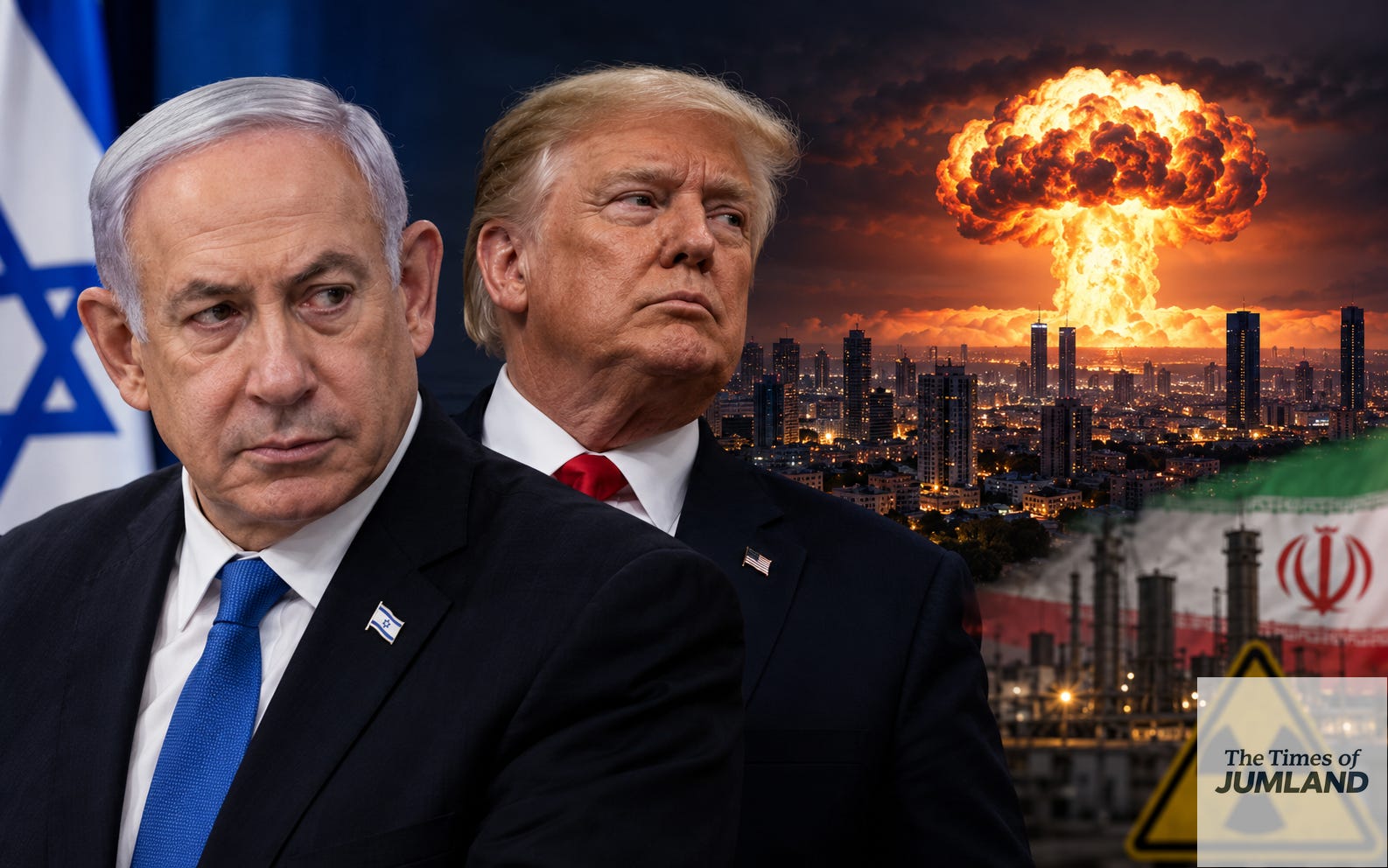
Benjamin Netanyahu’s image of a nuclear explosion over Tel Aviv has drawn international attention. But while the Israeli prime minister warned about Iran acquiring nuclear weapons, the United States was sending a different message: President Donald Trump would not launch another strike on Iran before America’s November 3 midterm elections.
The contrast raises a larger question than the image itself. Israel regards Iran as a major security threat, but how far is Washington prepared to go in helping Israel confront Tehran, and when?
Netanyahu shared the AI-generated image on X on Sunday, October 25, just two days before Israel’s national election. The fictional picture showed a mushroom cloud rising above Tel Aviv. It was not evidence of a real attack or an imminent nuclear explosion.
The image accompanied a message written by right-wing political commentator Yuval Bloomberg, who argued that preventing Iran from acquiring nuclear weapons must take priority over Israel’s domestic political controversies.
Bloomberg warned that a future Iranian nuclear capability could threaten Israel’s existence. He also argued that Israel had a limited opportunity to confront Iran while Trump remained in the White House.
His message suggested that the country needed leadership capable of maintaining close relations with Washington and warned that electing a prime minister unable to confront Iran could expose Israelis to the danger of a “second Holocaust.”
Netanyahu’s decision to share the warning brought Iran back into focus during the final days of the election campaign.
Yet the message also highlighted a complicated relationship between Israel’s security priorities and Washington’s political timetable.
On October 18, Trump publicly endorsed Netanyahu’s re-election, describing him as an important partner in confronting Iran. Trump argued that replacing Netanyahu could leave the United States carrying more responsibility for dealing with Tehran.
The endorsement reinforced Netanyahu’s position that his personal relationship with Trump is an important asset in managing Israel’s national security challenges.
However, American political support does not necessarily mean immediate agreement on military action.
On October 8, Trump announced that the United States would not resume strikes against Iran before the November 3 midterm elections. On October 25, he again ruled out an American attack that day.
The timing is significant. Israelis will vote on October 27, while American voters go to the polls one week later. Both elections are taking place amid an unresolved conflict with Iran.
According to an October 22 ABC News report, Israeli and American military officials have developed plans for possible renewed strikes on Iranian targets following the US midterms. The report cited Israeli sources familiar with the planning.
The White House confirmed that no American strikes would take place before November 3 but declined to comment on the reported operational plans. Their existence does not establish that Trump has approved another attack.
That distinction matters because any renewed confrontation could have consequences far beyond Israel and Iran, including further disruption to regional security and global energy markets.
Netanyahu’s nuclear image also reportedly caused concern in Washington.


Israel’s Channel 12 reported on October 25 that White House officials feared the picture could cause Iranian leaders to misinterpret Israeli intentions, potentially provoking an attack or further escalation. The reported concern has not been independently confirmed.
The broadcaster suggested Trump’s public statement ruling out a strike that day might have been intended to reassure Tehran, although no official explanation established such a connection.
Meanwhile, the Iranian nuclear question remains unresolved despite extensive Israeli and American military operations.
Following strikes on Iranian nuclear facilities in June 2025, Netanyahu repeatedly argued that Tehran’s nuclear programme had suffered devastating damage. In March 2026, he said Iran could no longer threaten Israel’s existence.
But destroying nuclear infrastructure does not necessarily eliminate surviving enriched uranium, technical knowledge or the ability to rebuild damaged facilities.
According to an October 7 Reuters examination of the nuclear programme, Iran possessed an estimated 440.9 kilograms of uranium enriched to up to 60 percent before the June 2025 attacks.
The International Atomic Energy Agency has since struggled to determine the condition and location of Iran’s surviving nuclear material because inspectors have not regained access to the bombed facilities.
IAEA Director General Rafael Grossi estimated in March that slightly more than 200 kilograms of uranium enriched to up to 60 percent remained in a tunnel complex at Isfahan, with additional material believed to be elsewhere.
However, there has been no verified finding that Iran currently possesses a nuclear weapon. Nor is there confirmed evidence that the country has resumed uranium enrichment since the attacks.
This uncertainty lies at the heart of Israel’s security concerns. Even extensive military damage cannot guarantee that a determined state will never rebuild its nuclear capabilities.
Diplomatic possibilities also remain, although negotiations have produced little progress. On October 25, Iranian officials said messages were still being exchanged with Washington through intermediaries.
The immediate question is therefore not simply whether Israel should confront Iran. It is whether renewed military action, sustained pressure or a negotiated arrangement could provide a lasting solution.
Israel’s opposition leaders have criticised Netanyahu’s use of the nuclear image. Gadi Eisenkot, chairman of the Yashar party, accused him of using fear during the election campaign, while Democrats chairman Yair Golan also condemned the post.
Nevertheless, concern about Iran extends across much of Israel’s political establishment. An October 21 Reuters analysis found that a change of government would not necessarily produce a fundamental change in Israel’s approach to Tehran.
The election may determine who leads Israel, but the broader Iranian challenge will remain.
Netanyahu’s warning and Trump’s response reveal another important reality: the two governments may share the objective of preventing Iran from acquiring nuclear weapons while differing over the timing and methods of achieving it.
The mushroom cloud over Tel Aviv was fictional. The uncertainty surrounding Iran’s nuclear capabilities and the possibility of renewed military confrontation are not.
For Israel, the decisive question is no longer what Netanyahu’s image depicts, but what Washington and Jerusalem will decide after the elections are over.
Sources and References:
The Times of Israel (25 October 2026) — Netanyahu shares AI-generated image depicting a nuclear explosion over Tel Aviv.
https://www.timesofisrael.com/pm-posts-ai-image-of-nuke-hitting-tel-aviv-warns-of-2nd-holocaust-if-hes-not-elected/The Times of Israel (25 October 2026) — White House reportedly concerned Netanyahu’s nuclear image could lead Iran to miscalculate.
https://www.timesofisrael.com/liveblog_entry/white-house-worried-netanyahus-tel-aviv-nuke-post-could-lead-iran-to-miscalculate-report/Axios (18 October 2026) — Trump endorses Netanyahu ahead of Israel’s election amid concerns over Iran.
https://www.axios.com/2026/10/18/trump-endorses-netanyahu-israel-election-iranABC News (22 October 2026) — US and Israel develop plans for possible renewed military strikes against Iran.
https://abcnews.com/Politics/us-israel-drawing-plans-resume-attacks-iran-post/story?id=137479897Reuters (7 October 2026) — Explainer: The status of Iran’s uranium enrichment programme.
https://www.internazionale.it/ultime-notizie-reuters/2026/10/07/explainer-the-status-of-iran-s-uranium-enrichment-programmeReuters (21 October 2026) — Israel’s election may change its leader, but not its Iran war policy.
https://www.reuters.com/world/middle-east/israels-election-may-change-its-leader-not-iran-war-policy-2026-10-21/Associated Press (October 2026) — Continuing indirect communications between Iran and the United States.
https://apnews.com/article/4779a3deeb1a23f59414164532d5c885