

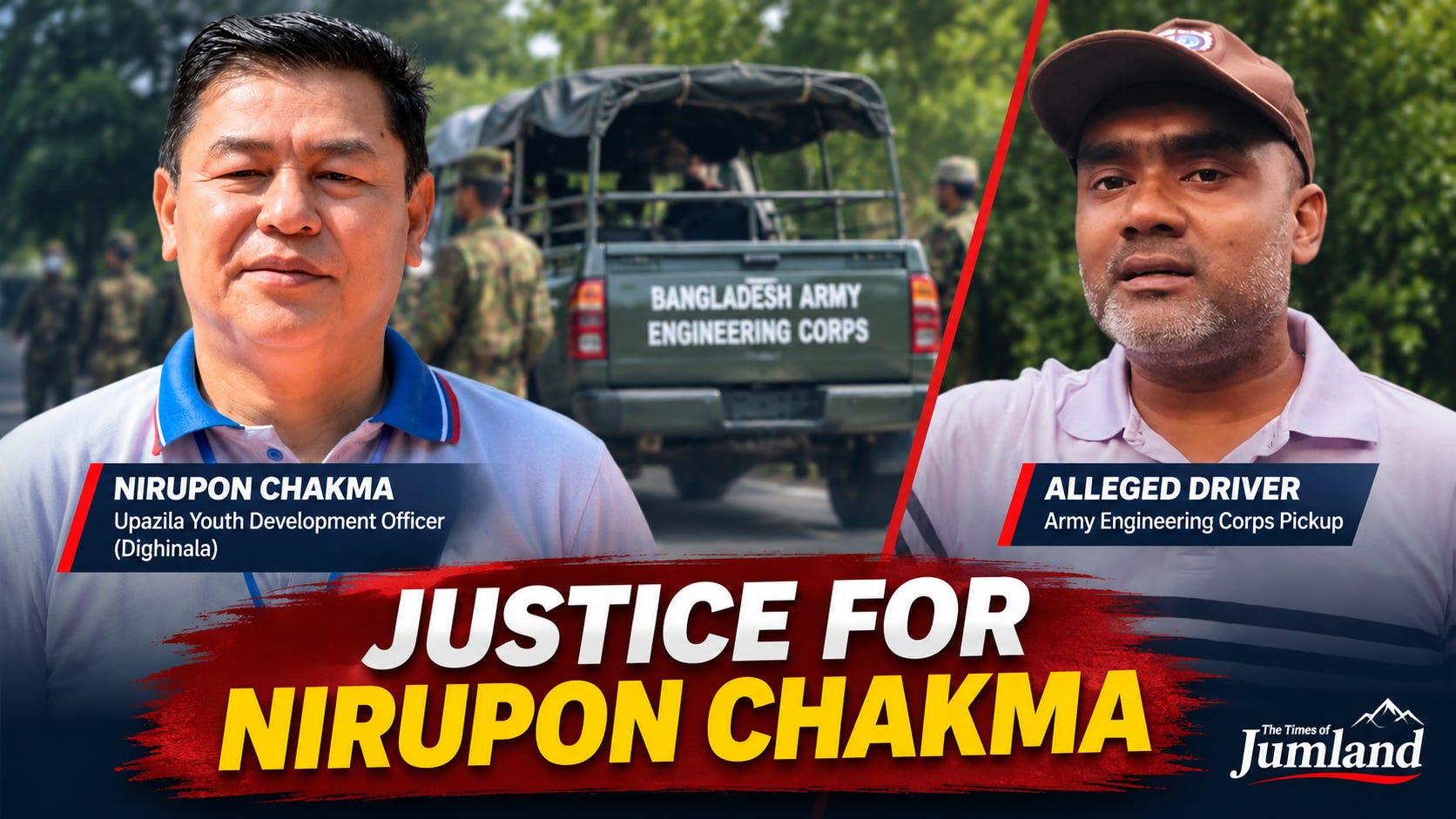
KHAGRACHHARI, Bangladesh — The death of Indigenous Chakma government officer Nirupon Chakma after being struck by a pickup truck reportedly belonging to the Bangladesh Army’s Engineering Corps has sparked demands for justice in the Chittagong Hill Tracts (CHT), where military accountability remains a longstanding concern among Indigenous Jumma communities.
Chakma, who served as the Upazila Youth Development Officer in Dighinala, was returning home from work on Monday, November 9, when a pickup struck his motorcycle near the second gate of the Khagrachhari Agricultural Research Centre.
He was travelling towards his home in Aparna Chowdhury Para of Khagrachhari municipality when the collision occurred.
According to eyewitness accounts, the pickup approached from the opposite direction at excessive speed and struck Chakma’s motorcycle. The impact left him with fatal injuries.
Local accounts described a violent collision that sent his motorcycle several yards away. Chakma died from his injuries, leaving his family, colleagues and the wider Indigenous community demanding answers.
Indigenous media identified the vehicle as belonging to the Bangladesh Army’s Engineering Corps, raising questions about the identity of its driver and the responsibility of the military authorities connected to the vehicle.
The incident became particularly controversial after witnesses reported that the pickup driver attempted to flee.
Local motorcyclists pursued the vehicle and managed to intercept it. However, conflicting reports subsequently emerged about whether the driver escaped or was taken into police custody.
Several local news outlets reported that the driver fled after residents stopped the pickup, while other reports quoted police as saying that both the driver and the vehicle had been taken into custody.
The identity of the driver and his current legal status have not been clearly established in the published accounts.
The conflicting information raises an important question: how can a driver involved in a fatal collision remain publicly unidentified when local residents reportedly intercepted the vehicle?
If the pickup belonged to the Army’s Engineering Corps, military records should establish which unit operated it, who was assigned to drive it and whether the journey was officially authorised.
The vehicle’s reported military connection also raises concerns about whether the driver will face the same legal process as any other person involved in a fatal road collision.
Witnesses have alleged that the pickup was being driven recklessly. Some also claimed that the driver’s behaviour appeared abnormal and suggested he might have been intoxicated.
The allegation of intoxication has not been established through a publicly documented medical examination.
The accounts of excessive speed, dangerous driving and attempted escape warrant a thorough investigation, including examination of the vehicle and testimony from those who witnessed the collision.
For Chakma’s family, the immediate concern is justice for a man who was returning home after completing his official responsibilities.
According to bdnews24.com, Arthi Chakma, a relative of the deceased officer, described him as a careful motorcyclist who usually travelled at low speed. She demanded a fair investigation and justice for his death.
Her statement draws attention to the circumstances surrounding the collision and the family’s demand that responsibility be established through a proper legal process.
Another relative, Bhagis Chakma, told local reporters that Chakma was returning from Dighinala when the approaching pickup struck him near the Agricultural Research Centre.
Khagrachhari Sadar Police Station Officer-in-Charge Mohammad Kay Kislu confirmed the fatal collision and the seizure of the pickup. However, the differing published accounts of the driver’s custody have left the public without a consistent explanation of what happened after the vehicle was stopped.
The case has wider significance in the Chittagong Hill Tracts, where Indigenous Jumma communities have lived under a substantial military presence for decades.
The 1997 Chittagong Hill Tracts Accord sought to address the region’s longstanding political conflict and included provisions concerning the withdrawal of temporary military camps.
Nearly three decades later, military authority and its relationship with civilian life remain subjects of concern among Indigenous communities.
Indigenous rights organisations have repeatedly raised allegations of excessive military interference, arbitrary detention, land-related abuses and inadequate accountability for violations affecting Jumma residents.
The death of a civilian involving a reportedly military-owned vehicle has renewed questions about how accountability works when members or assets of a powerful state institution are involved.
The issue is not simply whether the collision resulted from careless driving. It is whether the investigation will establish the facts without institutional influence or preferential treatment.
The military’s responsibility to maintain security cannot place its personnel or employees beyond civilian legal accountability.
A government vehicle, military designation or official position cannot justify dangerous driving or protect anyone found responsible for a civilian death.
The authorities must establish the driver’s identity, determine whether criminal negligence was involved and clarify whether any charges have been filed.
If the vehicle belonged to the Army’s Engineering Corps, the responsible military authorities must also account for its use and explain what steps were taken following the collision.
A transparent investigation would help establish whether the driver attempted to escape, whether he was detained and what legal action has followed.
For Indigenous communities in the CHT, these questions are closely connected to a larger demand that state institutions be held accountable when civilians suffer harm.
Nirupon Chakma was a government officer returning home from an ordinary working day. His death has left a family grieving and a community questioning whether justice will be delivered.
His family deserves a clear explanation of how he died, who was driving the vehicle and what legal consequences will follow.
The identity of the driver must be established, the conflicting custody reports resolved and any criminal responsibility pursued without regard to military rank or institutional connections.
Nirupon Chakma’s family is demanding justice, not special treatment. The same law that applies to an ordinary civilian must also apply to anyone responsible for his death, regardless of whose vehicle they were driving.