

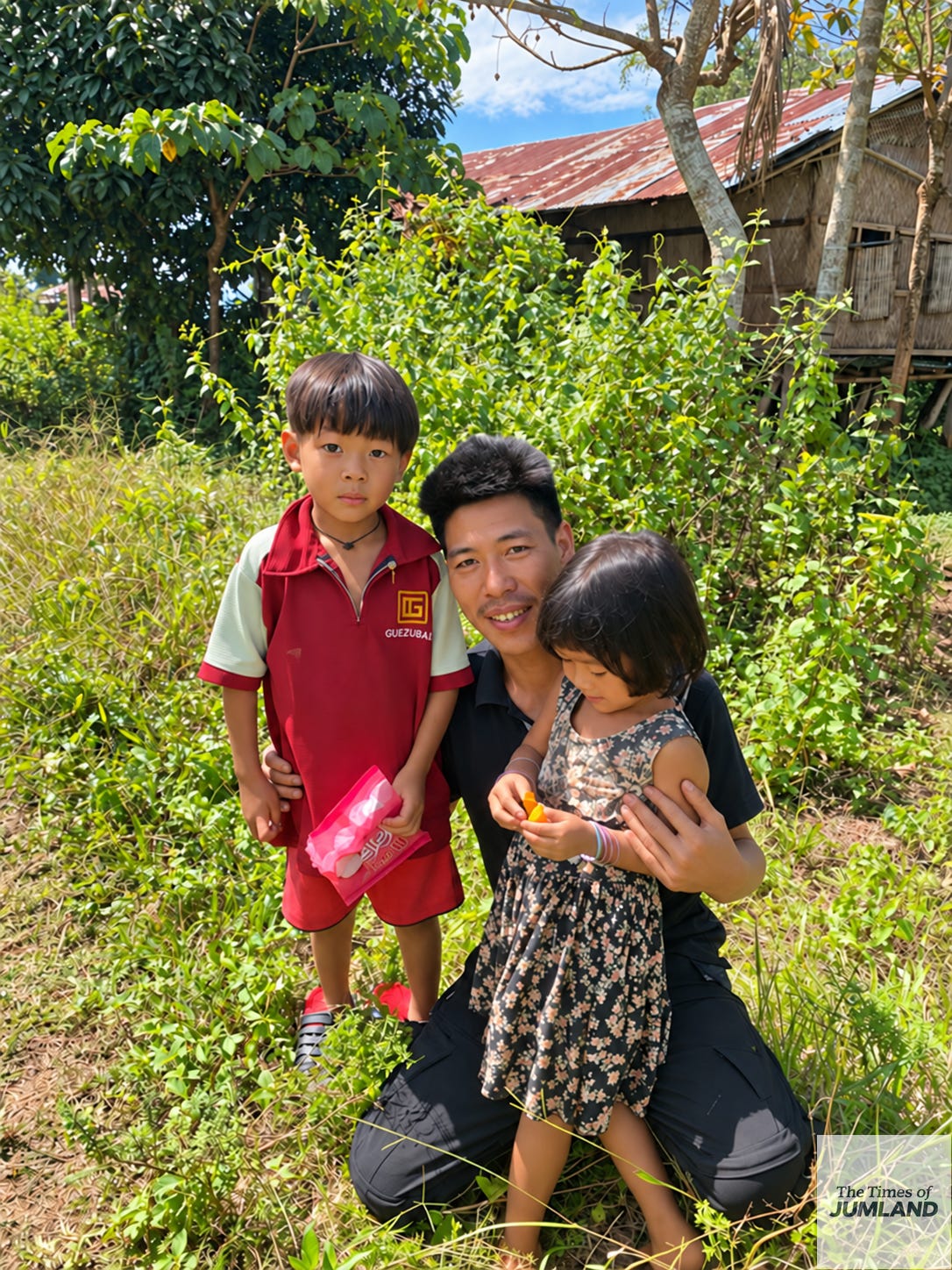
Only two young children remain in Baktlai Para, according to Reng Hai Mro, whose photograph and accompanying account describe a Bawm village where many homes now stand empty.
Mro says the settlement once housed more than 45 families and over 200 residents. Now, he reports, nine families comprising 27 people remain. The two children in his photograph are siblings and, according to his account, the village’s only remaining young children.
Wooden houses still stand. Many of the families who once lived in them are gone.
Baktlai’s shrinking population sits within a wider crisis affecting the Bawm community. Military operations against the Kuki-Chin National Front, armed conflict and fear of arrest have disrupted civilian life across parts of the Chittagong Hill Tracts.
The European Union Agency for Asylum’s August 2025 country report cites research by the International Work Group for Indigenous Affairs estimating that around 4,000 Bawm community members were displaced by military operations between October 2022 and September 2024. Some fled across international borders, while others sheltered in forests near their villages.
That wider displacement provides context for Baktlai’s situation. Mro’s account, however, does not establish when each family left or the circumstances of every departure.
Prolonged detention has added to the pressure on Bawm families. Netra News’s investigation, “The Price of Being Bawm,” published in English on December 30, 2025, and in Bengali on January 11, 2026, documented eight Bawm women who remained detained without trial when it reported.
The investigation described interrupted education, households struggling without caregivers and families selling ancestral land to finance legal proceedings. These were documented individual cases, rather than a complete count of Bawm people currently in prison.
Authorities accused detainees of membership of, or support for, the armed group implicated in bank robberies and hostage-taking in April 2024. Amnesty International challenged the arrests as arbitrary and raised concerns about the failure to establish individual criminal responsibility.
The distinction between an armed organisation and an ethnic community is essential. Allegations against individuals cannot establish the guilt of their neighbours or an entire village. Bawm civilians are entitled to safety, legal protection and fair proceedings.
For families who have left their homes, displacement reaches into almost every part of daily life. Children can lose access to education. Parents lose livelihoods. Relatives become separated, and farmland may become inaccessible.
A village also loses the everyday relationships through which children learn their language, traditions and community history. Empty homes represent more than missing residents. They mark an interruption in the life of a community.
Mro reports that the army has provided food rations and medical assistance. He also calls for longer-term rehabilitation, education and security so that families can return to their villages.
Emergency assistance addresses immediate needs. Lasting recovery requires conditions in which families can return voluntarily and safely, rebuild livelihoods and access schools and healthcare.
The questions facing Baktlai are therefore practical as well as urgent. What prevents families from returning? What educational support can the remaining children access? What arrangements will allow residents to rebuild their lives without fear?
For the two children in Mro’s photograph, the answers will shape the community in which they grow up.
Baktlai Para’s future depends on more than keeping its houses standing. It depends on whether families can return safely—and have the confidence and means to stay.
Further reading sources:
The Price of Being Bawm — Netra News
বাংলাদেশে বম হওয়ার মূল্য — নেত্র নিউজ
Indigenous detainees still jailed without trial — Amnesty International, December 12, 2025