

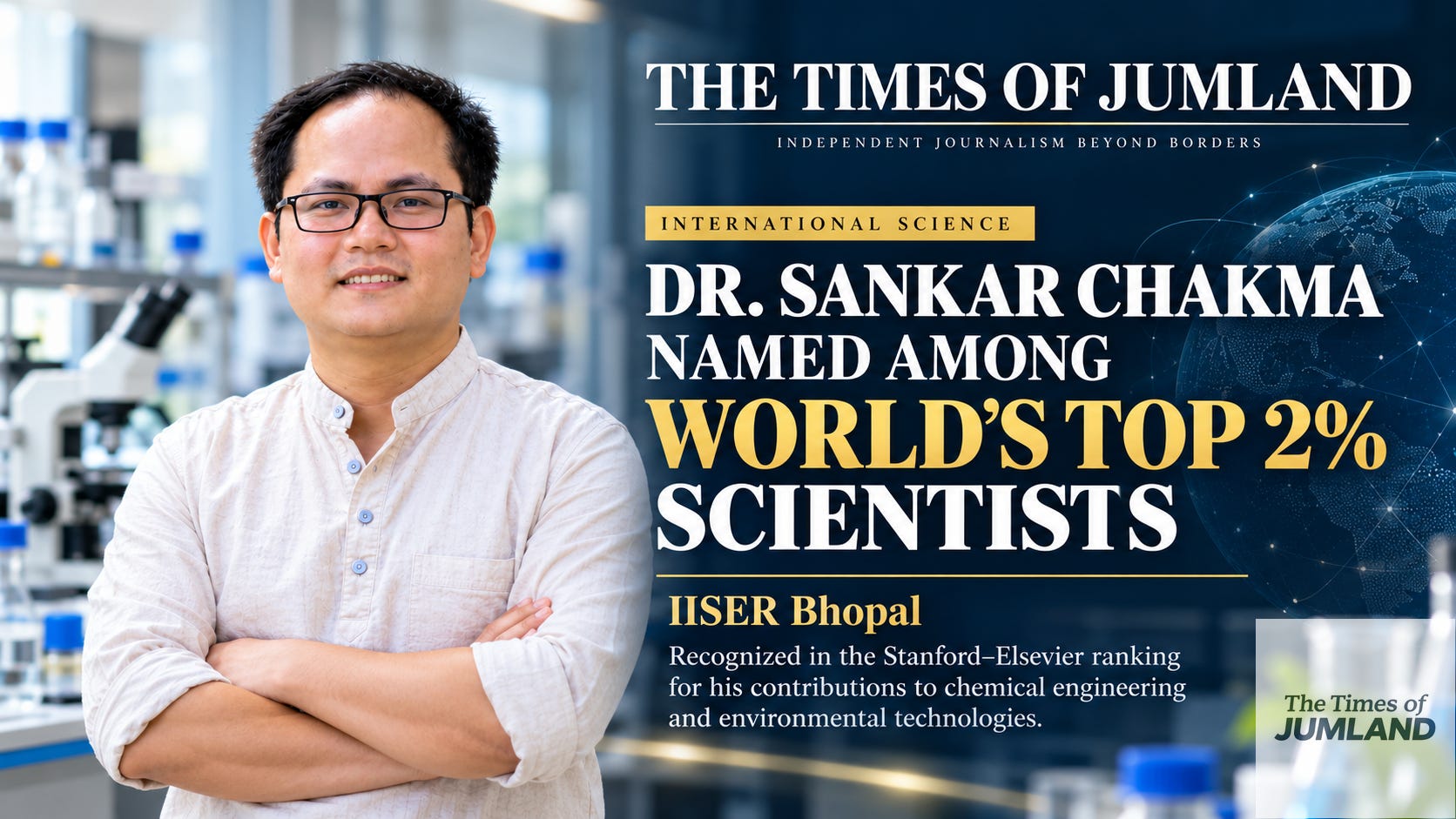
Dr. Sankar Chakma, a chemical engineering researcher whose work addresses water pollution, industrial waste and environmental sustainability, has been named among the world’s top 2% scientists in the 2026 Stanford–Elsevier research-impact database.
An Associate Professor in the Department of Chemical Engineering at the Indian Institute of Science Education and Research (IISER) Bhopal, Dr. Chakma has received international recognition for the citation impact of his scientific research. His department publicly congratulated him on the achievement, marking another important milestone in his academic career.
The recognition is particularly significant because his research focuses on environmental problems affecting millions of people. Access to clean water, industrial pollution and the disposal of hazardous waste remain major challenges for countries across the world. Scientists developing more effective treatment technologies have an important role in addressing these problems.
One of Dr. Chakma’s principal research interests is sonochemistry, which involves using ultrasound to influence chemical reactions. In environmental engineering, ultrasound-based methods can help break down pollutants in contaminated water, particularly when combined with other treatment processes.
His research also involves advanced oxidation processes, wastewater treatment, sustainable energy technologies and resource recovery from waste materials. These areas seek practical solutions to environmental problems while improving how industries manage pollution and use resources.
A particularly interesting example appeared in the scientific journal Chemosphere in 2025. Dr. Chakma and his co-authors investigated how biochar produced from agricultural waste, specifically wheat straw, could be used to remove ciprofloxacin, an antibiotic, from contaminated water.
The researchers reported that chemically activated biochar achieved approximately 98% removal of the antibiotic under the laboratory conditions tested. Although further research would be necessary before applying the technology widely, the findings illustrated how agricultural waste could potentially become a useful material for water purification.
Such research has implications beyond India. Industrial wastewater, pharmaceutical residues and environmental contamination are international problems. Developing effective and affordable technologies to address them is particularly important for regions where sophisticated water-treatment infrastructure remains limited.
Dr. Chakma’s academic career began at Jadavpur University in Kolkata, where he completed his Bachelor of Engineering degree in 2009. He subsequently earned his Master of Technology degree in 2011 and Ph.D. in 2015 from the Indian Institute of Technology Guwahati.
He joined IISER Bhopal as an Assistant Professor in September 2015 and became an Associate Professor in October 2023. He also served as Head of the Department of Chemical Engineering from January to December 2024.
His professional achievements extend beyond the latest international recognition. Among his earlier distinctions are the Institution of Engineers (India) Young Engineers Award for 2018–2019 and selection as an Associate of the Indian Academy of Sciences in 2017. He has also received recognition for his work in environmental research and engineering.
The Stanford–Elsevier recognition comes from a science-wide database developed by Stanford University researcher John P. A. Ioannidis and colleagues using citation information from Elsevier’s Scopus database.
The 2026 edition was published on October 7 and includes assessments of both career-long research impact and citations received during 2025. Researchers are evaluated using standardized citation indicators, including the h-index, co-authorship-adjusted measures and the influence of their published work.
Although commonly described as the world’s top 2% scientists list, the database is not a scientific award presented directly by Stanford University. Its selection criteria include researchers within the top 100,000 by composite citation score or the top 2% of their scientific subfields.
Nevertheless, inclusion provides an indication that a researcher’s published work has attracted substantial attention within the international academic community.
Dr. Chakma’s achievement also highlights the growing presence of Chakma scholars and professionals in international scientific research.
Public discussions involving Chakma communities frequently focus on political struggles, land disputes, Indigenous rights and the unresolved challenges of the Chittagong Hill Tracts. These issues remain important, but achievements in science, education and professional life also deserve recognition.
The accomplishments of researchers and academics can encourage younger generations to pursue higher education, scientific research and international professional opportunities.
Dr. Chakma’s precise family or geographical connection to the Chittagong Hill Tracts has not been independently established. His scientific achievements, however, are documented through his academic career, published research and the recognition announced by his university department.
His work also illustrates something broader: scientific research can connect individual achievement with problems that affect societies across national borders.
Dr. Sankar Chakma’s recognition is therefore not simply another entry in an international database. It is an example of how education, sustained research and scientific innovation can bring an individual’s work to international attention while contributing to the search for solutions to real environmental challenges.
Sources and Further Reading:
Department of Chemical Engineering, IISER Bhopal — Official department announcements
https://www.linkedin.com/company/chemeng-iiserb/
IISER Bhopal — Dr. Sankar Chakma’s Faculty Profile
https://che.iiserb.ac.in/index.php/read_more_content/faculty_read_more/schakma
Alawa et al., Chemosphere (2025) — Research on agricultural-waste biochar and ciprofloxacin removal
https://pubmed.ncbi.nlm.nih.gov/40020449/
Elsevier Data Repository — August 2026 Update of Science-Wide Author Databases, Version 9
https://elsevier.digitalcommonsdata.com/datasets/btchxktzyw/9/