
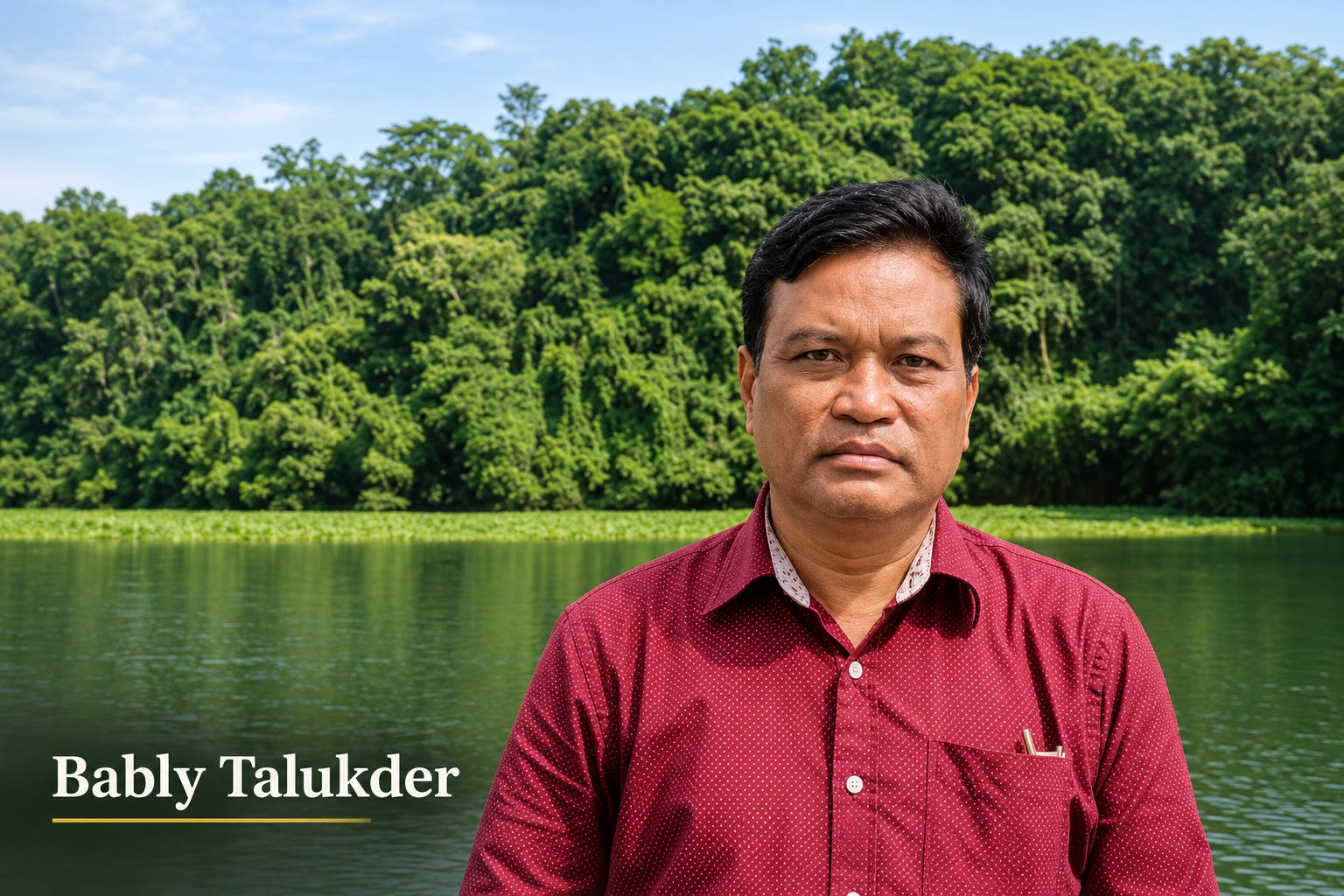
By Bably Talukder | Translated by Tokyo Desk
I entered the contracting business in 1990 and obtained a contractor’s licence from the Roads and Highways Department. As far as I remember, there were only about 24 or 25 Indigenous contractors at that time.
Back then, government contracts worth less than Tk 200,000 were reserved for hill people under what was known as the tribal quota. All Indigenous contractors received work through a rotational lottery system. I also received many contracts, and there was no shortage of work in those days.
Our contractors’ association had its temporary office at the Youth Sporting Club in Tabalchhari, Rangamati. The lotteries for distributing contracts among contractors were held there.
During that period, I had the opportunity to meet several senior contractors, including the late Nilamohan Karbari, the late Mrs. Sudipta Dewan, the late Ashwini Kumar Tripura, the late Bimal Chakma, the late Suniti Bikash Chakma, the late Mathura Bikash Chakma, the late Anil Tanchangya, and Himangshu Bikash Khisa, among others.
In 1995, I obtained a shop space at the newly constructed Gausia Market, opposite the Deputy Commissioner’s Office in Rangamati. I opened a business there under the name Oshin Enterprise and became the first person to start a business in that market.
I was also the first in Rangamati to start a business offering computer services, photocopying, telephone and fax services, electric typewriting, spiral binding, and stationery supplies. The business received an excellent response, and I had many customers. Alongside it, I continued working as a contractor.
Around that time, I also became involved with my beloved organization, the Jum Aesthetics Council (JAC). My earlier connections with Jhimit Babu, Shanti Babu, Mrittika Babu, Shishir, Biro, Hiralal, Manas, and many others from our days at the University of Chittagong made it easier for me to become involved in the organization.
I remember packing my bag at my business establishment, Oshin Enterprise, and setting out for Khagrachhari to witness the arms surrender ceremony of the returning Shanti Bahini members on February 10, 1998.
We travelled in a large convoy that included the respected Raja Barrister Devasish Roy, Moni Swapan Dewan, Rupayan Dewan Ranga, and members of the Gengkhuli performing artists’ group. Together, we witnessed the events at Dudhukchhara and Khagrachhari Stadium.
Our convoy set out from Manikchhari in Rangamati. When we reached the army camp at Ghilachhari Bazar, I saw several hundred Shanti Bahini members wearing green uniforms and carrying weapons for the first time.
Sudhasindhu Babu was waiting for us there. After we arrived, Raja Babu and Moni Swapan Dewan held discussions with him for some time. Afterwards, Sudhasindhu Babu and the Shanti Bahini members boarded several buses, and our group continued its journey.
On the way, we reached the army camp at Thakurchhara. As far as I remember, Rakta Utpal Tripura Babu was waiting for us there with several hundred more Shanti Bahini members. After they joined us, we resumed our journey.
Upon reaching Khagrachhari, we left the Shanti Bahini members at Perachhara School and proceeded directly towards Panchhari. Along the road, I noticed many strongly worded political slogans written on the walls.
One of them read, “This Peace Accord will be resisted with blood.” Reading such statements filled me with fear and uncertainty. I had never imagined that I would encounter something like this along the way.
I continued reading the wall writings as we travelled towards Panchhari. That night, we stayed at the home of Samir Dutta, the principal of Panchhari College. In the evening, members of the Gengkhuli performing artists’ group arranged a musical programme.
The following day, we set out for Dudhukchhara. When we reached the meeting venue, we found a large gathering of curious and enthusiastic people who had come to witness the occasion.
It was there that I saw the respected Santu Larma and other senior leaders of the Jana Samhati Samiti (JSS) for the first time. Until then, I had heard their names many times but had never seen them in person.
I also met my uncle, the late Chiranjeet Talukder, my cousins Yasheshwar Chakma (Biltu) and Arnab Chakma (Belun), and many other relatives and acquaintances.
Several senior government and political figures arrived at the venue by helicopter, including Abul Hasnat Abdullah, Mohiuddin Chowdhury, and Kalpa Ranjan Chakma. During the gathering, Kalpa Ranjan Chakma and several other leaders delivered speeches.
After the meeting ended, we met and spoke with several JSS members before beginning our return journey. On the way, lunch had been arranged for us at the home of Moni Swapan Dewan’s in-laws in Pujgang.
After lunch, we continued towards Khagrachhari town. There, we stayed at the residence of Sukhamoy Chakma Babu, a senior official of the Chittagong Hill Tracts Development Board. That evening, members of the Gengkhuli performing artists’ group once again arranged a musical programme.
The following morning, we woke up and began preparing to attend the arms surrender ceremony at Khagrachhari Stadium. However, by the time we were ready, everyone else had already left the house. Only Manas Mukur and I remained behind.
When we finally reached the stadium, we found the entire area overflowing with people. We noticed that the other members of our group had already obtained entry passes and entered the pavilion.
Apparently, my cousin Sajib Chakma (Habul) and the others had managed to collect the passes sometime during the previous night. Unfortunately, Manas and I had not noticed this.
Since we had no passes, we could not enter the pavilion and decided to make our way towards the public gallery instead. The crowd was enormous, and even entering the gallery was difficult.
While standing in the queue and struggling through the crowd, someone stole the wallet from the back pocket of my trousers. I did not even realize when it happened.
Despite that unpleasant experience, Manas and I somehow managed to push our way into the gallery. Unfortunately, we ended up sitting directly opposite the pavilion, where the other members of our group had already secured their places.
A little later, Prime Minister Sheikh Hasina arrived by helicopter. The returning Shanti Bahini members were seated in orderly rows in the middle of the field. They were the main attraction of the day’s ceremony.
Unfortunately, our bad luck did not end there. Shortly after the programme began, two groups of masked opponents of the Peace Accord appeared on either side of us, carrying red banners. They began shouting various provocative slogans.
Manas and I suddenly found ourselves trapped between the two protesting groups. The situation became extremely frightening and uncomfortable. Within moments, army personnel and members of the intelligence agencies surrounded the gallery.
The incident happened so unexpectedly that neither of us knew what to do. We were caught between the two groups, with security personnel surrounding the area. We were frightened out of our wits and desperately wished we could get away from there.
After quite some time, the two groups carrying the banners finally left the gallery. Only then did we breathe a sigh of relief.
Following Prime Minister Sheikh Hasina’s speech, the main event of the day began—the surrender of weapons by the returning Shanti Bahini members.
I still remember the sight of the people sitting in the gallery, weeping uncontrollably as the returning Shanti Bahini members surrendered their weapons.
Source:
Originally written in Bengali and shared on Facebook by Bably Talukder. English translation by The Times of Jumland. This personal account reflects the author’s memories and experiences of the 1998 Shanti Bahini arms surrender ceremony.