

Why would a Tripura woman place a piece of newly handwoven cloth into a flowing stream at the beginning of the New Year? Why would a farming family decorate its cattle with flowers? And why would a group of dancers travel from one village courtyard to another, performing movements that represent human experiences from birth to death?
These customs reveal a history that is rarely explained in photographs of the Tripura Boishuk festival. What many people recognize today as a colourful Indigenous New Year celebration was also an occasion for expressing gratitude, renewing relationships, honouring elders and seeking blessings for the coming agricultural year.
Every April, the Chittagong Hill Tracts of southeastern Bangladesh welcome the New Year through celebrations organized by different Indigenous communities. Among them, the Tripura people observe Boishuk, also written Baisuk, Buisu, Boisu or Boisuk. The variations reflect differences in pronunciation, local usage and English transliteration.
For outsiders, the festival may appear to consist mainly of traditional clothing, public processions, food and dancing. But earlier accounts describe a celebration in which almost every part of household life had a place. Rivers received offerings, animals were cared for, neighbours shared meals, young people sought the blessings of elders and religious dancers visited village homes.
The Tripura Boishuk festival is traditionally observed over three days in mid-April, spanning the final two days of the Bengali month of Chaitra and the first day of Baishakh. These are commonly known as Hari Boishuk, Boisuma and Bisi Katal, although their names and pronunciations vary among Tripura communities.
The three days provide a useful way to understand the festival’s cultural meaning. The first focuses on preparation and renewal, the second emphasizes hospitality and community relationships, and the third welcomes the New Year through blessings and concern for the wellbeing of the family.
These descriptions should not be mistaken for an identical set of rules followed in every village. Tripura communities live across Bangladesh and northeastern India, and their traditions have developed through different religious, linguistic and social experiences.
The Tripura people possess a history extending across the region now divided between Bangladesh and India. Their historical homeland is associated with the kingdom of Tripura, while Kokborok and related linguistic traditions connect communities living in the Chittagong Hill Tracts, India’s Tripura state and neighbouring areas.
Their festival history cannot be fully understood through present-day national boundaries. Yet neither should every custom recorded in India’s Tripura state be assumed to have been practised in exactly the same form among Tripura communities in Bangladesh.
Boishuk is widely recognized as an old festival closely associated with agricultural life and the traditional New Year. Its precise historical beginning, however, has not been established through surviving records. There is no reliable reason to assign it an exact founding year or claim that its present ceremonies have remained unchanged for thousands of years.
The absence of a documented founding date does not diminish the festival’s importance. Much of Indigenous cultural history was preserved through oral traditions, agricultural knowledge, household practices, songs and ceremonies rather than through written records identifying the first celebration.
The history of Boishuk is therefore best approached through the practices people remember, the meanings they attach to them and the changes that can be documented across generations.
Hari Boishuk, the first day, is associated with cleaning homes, washing clothing, gathering flowers and preparing traditional food. Accounts describe children and young people waking early to collect flowers from gardens and surrounding vegetation, while families prepare their houses to welcome the New Year.
Flowers may be used to decorate houses, doorways and places of worship. In some communities, people also carry them to rivers or streams as offerings. The practice links the beginning of the year with the natural environment that has long supported village life.
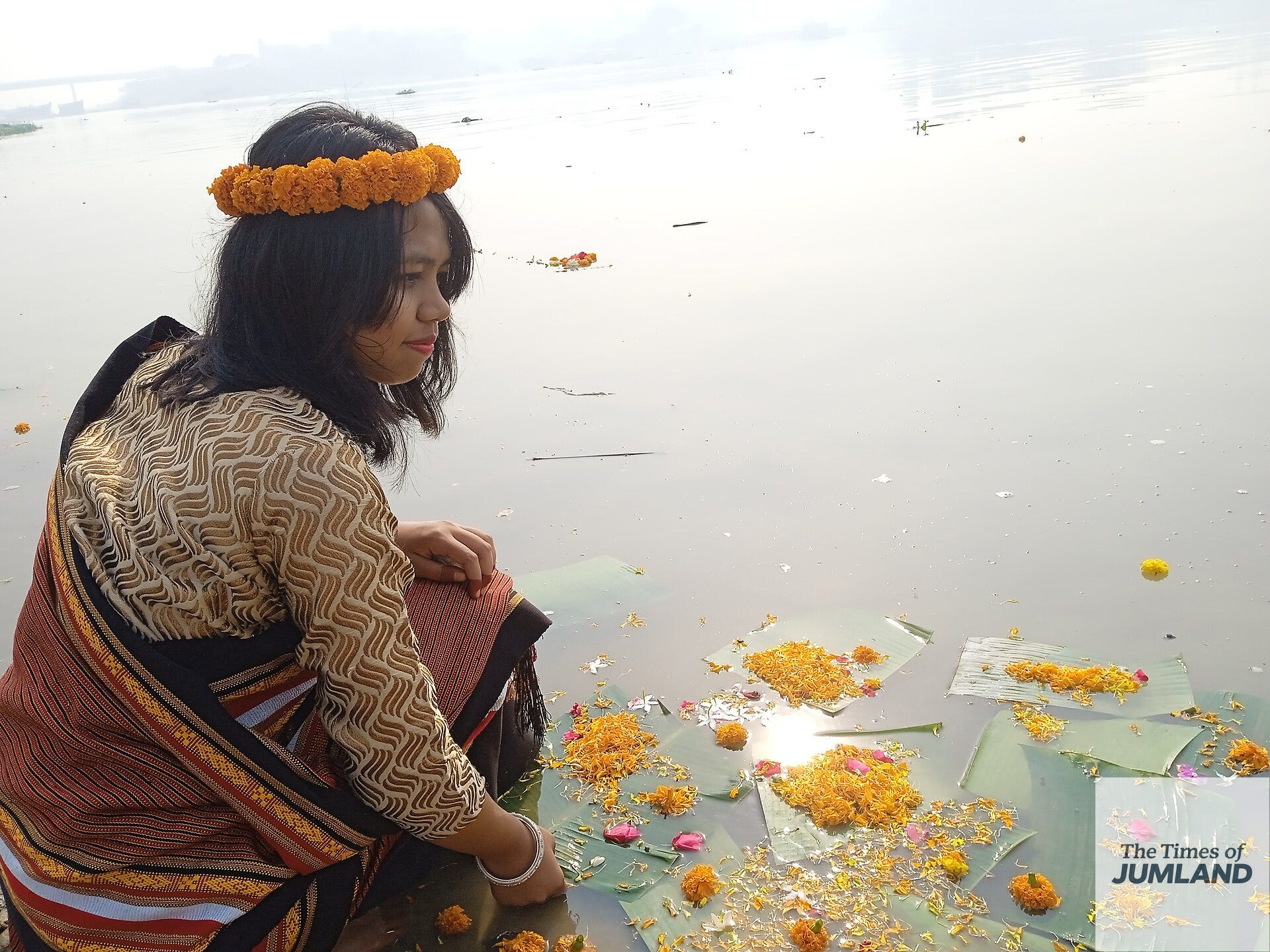
One particularly significant custom was documented in Khagrachhari on April 13, 2026. During Hari Boishuk, Tripura women dressed in traditional rinai and risai gathered beside a stream at Khagrapur. They offered flowers, floated small pieces of newly woven cloth on the water and lit lamps while praying for peace and happiness.
The ceremony was associated with worship of the goddess Ganga. Yet one detail made the occasion especially important for understanding Tripura cultural heritage: the pieces of handwoven cloth placed alongside the flowers.
Chameli Tripura, the convenor of the organizing committee, explained that the cloth was offered with the hope that women’s skills and craftsmanship in weaving rinai and risai would improve during the coming year.
This explanation deserves to be remembered. The cloth was not simply a colourful object added to a religious ceremony. It represented a skill that had been developed, practised and transmitted through generations of Tripura women.
The rinai is a traditional wraparound garment worn around the lower body, while the risai is a separate woven cloth used in different ways according to community custom. Their patterns, colours and styles form part of Tripura textile heritage, although these features vary across different Tripuri groups.
Traditional weaving required knowledge of thread preparation, loom operation, pattern arrangements and the careful coordination of colours. Skills were often passed from older women to younger family members through observation and practice.
The offering at the stream therefore connected religious devotion with women’s craftsmanship. The prayer for improvement in weaving was also a hope that an important form of cultural knowledge would continue into another year.
Not every Tripura community necessarily follows this particular custom or explains its meaning in the same way. But the documented observance demonstrates why recording local interpretations is essential. Without the explanation given by a practitioner, future generations might see only a photograph of flowers and cloth floating on water.
The place of rivers in Hari Boishuk also reflects the importance of water in older hill settlements. Streams supplied households, supported farming and helped sustain everyday life. Religious ceremonies associated with water developed within that broader relationship between people and their surroundings.
It would be too simple to describe these traditions as either entirely Indigenous nature worship or entirely derived from wider Hindu practice. Tripura religious life has developed through longstanding interactions between local deities, ancestral customs and broader religious traditions. The precise meaning of a ritual must be understood through the people who practise it.
Another part of Hari Boishuk involved preparing food for the days ahead. Cultural accounts describe families pounding glutinous rice, known in many communities as binni rice, into flour for traditional cakes.
Household members gathered banana leaves and locally known lairu leaves for preparing or wrapping food. The work required familiarity with the plants available nearby, their uses and the methods of preparation taught within the family.
Tripuri cultural writer Dharinjoy Tripura has recalled earlier village preparations in which groups of young people worked together to pound sticky rice using traditional mortars. He contrasts those collective activities with the growing use of mechanical rice mills and changing household practices.
The distinction is meaningful because the older preparation involved more than producing ingredients. Working together provided opportunities for conversation, cooperation and learning. Younger people acquired practical knowledge while participating in an event shared by the village.
A rice mill may complete the task more efficiently, but it cannot automatically replace the social experience of preparing festival food together. Cultural change often occurs in precisely this way: the final dish survives while the process through which people learned to make it changes.
Domestic animals also received special attention during the New Year season. Traditional descriptions record families bathing or cleaning cattle, decorating them with flowers and feeding poultry and other household animals.
For an agricultural household, cattle and poultry were not merely possessions. They were part of a system of work, food production and household security. Some accounts specifically associate the care of cattle with gratitude for the labour they contributed to farming.
Children could also participate by distributing grain to chickens, ducks and other birds. This practice gave younger people a direct role in the celebration and expressed concern for living creatures beyond the human household.
Such customs should not be romanticized as proof that every relationship between people and animals was gentle or equal. Their historical importance lies in the values they expressed: animals contributed to family wellbeing and were given special consideration during the New Year.
The agricultural setting helps explain these observances. For generations, Tripura communities depended on jhum cultivation and other forms of farming. Rainfall, soil conditions, seeds, household labour and livestock all influenced the prosperity of a family.
The New Year occurred during a seasonal transition, when people looked ahead to another cycle of agricultural work. Hopes for successful crops, good health and protection from misfortune were therefore closely connected with the circumstances of everyday life.
Boisuma, the second day, placed particular emphasis on food and hospitality. Families prepared special meals, visited relatives and welcomed neighbours. Cultural accounts describe rice cakes, mixed vegetable dishes, drinks and other foods being shared according to household resources and local traditions.
These foods were not simply refreshments for a celebration. They represented knowledge of rice varieties, vegetables, edible plants, cooking methods and family recipes. The ingredients and their traditional names provide clues to the environments in which earlier generations lived.
Some accounts mention pajon, a mixed vegetable preparation also familiar in the wider Chittagong Hill Tracts. The precise combinations and preparations differ between households and communities. It would be inaccurate to assume that every Indigenous New Year dish follows one standard recipe.
One especially meaningful aspect of Boisuma is the ideal of hospitality across differences in wealth. A cultural account preserved by Jumjournal describes an occasion when richer and poorer households visited one another and shared food without allowing social status to determine who could participate.
The description reflects an important social aspiration. Families were expected to welcome others and offer what they could afford. The value of hospitality rested on willingness to share rather than on providing an expensive feast.
This does not mean that poverty or social inequality disappeared during the festival. But the custom encouraged people to behave as members of a wider community, rather than keeping celebrations within their own economic circles.
In older village life, such relationships mattered throughout the year. Families depended on one another during agricultural work, marriage ceremonies, illness and other events. Visiting neighbours during Boishuk helped renew the connections that supported those responsibilities.
Some accounts also describe a customary prohibition against killing animals on Boisuma. This is a useful reminder that particular days could carry their own ethical and religious expectations. The practice should not be confused with animal offerings associated with certain forms of Garia worship in other communities or at other times.
Bisi Katal, the third day, welcomes the New Year through blessings, respect for elders and wishes for household prosperity. Younger people traditionally visited parents, grandparents and other respected members of the community to seek their blessings.
Accounts describe children and young adults touching the feet of elders as a gesture of respect. In some villages, young people also brought fresh water from rivers or wells to bathe elderly relatives and respected community members.
The custom expressed a relationship between generations. Younger people acknowledged the guidance and care they had received, while elders offered blessings and hopes for the future.
Water appeared again, but in a different setting. On Hari Boishuk, it had been associated with flowers, offerings and cleansing. On Bisi Katal, it could become part of an act of care and respect for an older person.
Traditional accounts also describe younger people offering food to domestic animals and visiting neighbouring households. Some families arranged special meals for poorer villagers, including widows and others who might otherwise have had fewer opportunities to celebrate.
One belief recorded in cultural descriptions warned against allowing a visitor to leave the household without being offered food. Whether understood as a religious concern or a social expectation, it emphasized that prosperity should be accompanied by generosity.
Taken together, the three days reveal a coherent pattern. People prepared their homes and surroundings, renewed relationships through hospitality and entered the New Year seeking blessings from elders and spiritual powers.
But Boishuk also has an important cultural tradition that does not fit neatly into a description of only three days. That tradition is Garia dance, commonly called Garaiya in the Chittagong Hill Tracts.
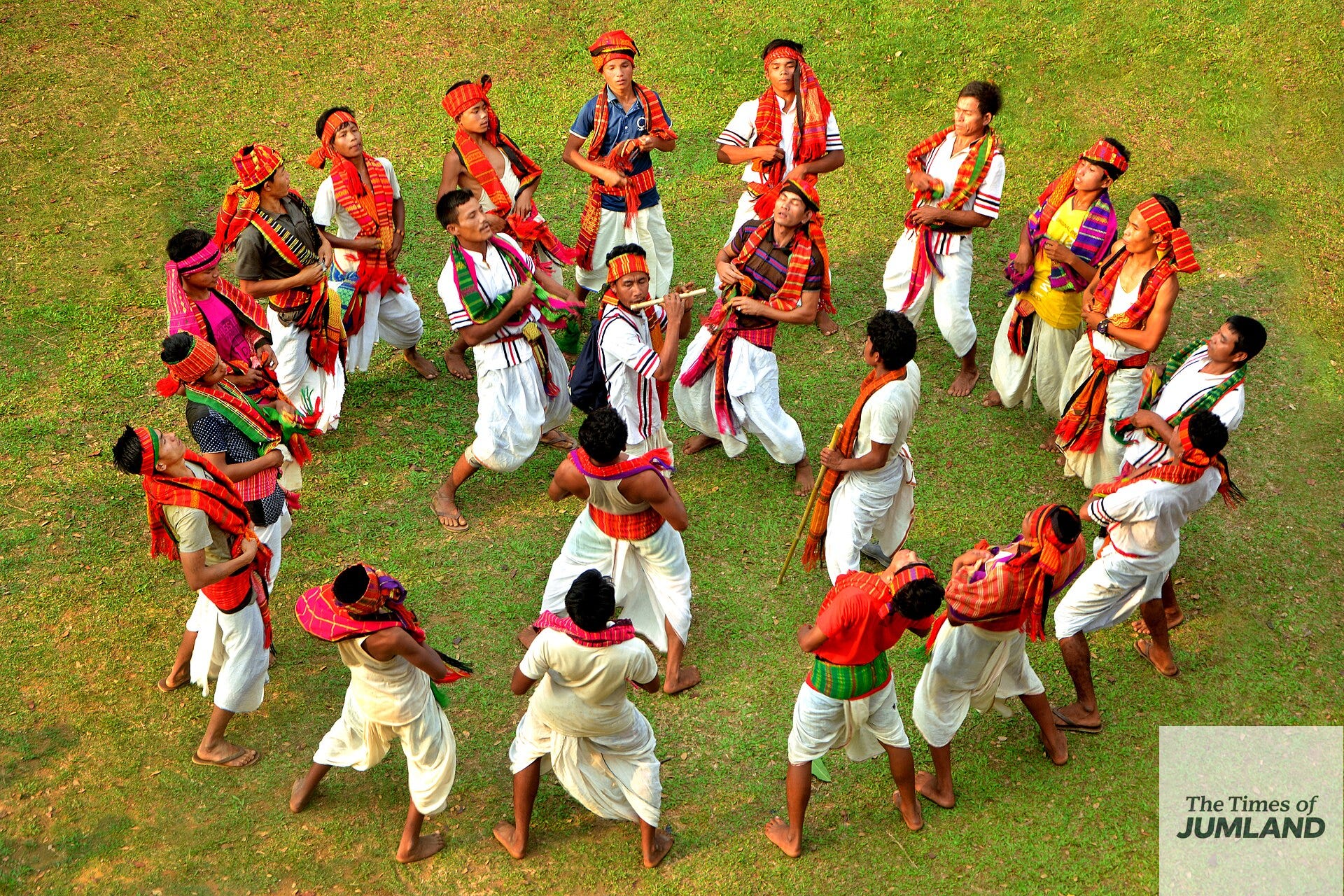
During the festival season, groups of performers traditionally travelled between Tripura villages, playing drums and flutes while performing dances in household courtyards. The musicians and dancers could be heard approaching before they arrived at a family’s home.
The courtyard was an important part of the performance. Instead of waiting for an audience to gather in a formal hall, dancers moved through the community, bringing music and ritual observances directly to households.
A 2024 account from Khagrachhari describes groups stopping at houses with spacious courtyards, forming circles and performing traditional movements. After the performance, household members offered rice, money, fruits, drinks or other gifts.

The dance is associated with Garia, a significant deity in Tripuri religious traditions. Worshippers seek blessings connected with agricultural prosperity, health, family wellbeing and protection from misfortune.
The religious connection is central to understanding the performance. Garia dance was not originally just a cultural programme arranged for entertainment. It formed part of a relationship between the community, its religious beliefs and the hopes associated with a new agricultural year.
One of its most remarkable features is the sequence of 22 rhythms and movements described by performers in Khagrachhari. These movements are traditionally understood as representing experiences and activities from the beginning of human life to death.
During an interview published in April 2024, ritual practitioner Ananda Mohon Tripura from Dighinala explained how a Garia dance group could depict scenes requested by the household. These included affection between young men and women, separation, disagreements between husbands and wives and other experiences of everyday life.
This detail gives Garia dance a meaning rarely conveyed by a photograph. The performance could tell stories about human relationships through rhythm and movement, bringing familiar experiences into a ceremonial setting.
The dance therefore connects two forms of knowledge. Its religious purpose involves seeking blessings, while its movements preserve a way of representing social life through performance.
The number and meaning of the movements should not be treated as identical across all Tripuri communities. The 22-movement tradition is documented among performers in Khagrachhari, while related Garia observances elsewhere have their own forms and repertoires.
The organization of the performance also involved established roles. Participants have been described as Kheyebai, with an Ochai, or ritual specialist, and a Dewai, or group leader, helping direct the proceedings.
The performance traditionally followed certain obligations. In accounts from Khagrachhari, a dancer who joined the ritual sequence was expected to participate over successive occasions. The final gatherings included worship of Garia and prayers for wellbeing.
Young people also found opportunities for social interaction through the dance. Community accounts describe an earlier practice in which young men demonstrated their dancing abilities before young women, and the performances could become occasions for expressing interest in possible relationships.
Contemporary performances have changed. Women now participate in some groups where the dance was previously performed mainly by men. Cultural organizations also present Garia dance on public stages and during New Year processions.
These changes demonstrate that traditions are not fixed forever. A performance can acquire new participants and audiences while retaining connections with its earlier religious and cultural meanings.
Yet a distinction must be made between the Tripura Boishuk festival and Garia Puja.
Boishuk is the traditional New Year observance commonly described through Hari Boishuk, Boisuma and Bisi Katal. Garia Puja is a related religious tradition with its own ceremonial arrangements and calendar, which may extend over a longer period.
Official cultural documentation from India’s South Tripura district describes Garia Puja as a seven-day celebration associated with the agricultural cycle. The community prays for a successful harvest and honours the deity through music and dance.
Other ethnographic accounts describe variations among Tripuri groups, including differences in sacred objects, ritual specialists, offerings and the timing of ceremonies. Traditions among Jamatia communities in India, for example, should not automatically be presented as identical to those observed in Khagrachhari.
The relationship between Boishuk and Garia worship is nevertheless historically significant. Both are connected with seasonal renewal, agricultural hopes and the wellbeing of the community. In some places, their observances overlap closely.
The connection reminds us that a New Year festival can preserve religious traditions that are older or more complex than the public celebrations now associated with it.
The same care is needed when considering religious identity. Tripura communities have experienced longstanding interactions between Indigenous religious practices and wider Hindu traditions. Some families also follow Christianity or other religious beliefs.
As a result, not everyone understands or observes the festival in exactly the same way. Cultural participation and religious worship are related but distinct choices, and the history of Boishuk should leave room for that diversity.
Traditional clothing provides another connection between cultural identity and the festival. The rinai and risai worn by Tripura women are among the most recognizable expressions of their textile heritage.
But the significance of these garments does not end with their appearance. They represent knowledge of weaving techniques, colour combinations, traditional patterns and the methods through which younger people learned from experienced weavers.
The offering of handwoven cloth during Hari Boishuk takes on additional meaning when placed within this history. It connects the festival’s religious observances with an everyday craft that has helped preserve Tripura cultural identity.
Other traditions face similar questions of continuity. A young person may recognize Garia dance without understanding its ceremonial roles. Someone may eat a traditional rice cake without knowing the names of the leaves once used to prepare it.
A photograph of a river offering may preserve the appearance of a ceremony while leaving its purpose unexplained. Without Chameli Tripura’s account, for example, future viewers might never know that the pieces of cloth offered at Khagrapur in 2026 were associated with hopes for greater weaving skill.
This is why the explanations of practitioners are as important as photographs of festivals. Objects and performances become historical evidence when their names, purposes and local meanings are recorded.
The collective term Boisabi has also increased the public visibility of Indigenous New Year celebrations in the Chittagong Hill Tracts. It combines names associated with the festivals of several communities, especially Tripura Boishuk, Marma Sangrai and Chakma Biju.
Joint celebrations can strengthen relationships between neighbouring Indigenous peoples, but the festivals should not be treated as culturally identical. Each has its own history, religious practices, food traditions and forms of community participation.
Boishuk’s Garia dance, for instance, cannot simply be substituted for the distinctive practices of Chakma Biju or Marma Sangrai. Recognizing these differences preserves cultural knowledge while allowing communities to celebrate together.
Public processions and organized cultural programmes have become important parts of contemporary Boishuk. They allow younger generations to display traditional clothing, music and dance before larger audiences.
They also introduce Tripura culture to people who may know little about its history. Such visibility has value, particularly for communities seeking to maintain their identity amid changing social circumstances.
But a public procession cannot preserve everything that an older village celebration contained. It may show a dance without explaining its ritual obligations, or display traditional cloth without revealing the skills involved in weaving it.
The change is not necessarily a decline. Cultures adapt because the lives of their members change. Agricultural households become urban households, traditional tools are replaced and young people pursue education and occupations that take them away from their ancestral villages.
The important question is whether cultural knowledge continues to be transmitted alongside those changes.
A serious archive of the Tripura Boishuk festival should therefore preserve the names and meanings of its three days, descriptions of river offerings, traditional food preparation, the treatment of domestic animals and the customs of hospitality and respect for elders.
It should also document Garia dance in much greater detail: the names of movements, the meanings attributed to them, the musical instruments, the responsibilities of performers and the differences between villages.
Traditional weaving deserves the same attention. Photographs of rinai and risai should be accompanied by explanations of their construction, patterns, terminology and the experiences of women who learned to produce them.
These records would not require every family to follow the same religious practices or preserve every custom unchanged. They would allow future generations to understand how their ancestors lived and why particular traditions mattered.
Tripura history has been carried not only by rulers and religious figures but also by farmers, weavers, cooks, musicians and elders whose knowledge was passed through everyday work. Their contributions belong in cultural history even when they do not appear in formal historical documents.
The Tripura Boishuk festival is therefore more than an annual celebration of flowers, food, traditional clothing and dancing. Its practices offer evidence of how a community understood relationships between people, water, animals, agriculture, religion and generations.
The rivers received offerings, domestic animals received special care, neighbours shared food and elders gave blessings. Through Garia dance, the experiences of human life became part of a performance connecting households with the hopes of a new agricultural year.
These customs did not eliminate the hardships, inequalities or disagreements of ordinary life. But they expressed values that people wanted to renew as one year ended and another began.
The future of Boishuk does not depend on reproducing every historical practice exactly as it was. It depends on whether the community continues to understand the traditions it chooses to preserve, adapt or leave behind.
A hundred years from now, a young Tripura researcher may find a photograph of women offering flowers and woven cloth beside a stream. Another image may show Garia dancers moving through a village courtyard.
The photographs will reveal the colours, clothing and movements, but not necessarily the prayers, skills, stories and relationships that gave those moments meaning.
The responsibility of today’s generation is not simply to celebrate Boishuk every April. It is to preserve the knowledge behind the celebration, so that future Tripura generations will inherit more than beautiful photographs of a history they can no longer explain.
Sources and Further Reading:
ত্রিপুরা জাতির আদ্যোপান্ত — Jumjournal. A detailed account of Tripura social life, religious traditions, the three days of Boishuk, Garia dance and customs associated with elders, food and household relationships.
https://www.jumjournal.com/ত্রিপুরা-জাতির-আদ্যোপান্তনদীতে ভাসানো হলো ফুল আর হাতে বোনা নতুন কাপড়, প্রদীপ জ্বেলে প্রার্থনা — Prothom Alo, April 13, 2026. Documentation of Hari Boishuk observances at Khagrapur and the explanation of handwoven cloth offerings by Chameli Tripura.
https://www.prothomalo.com/bangladesh/district/x7qxt66096Jayanti Dewan, পাড়ায় পাড়ায় গরাইয়া নাচে বৈসু উৎসবের আগমনী — Prothom Alo, April 11, 2024. Interviews concerning Garia dance, its 22 movements, traditional performers and village customs.
https://www.prothomalo.com/bangladesh/district/up5yvcy4xnDharinjoy Tripura, Tripura Tribe and Buisu Festival — Heritage Explorer. A cultural account discussing traditional food preparation, household observances, weaving, ceremonial practices and the Tripura New Year.
https://www.heritageexplorer.in/kola_details/16ত্রিপুরাদের উৎসব বৈসু যেভাবে উদ্যাপিত হয় — Prothom Alo, April 9, 2026. Documentation of contemporary Boishuk celebrations and the three principal observances.
https://www.prothomalo.com/bangladesh/district/mxw2ad0ny0Culture — South Tripura District Administration, Government of Tripura, India. Information about the agricultural background of Garia Puja and its traditional dance.
https://southtripura.nic.in/culture/Textiles of Tripura — Indira Gandhi National Centre for the Arts, India. Cultural documentation concerning traditional textiles and weaving heritage.
https://ignca.gov.in/divisionss/janapada-sampada/northeastern-regional-centre/textiles-of-tripura/Sanjoy Kumar Barua, Hill People Ready to Welcome Boisabi — The Daily Star, April 13, 2017. Comparative reporting on the traditional New Year observances of Indigenous communities in the Chittagong Hill Tracts.
https://www.thedailystar.net/backpage/hill-people-ready-welcome-boisabi-1390561