
Tokyo Desk | The Times of Jumland
The United People’s Democratic Front (UPDF)-aligned Pahari Chhatra Parishad (PCP) has drawn criticism over its decision to stop officially observing the death anniversary of Manabendra Narayan (M N) Larma, the founder of the Parbatya Chattagram Jana Samhati Samiti (PCJSS) and a pioneering leader of the Indigenous Jumma rights movement in Bangladesh’s Chittagong Hill Tracts.
The criticism is not limited to rival political organizations. Ordinary Indigenous Jumma people have also questioned the decision, arguing that M N Larma’s political contributions and sacrifices belong to the entire Jumma community, not any particular political party.
Some critics have even compared the UPDF-aligned student organization’s decision to the political positions of groups defending the interests of Bengali settlers who were brought into the Chittagong Hill Tracts under government-sponsored settlement programmes during the late 1970s and 1980s.
The comparison reflects anger over the resolution rather than evidence of any organizational relationship between the PCP and pro-settler groups.
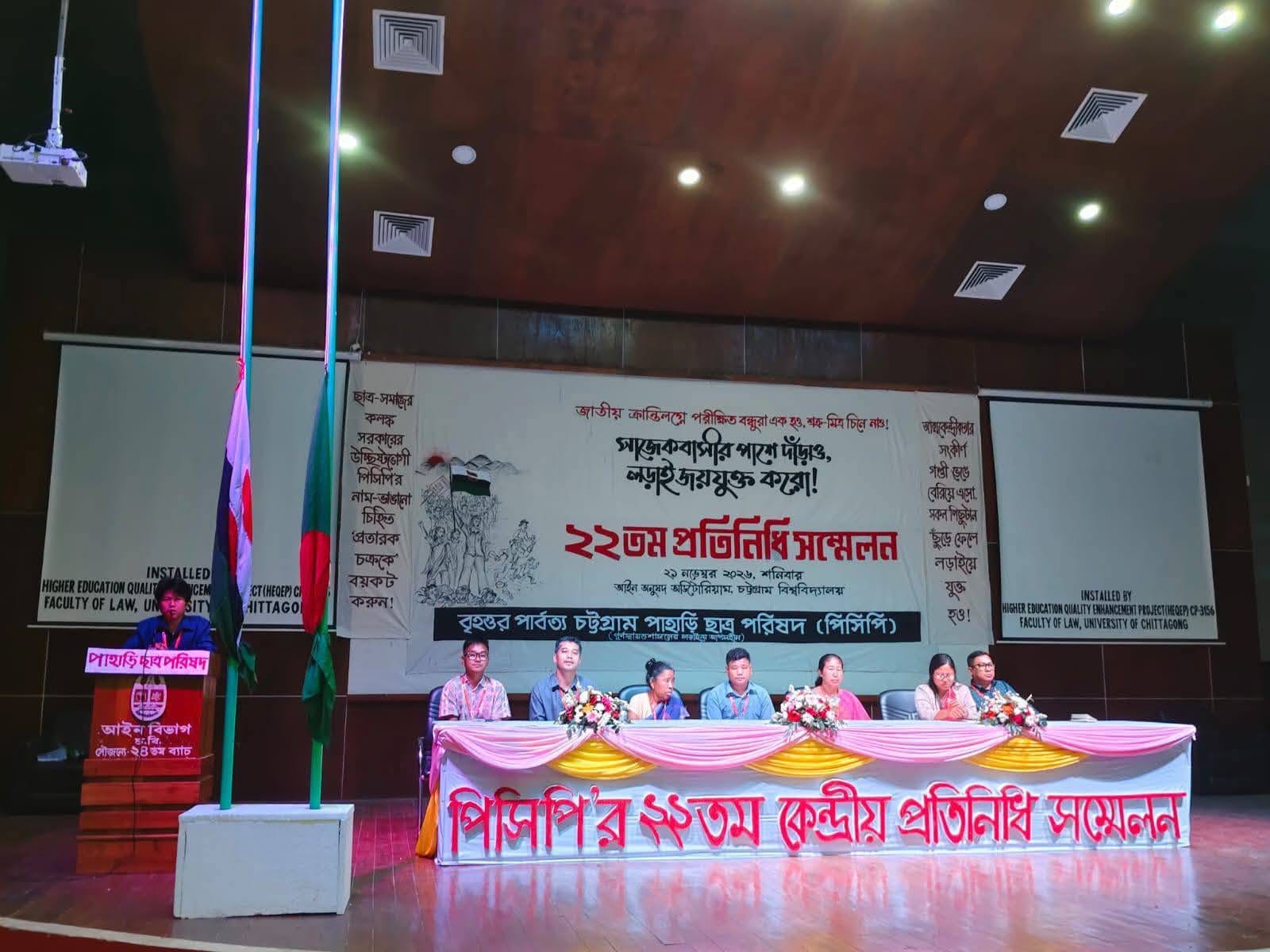
The controversial decision was adopted at the PCP’s 22nd Central Representatives’ Conference, held on Saturday, November 21, 2026, at the Faculty of Law auditorium of Chittagong University.
The organization resolved to stop officially observing November 10, M N Larma’s death anniversary, until the political situation in the Chittagong Hill Tracts changes.
In its resolution, the PCP accused certain individuals and groups of exploiting Larma’s memory for personal and political benefits instead of honoring his struggle and sacrifice.
The organization alleged that some people use annual commemorative events to strengthen their connections with the Chittagong Hill Tracts Regional Council, obtain influential positions and gain access to development projects, employment opportunities and financial benefits.
The resolution also criticized the political leadership of Santu Larma, the PCJSS president and younger brother of M N Larma.
However, the PCP stated that it continues to respect M N Larma’s contributions to the Jumma rights movement. Its decision concerns the organization’s official observance of his death anniversary rather than a rejection of his historical role.
For many Indigenous Jumma people, however, the decision raises a deeper question: should political disagreements with Santu Larma and the present PCJSS leadership determine how M N Larma is remembered?
M N Larma was not simply the founder of a political organization. He was among the first Indigenous leaders to challenge the exclusion of non-Bengali communities from Bangladesh’s national identity.
As a member of Bangladesh’s first parliament, he advocated recognition of the distinct identity, culture and political rights of Indigenous peoples.
He later became a central figure in the movement for regional autonomy and the protection of ancestral lands in the Chittagong Hill Tracts.
Larma was killed on November 10, 1983, during an internal conflict within the Jumma political movement. His death anniversary has since become an important occasion for remembering the sacrifices and unfinished political demands of the Jumma people.
For many Indigenous people, November 10 is therefore more than an event organized by the PCJSS. It represents a shared history of political struggle, suffering and sacrifice.
This historical significance helps explain why the PCP’s latest decision has provoked criticism.
Critics distinguish between opposing the alleged misuse of Larma’s name for personal advantage and deciding not to observe an anniversary that carries meaning for the wider Jumma population.
The dispute has also brought renewed attention to the history of Bengali settlement in the Chittagong Hill Tracts.
During the late 1970s and 1980s, the Bangladesh government facilitated the settlement of large numbers of Bengali Muslims from the plains in the region.
The settlement programmes contributed to demographic changes, land disputes, displacement and serious tensions between Indigenous communities and settlers.
Many Indigenous families lost access to ancestral land, while unresolved ownership disputes continue to affect communities across the three hill districts.
Against this historical background, the comparison with pro-settler organizations has become a particularly serious accusation.
However, the PCP’s own political demands oppose further unauthorized settlement and call for action against alleged land grabbing and human rights abuses in the Chittagong Hill Tracts.
The organization’s decision therefore highlights a growing disagreement over political leadership and the legacy of M N Larma rather than establishing that it supports the interests of Bengali settlers.
The conference adopted six resolutions, ten political demands and changes to the organization’s constitution, principles and official symbols.
Among the major demands were the withdrawal of Operation Uttoron, cancellation of the Home Ministry’s 11 directives concerning the Chittagong Hill Tracts and abolition of three recently formed government committees on regional affairs.
The organization also demanded an end to further unauthorized settlement and called for investigations into alleged killings, disappearances, sexual violence and land grabbing.
Another demand concerned the Indigenous Bawm community in Bandarban. The PCP called for a judicial investigation into reported killings, the release of detained Bawm people and the return of refugees sheltering in India’s Mizoram state.
It also called for improved mother-tongue education, a separate education board for the Chittagong Hill Tracts and an end to tourism projects that displace Indigenous residents.
The conference urged the BNP-led government to begin formal political dialogue with the UPDF over its demand for full autonomy.
The meeting was inaugurated by Amita Chakma, the mother of the late Miton Chakma, a former PCP Chittagong University leader and UPDF organizer.
PCP president Samar Chakma chaired the opening session, while general secretary Sohel Chakma conducted the proceedings. More than 200 delegates and observers attended.
The organization also announced a rally in Dhaka on December 10 to mark International Human Rights Day, further rallies in Chittagong, Khagrachhari and Rangamati on February 21, 2027, and expanded political activities in educational institutions.
Yet the decision concerning M N Larma has become one of the most controversial outcomes of the conference.
The dispute reflects longstanding political divisions between the UPDF and PCJSS over the 1997 Chittagong Hill Tracts Peace Accord and the future direction of the Jumma rights movement.
The PCJSS signed the agreement with the Bangladesh government, while the UPDF emerged in opposition to it and continues to demand full autonomy.
These political differences have shaped competing strategies and organizations within the Jumma movement for nearly three decades.
However, M N Larma’s historical contribution extends beyond those divisions. Different generations of Indigenous people continue to recognize his role in building political awareness and demanding recognition of Jumma identity.
The latest controversy therefore raises a question that goes beyond the rivalry between the UPDF and PCJSS: whether disagreements between today’s political leaders should determine how future generations remember a man who devoted his life to the rights of the Jumma people.
For many Indigenous Jumma people, remembering M N Larma is not an expression of loyalty to Santu Larma or any particular political organization. It is an acknowledgment of a collective history and a struggle for rights that remains unfinished.
The controversy surrounding the PCP’s resolution shows how deeply that history continues to influence political identity, leadership and the future of the Jumma movement.
Note: See the whole Bengali resolution here.