

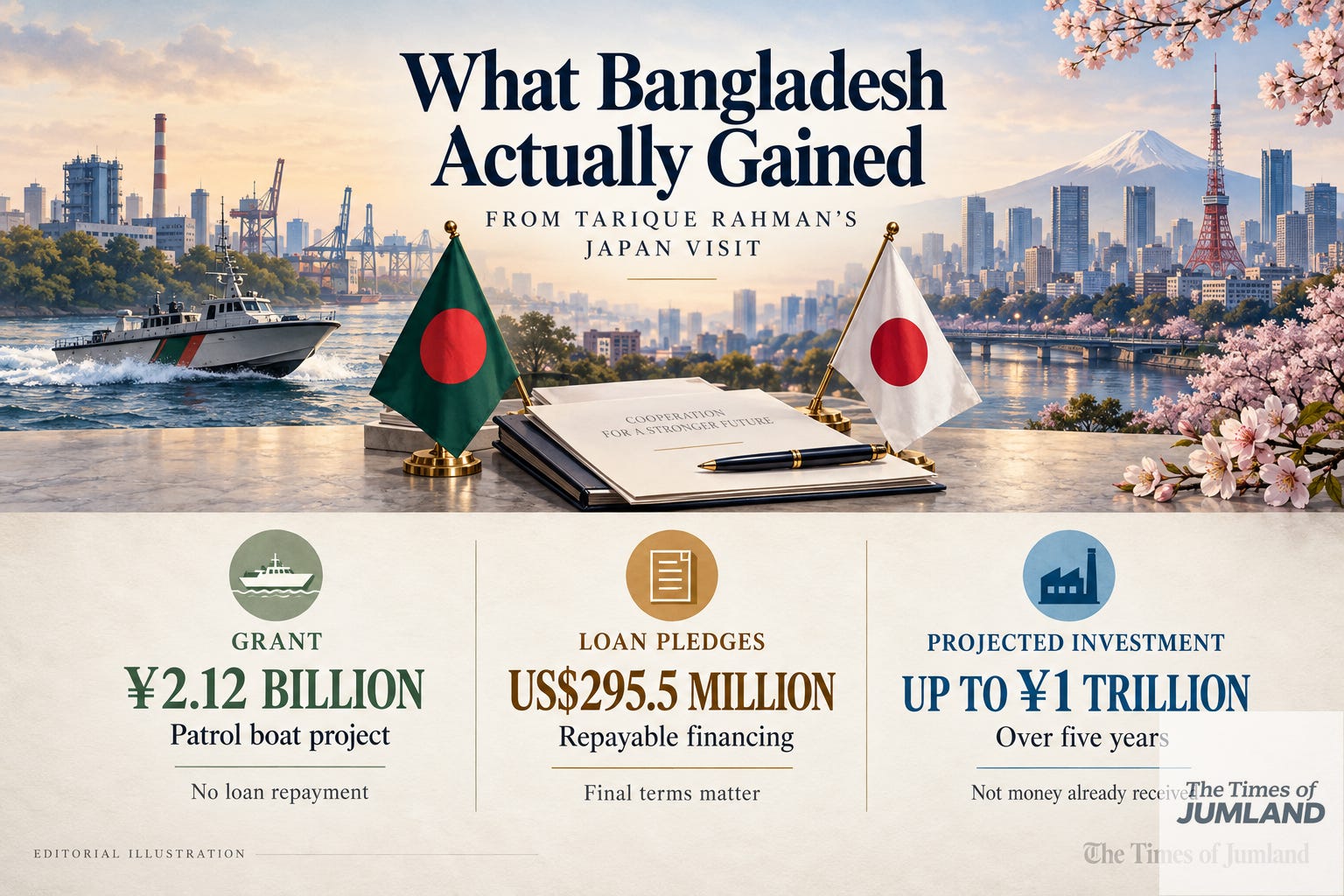
What Bangladesh gained from Tarique Rahman’s Japan visit falls into three categories: a signed maritime-security grant, pledges for two development loans and potential Japanese private investment. The largest financial figure announced during the 26–29 October visit represents projected investment over five years, not money already received.
Understanding the outcome requires separating three categories. Grant assistance does not carry a loan’s repayment obligation. Government borrowing must be repaid under agreed terms. Private investment finances commercial projects and businesses.
These distinctions determine what Bangladesh has gained, what it will owe and which benefits remain dependent on future decisions. Counting signatures alone cannot answer those questions.
The clearest specific grant concerns maritime security. Japan International Cooperation Agency’s announcement confirms that JICA and Bangladesh signed an agreement in Tokyo on 26 October for assistance of up to ¥2.12 billion.
The project covers one patrol boat for the Bangladesh Coast Guard and consulting services. It is intended to strengthen maritime-security operations and responses to maritime incidents and natural disasters.
Bangladesh does not repay this assistance as a loan. However, it is funding for a specified project, not unrestricted money the government can spend elsewhere.
The agreement also does not mean the boat has arrived. JICA gives a planned implementation period of 31 months, including detailed design and procurement. The immediate outcome is a signed agreement; the operational benefit follows when the project is delivered.
The development-loan pledges are substantially larger. According to BSS’s account of the announced outcomes, Japan pledged ¥15.88 billion for improving Bangladesh’s investment environment and ¥30.68 billion for the second phase of the Upazila Governance and Development Project.
Together, these pledges amount to ¥46.56 billion, approximately US$295.5 million at the conversion used in the announcement. Their stated purposes are to improve conditions for investment and strengthen governance and development at the upazila level.
These are borrowing commitments, not gifts. Bangladesh would repay the principal—the amount borrowed—along with interest and any applicable charges under the final agreements. Interest is the cost of using borrowed money.
The announcements reviewed do not establish the project-specific interest rates, grace periods or repayment schedules for these two pledges. Their total repayment cost therefore cannot be calculated from those announcements. Nor does a pledge establish that the full amount has been disbursed.
A separate ¥50 billion emergency-support loan illustrates why dates and terms must be checked individually. JICA’s record says that agreement was signed on 9 June 2026, months before the October visit.
The June programme supports economic resilience and stable energy supply. JICA lists an annual interest rate of 3.05%, a 30-year repayment period and a 10-year grace period.
Those are the published terms of that particular programme. They should not be assigned to the two October loan pledges. The June agreement is also part of earlier cooperation, rather than a newly signed October outcome.
The largest headline figure belongs to another category. Japan’s foreign ministry’s summit account says Japanese private investment in Bangladesh is projected to reach up to ¥1 trillion over the next five years, with an expected 200,000 jobs.
This is a substantial opportunity. It does not mean that ¥1 trillion has already entered Bangladesh, that the government has received that amount or that every proposed project has reached a final investment decision.
Private companies invest with an expectation of commercial returns. Bangladesh’s benefits would depend on the projects delivered, employment created, skills developed and wider economic activity generated.
The employment figure needs an equally direct explanation. It concerns jobs expected from investment in Bangladesh. It is not a promise that Japan will recruit 200,000 Bangladeshi workers.
Cooperation on skills and employment is a separate subject. The government’s briefing described an Employment for Skill Development Programme instrument, but the reported announcement does not establish an open recruitment process, a guaranteed worker quota or application conditions.
Prospective workers need information about eligible occupations, language standards, qualifications, recruitment channels and costs before treating that cooperation as an opportunity to apply for a job.
State Minister for Foreign Affairs Humaiun Kobir also reported 17 private-sector memorandums of understanding. Such documents can help business cooperation advance, but their number does not establish how much investment has been committed.
Seventeen MoUs do not necessarily mean 17 different companies. One organisation may participate in several agreements. Without their contents, the documents also cannot automatically be treated as completed investment contracts.
JETRO’s official forum programme includes an MoU presentation session, but does not identify the parties behind all 17. The sources reviewed did not provide a complete breakdown of signatories, projects and investment amounts.
The MoUs should therefore not be added to the ¥1 trillion forecast as a separate financial gain without evidence explaining their relationship. Otherwise, the same prospective activity could be counted twice.
The visit also advanced the broader economic relationship. The leaders agreed to develop cooperation under the Bay of Bengal Industrial Growth Belt initiative and work towards early entry into force of their Economic Partnership Agreement. These frameworks can support future gains, but their practical value depends on implementation.
Some documentary questions remain. Japan’s summit announcement links to an environmental memorandum that its environment ministry says was signed on 6 February 2026 by Doi Kentaro, Japan’s Vice-Minister for Global Environmental Affairs, and Md. Daud Ali, Bangladesh’s Ambassador to Japan.
A related climate-cooperation letter of intent was signed on 14 October, twelve days before Rahman arrived. Bangladesh’s account includes a climate-cooperation letter among six instruments, but the sources reviewed do not establish whether this refers to that earlier letter or a separate document.
The Japanese linked list and Bangladesh’s reported six-instrument list differ. These dates alone do not prove that the entire count is wrong. A complete list of document titles, signatories and signing dates would distinguish new agreements from earlier cooperation endorsed or advanced during the visit.
The immediate financial picture is nevertheless clear: a signed grant agreement worth up to ¥2.12 billion for a Coast Guard patrol boat, and pledges for two development loans totalling approximately US$295.5 million. The grant does not require loan repayment. The loans would have to be repaid under their final terms.
The much larger ¥1 trillion figure is projected Japanese private investment over five years, with an expected 200,000 jobs in Bangladesh. It is neither money already received nor a promise to take 200,000 Bangladeshi workers to Japan.
The visit produced concrete assistance and valuable opportunities. Its biggest economic benefits remain ahead. Bangladesh should judge success by investment delivered, jobs created, projects completed and repayment costs—not simply by the number of documents announced.