

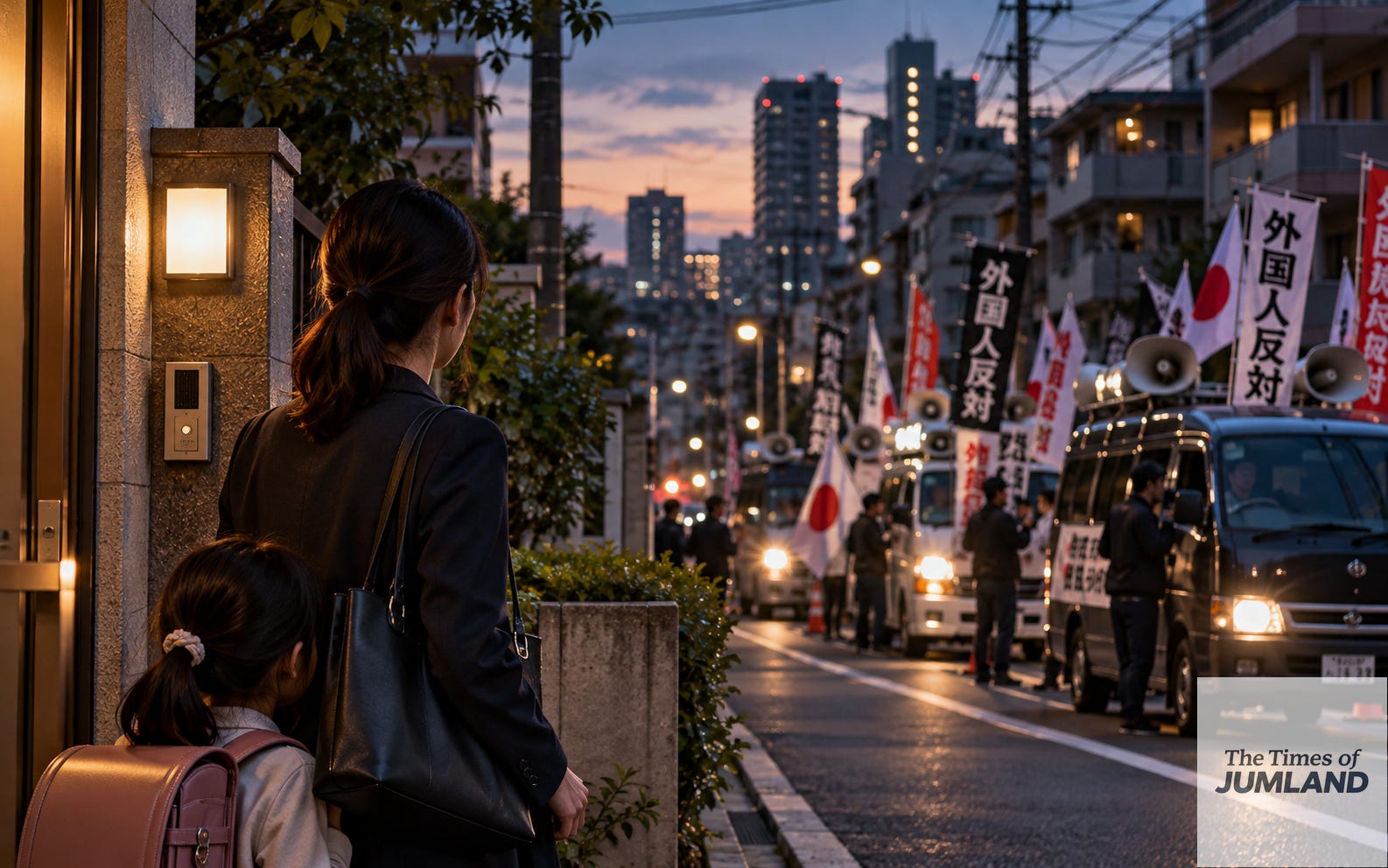
Japan’s immigration debate has reached an uncomfortable point. A local politician who faced criticism over her own public statements is now asking a court to protect her from demonstrations near her office and family home. The dispute raises a larger question about political freedom, public safety and personal intimidation.
On October 16, 2026, Sayuri Okamoto, a 37-year-old independent member of Kawaguchi City Council in Saitama Prefecture, announced that she had applied to the Saitama District Court for a provisional injunction against 10 political organisations.
According to the Asahi Shimbun, approximately 20 campaign vehicles reportedly gathered near her office during September. Demonstrators allegedly used loudspeakers to accuse her of defending foreigners, called her a traitor and demanded her resignation.
Okamoto says the demonstrations disrupted her work, frightened her child and disturbed nearby residents. Her office is close to her home and her child’s school, making the dispute particularly sensitive.
She is seeking restrictions on loudspeaker demonstrations and related activities within 500 metres of her office. A court decision was expected as early as October 19. As of October 18, no ruling had been confirmed, and the allegations had not been judicially established.
The controversy matters because Kawaguchi, immediately north of Tokyo, has become one of Japan’s most closely watched cities in debates over immigration, public safety and the integration of foreign communities.
According to municipal statistics, Kawaguchi had 56,524 foreign residents on July 1, 2026, representing 9.26 percent of its population of 610,232. Chinese nationals formed the largest foreign community, followed by Vietnamese, Nepalese, Filipino and other residents.
The city is also home to people from Turkey, including ethnic Kurds who have lived in southern Saitama for decades. Many work in construction, demolition, restaurants and other businesses. Yet their community has increasingly attracted political attention over immigration enforcement and public behaviour.
Local complaints have included dangerous driving, excessive noise, waste disposal and suspected violations of immigration regulations. These are legitimate matters for investigation. Japanese residents have every right to expect safe neighbourhoods, while foreigners living in Japan must obey Japanese laws and respect local regulations.
However, responsibility for wrongdoing belongs to the individuals involved, not everyone who shares their nationality or ethnic background. Enforcing immigration laws and protecting people against discrimination should not be treated as competing responsibilities.
Okamoto’s own political record adds another dimension to the controversy. Elected to the city council in February 2026, she has publicly opposed discrimination directed at foreign residents. Her position has attracted supporters, but her statements have also generated serious criticism.


Earlier this year, she faced controversy over comments concerning a fatal traffic accident involving a Turkish national and a 19-year-old Japanese victim. Following a court ruling in September, she acknowledged that her understanding of certain facts had been mistaken and apologised for spreading misleading information.
That mistake deserves scrutiny. An elected representative discussing a fatal accident must respect the facts, particularly when a grieving family is involved. Defending foreign communities against discrimination cannot justify inaccurate statements or diminish the suffering of crime victims.
Okamoto’s critics therefore have legitimate grounds to question her judgment, challenge her political positions and demand accountability. They also have the right to organise lawful demonstrations. Freedom of expression must protect criticism of elected officials, even when that criticism is uncomfortable.
But criticism and intimidation are not necessarily the same thing. Repeated amplified demonstrations near a politician’s home or child’s school raise concerns that extend beyond ordinary political disagreement, particularly when family members and neighbours are affected.
The court must determine whether the alleged activities justify restrictions and whether the requested 500-metre boundary would be proportionate. Demonstrators have rights, but so do the councillor’s family and nearby residents. Neither side’s claims should automatically determine the outcome.
Behind this confrontation lies a broader challenge for Japan. The country is ageing, its workforce is shrinking, and businesses increasingly depend on foreign labour. According to the Ministry of Health, Labour and Welfare, approximately 2.57 million foreign nationals were employed in Japan at the end of October 2025, a record number.
Yet the economic need for foreign workers does not automatically produce public acceptance of immigration. Some residents worry that social changes are happening faster than the government can manage, especially when complaints about public order go unresolved.
Another concern is less openly discussed. Some people in Japan fear that their country could eventually experience social tensions similar to those seen in parts of Western Europe, including France. Religion, particularly Islam, has also entered this debate. Disputes over mosques and Muslim burial facilities reveal concerns about religious accommodation and future cultural change. These concerns can be discussed openly without assuming that a growing Muslim community will inevitably threaten Japan’s peace or social stability.
Japan’s immigration debate must therefore address more than labour shortages. It must also examine integration, public safety, cultural expectations and the responsibilities of foreign residents. Avoiding difficult questions will not resolve them, but neither will treating an entire religious community as a potential source of disorder.
Kawaguchi illustrates the importance of practical solutions. Authorities must enforce regulations consistently, investigate complaints fairly and provide residents with effective ways to resolve disputes. Foreign communities also need clear information about Japanese laws, customs and everyday responsibilities.
In July 2026, Kawaguchi established a consultation service involving municipal staff and an immigration official to address concerns involving foreign residents. Such measures offer a practical alternative to allowing local disagreements to develop into wider confrontations over nationality.
Political leaders also have responsibilities. Those defending foreign communities should acknowledge genuine concerns about public safety. Those demanding stricter immigration controls should recognise that many foreign residents work, pay taxes, raise families and contribute to Japanese society while respecting its laws.
Japan’s challenge is not simply deciding how many foreigners to accept. It is creating an immigration system that maintains public confidence, enforces common rules and allows people from different backgrounds to live together without unnecessary confrontation.
Okamoto’s court application will not resolve Kawaguchi’s immigration tensions or determine Japan’s future immigration policy. Whatever the court decides, disagreements about law enforcement, cultural integration and public safety will remain.
But the case raises a principle that should not be overlooked. Politicians must answer for their statements and decisions, while their families and neighbours should not have to bear unreasonable pressure arising from political disputes.
Japan has every right to protect its social stability, enforce its immigration laws and expect foreign residents to respect its customs. But those expectations must apply within a system that protects lawful expression, personal safety and equal treatment.
If Japan demands respect for its laws from foreigners, it must demand the same from politicians, protesters and everyone else. The country’s future will depend not only on how many foreigners it accepts, but also on how successfully it preserves public trust while managing the changes immigration brings.
Sources and Further Reading:
Asahi Shimbun, October 17, 2026 — Reporting on Sayuri Okamoto’s application for a provisional injunction.
Kawaguchi City Government — Foreign resident statistics and municipal policy.
Kawaguchi City Council — Official profile of Sayuri Okamoto.
Nippon.com — Background on hostility directed at Kurdish residents in Japan.
Ministry of Health, Labour and Welfare — Foreign employment statistics.
East Asia Forum, July 17, 2026 — Disputes surrounding Muslim communities and mosques in Japan.
Kawaguchi City Government — Consultation Service — Municipal consultation initiative.
Sayuri Okamoto on X — Public statements and correction.