

The word Jumma is unfamiliar to many people outside Bangladesh. Even those who know the country may know little about the Indigenous peoples living in its southeastern hills. Yet Jumma is more than a regional label. It expresses a shared homeland, cultural belonging and a history of standing together despite differences in language, religion and tradition.
The Jumma people are not a single ethnic community. They are distinct Indigenous peoples of the Chittagong Hill Tracts, a mountainous region bordering India and Myanmar and comprising three districts: Rangamati, Khagrachhari and Bandarban. Each community has its own history, but their lives have long been connected by the land and the political changes affecting it.
The name Jumma is associated with jhum, a traditional form of shifting cultivation practiced in the hills. Families cultivated rice, vegetables and other crops on selected slopes, drawing on knowledge of rainfall, soil and seasonal cycles. Today, many Indigenous residents work in education, healthcare, government and business. The collective name has endured even as livelihoods have changed.
Historical and political accounts commonly identify eleven principal Indigenous hill peoples: Chakma, Marma, Tripura, Tanchangya, Mro, Bawm, Chak, Khumi, Khyang, Pankho and Lushai. Broader descriptions of the region’s ethnic diversity also include Santal and Rakhine communities, giving a total of thirteen. The classifications vary between sources; they should not be mistaken for a claim that every community has the same history or relationship to Jumma identity.
As I discussed in Who Are the Indigenous People of the Chittagong Hill Tracts?, the region’s peoples have distinct languages, customs and inherited institutions. Their shared identity does not erase these differences. Understanding Jumma identity begins with recognizing that diversity rather than imagining a single, uniform culture.
The Chakma, the largest Indigenous community in the hills, have their own language and traditional script, along with distinctive clothing and Buddhist religious practices. The Marma maintain a different language, Buddhist traditions and cultural links with neighboring parts of Southeast Asia. The Tripura have their own linguistic heritage, with Hindu practices important in many families.
Smaller communities, including the Bawm, Mro, Lushai, Chak, Khumi, Khyang and Pankho, also preserve distinct languages, customs and beliefs. Christianity is influential in several communities, while traditional spiritual practices remain significant in others. A Jumma person, therefore, is not defined by being Buddhist, Hindu or Christian, or by speaking any one language.
Language is among the clearest expressions of this diversity. Some Indigenous communities use established scripts; others have passed much of their knowledge through songs, storytelling and oral tradition. The Chakma script is increasingly used in digital communication and educational materials, while other communities are working to record and teach their mother tongues.
In What Languages Do the Indigenous People of the Chittagong Hill Tracts Speak?, I explored this remarkable linguistic landscape. Language loss is not merely a matter of disappearing vocabulary. It can mean losing oral histories, family memories and ways of describing the land that shaped a community’s life.
Traditional New Year festivals offer another window into Indigenous culture. The Chakma celebrate Biju, the Marma observe Sangrai, and the Tripura celebrate Baisu or Baisuk. These festivals occur around the same season but involve different ceremonies, foods and customs. Families visit elders, gather with relatives and pass traditions to younger generations.
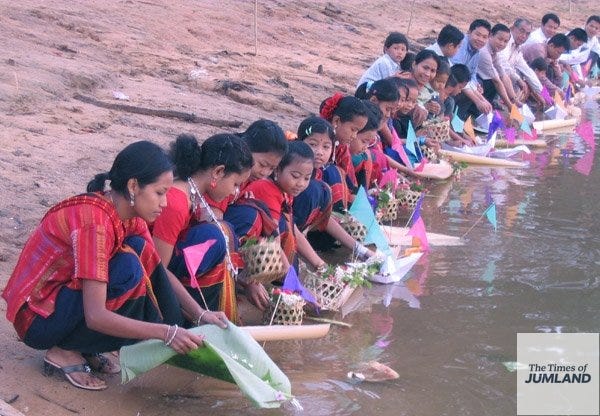
During Ful Biju, Chakma participants may offer flowers in rivers and streams, a visible expression of the festival’s connection to nature and renewal. Photographs of this observance capture one beautiful tradition, but they should not be taken as representative of every Indigenous community. Each people has its own ways of marking the season and passing its meaning to children.
Weddings reveal similar diversity. A Chakma marriage ceremony is not identical to a Marma, Tripura or Bawm wedding. Clothing, blessings, religious practices and family responsibilities vary. Recording these ceremonies matters because they preserve cultural knowledge that may otherwise be overlooked when people move away from their villages.
Traditional weaving is equally important. Chakma women wear the pinon and hadi, while other Indigenous communities make clothing with their own colors, designs and techniques. Passed through families, weaving skills express cultural pride and can also create income. Food, music and oral literature likewise connect everyday life with an inherited sense of belonging.
But culture alone does not explain why the name Jumma became a shared political identity. Colonial rule, the partition of British India in 1947 and the construction of the Kaptai Dam in the early 1960s changed the region’s administration and displaced many Indigenous families. These events gave different communities overlapping concerns about their homeland.
After Bangladesh became independent in 1971, Indigenous leaders sought political recognition and regional autonomy. Manabendra Narayan Larma helped organize these demands through the Parbatya Chattagram Jana Samhati Samiti, or PCJSS, established in 1972. The movement encouraged communities with separate cultural identities to speak together on land rights, representation and regional governance.
Historian Willem van Schendel examined this process in his study The Invention of the ‘Jummas’: State Formation and Ethnicity in Southeastern Bangladesh. The emergence of a wider Jumma identity did not mean that older ethnic identities were invented or abandoned. Rather, distinct peoples developed an additional form of solidarity in response to common political experiences.
The 1997 Chittagong Hill Tracts Accord between the Bangladesh government and the PCJSS attempted to address longstanding grievances through negotiation. Its implementation remains contested. Yet Jumma identity should not be treated as the property of any political organization. Indigenous people can disagree over leadership and strategy while continuing to share concerns about their languages, ancestral land and cultural rights.
Today, cultural survival presents challenges of its own. Young people study and work in Bangladeshi cities or settle overseas. Children may speak Bengali, English or the language of their new country more fluently than their grandparents’ mother tongue. Festivals and traditional ceremonies can become harder to maintain when relatives live far apart.
Migration also creates opportunities. Writers, teachers, artists and community organizations can record oral histories, develop learning materials and share cultural traditions with international audiences. Technology can help preserve languages rather than replace them. Education should open professional opportunities without requiring younger generations to surrender their cultural identities.
Elders hold knowledge of songs, rituals, place names and village histories that may never have been written down. Preserving it requires deliberate work. So does protecting the landscapes to which that knowledge belongs: agricultural practices, ceremonies and memories are often linked to particular rivers, hills and ancestral settlements.
The Indigenous peoples of the Chittagong Hill Tracts should not be portrayed only through conflict or loss. They are farmers, scientists, students, entrepreneurs, artists and professionals contributing to modern society. Their future should not require a choice between opportunity and heritage. Both should be possible.
For international readers, the story of the Jumma people is a reminder that Bangladesh is not culturally uniform. The hills contain languages and traditions shaped by connections across South and Southeast Asia. Their diversity deserves attention beyond tourism images, political disputes and occasional news of violence.
A shared identity is strongest when it protects differences rather than erasing them. The Chakma should remain Chakma, the Marma should remain Marma, the Tripura should remain Tripura, and smaller Indigenous communities should have the same freedom to preserve their heritage. Their histories connect through a homeland whose significance goes far beyond geography.
Jumma is not the name of a single tribe, a single religion or a single language. It is a shared identity among distinct Indigenous peoples whose histories are connected by a common homeland and whose future depends on their ability to preserve both their diversity and their solidarity.
Sources and Further Reading:
Willem van Schendel — The Invention of the ‘Jummas’: State Formation and Ethnicity in Southeastern Bangladesh, Modern Asian Studies, 1992.
https://doi.org/10.1017/S0026749X00015961International Work Group for Indigenous Affairs — The Indigenous World 2026: Bangladesh.
https://www.iwgia.org/en/news/iw-2026-bangladeshUnited Nations Development Programme — Chittagong Hill Tracts Watershed Co-Management Activity.
https://www.undp.org/bangladesh/projects/chittagong-hill-tracts-watershed-co-management-activity-chtwcaUnited Nations Development Programme — Strengthening Inclusive Development in Chittagong Hill Tracts.
https://www.undp.org/bangladesh/projects/strengthening-inclusive-development-chittagong-hill-tractsParbatya Chattagram Jana Samhati Samiti — About PCJSS.
https://www.pcjss.org/about-pcjss/The Daily Star — Weaving: An Indigenous Heritage in Chittagong Hill Tracts.
https://www.thedailystar.net/news-detail-46945Purna Lal Chakma — Who Are the Indigenous People of the Chittagong Hill Tracts?
https://purnalalchakma.com/indigenous-people-chittagong-hill-tracts/Purna Lal Chakma — What Languages Do the Indigenous People of the Chittagong Hill Tracts Speak?
https://purnalalchakma.com/indigenous-languages-of-the-chittagong-hill-tracts/