Israel’s 2026 election presents a striking contradiction: Benjamin Netanyahu’s opponents lead several polls, but they still lack a clear parliamentary majority. That gap between winning public support and assembling a government could determine who leads Israel after the October 27 vote.
Netanyahu faces serious dissatisfaction, a formidable challenger and unresolved questions about the catastrophe of October 7. Yet he retains advantages that polling headlines alone cannot explain: experience directing Israel’s response to its enemies, established political relationships and a campaign built around security challenges that remain unfinished.
The prediction that Israelis will return him to power rests on those advantages. It remains a prediction, but one that deserves more serious consideration than declarations that his political career is approaching its end.
Why this election matters beyond Israel
The election will influence Israel’s confrontation with Iran, its approach to Hamas and its relationship with Washington. Its consequences will reach beyond Israel’s borders, affecting regional security and the diplomatic efforts intended to prevent further conflict.
Several of Netanyahu’s challengers share important elements of his security outlook. The contest therefore concerns who can deliver security as much as which objectives Israel should pursue. That gives Netanyahu an opening: voters may demand accountability and institutional change while still preferring continuity in national leadership.
For international readers, this distinction matters. Opposition to Netanyahu does not necessarily mean opposition to military action against Israel’s enemies. Equally, concern about those enemies does not automatically translate into a vote for him.
The polls leave the decisive question unanswered
A Maariv poll published on October 23 projected 21 seats for Gadi Eisenkot’s Yashar, 19 for Netanyahu’s Likud and 15 for Naftali Bennett’s B’Yachad. It placed Netanyahu’s coalition bloc at 48 seats and the principal opposition bloc at 54, with Arab parties receiving 14 and the Reservists-Economic Party four.
Those figures are unfavorable to Netanyahu. They also leave both main camps below the 61 seats normally required for a governing majority. The same survey put Ofer Winter’s People of Israel at 3 percent, narrowly below the electoral threshold, while the Reservists-Economic Party barely crossed it. Small shifts could change the distribution of parliamentary seats.
Israelis elect parties to the 120-member Knesset rather than directly choosing their prime minister. Electoral lists need at least 3.25 percent of valid votes to enter parliament, after which negotiations determine who can assemble a government. Finishing first is therefore an advantage, not a guarantee of power.
Netanyahu cannot govern on reputation alone. He needs parliamentary support. His opponents, however, also need more than a polling lead.
Hamas and Iran remain unfinished security challenges
Hamas demonstrated on October 7 that its threat to Israeli civilians was deadly and real. Iranian leaders have also repeatedly called for Israel’s elimination. These threats remain central to understanding why security carries such weight in Israeli politics.
Under Netanyahu’s leadership, Israel has conducted military campaigns against Hamas and Hezbollah and struck Iranian military and nuclear infrastructure. His willingness to authorize major operations forms a substantial part of his political appeal. His supporters see a leader prepared to confront threats despite the costs, risks and international pressure involved.
Yet military achievements have not produced lasting security. Hamas remains armed, and Netanyahu has acknowledged that operations against Iran addressed immediate dangers without eliminating the underlying threat. The difficult decisions about military pressure, diplomacy and enforceable security arrangements remain ahead.
This is Netanyahu’s strongest argument for continuity. A temporary reduction in fighting will offer little lasting protection if Hamas can rebuild its military capabilities or Iran can renew its threats. Any settlement must be judged by whether it prevents another catastrophe, alongside its protection of civilians and its practical prospects for implementation.
Netanyahu can ask voters whether the leader who has directed the confrontation should remain responsible for securing its outcome. His rivals must persuade them that changing leadership would produce better results. For enough Israelis, the unfinished nature of these challenges may outweigh the appeal of political change.
Experience matters when the result is divided
Netanyahu’s political resilience is well established. He defied expectations in the 2015 election, lost office in 2021 and returned following the 2022 vote. Over decades, he has built relationships with parties whose political interests are closely connected to his leadership.
Those relationships do not eliminate disagreements. His partners remain divided over important questions, including military service for ultra-Orthodox men. Nevertheless, established channels of negotiation give him a starting point if the election produces another fragmented parliament.
His advantage is practical. A prospective prime minister must agree on policies, allocate responsibilities and sustain parliamentary support through difficult decisions. Netanyahu has extensive experience doing that. An opposition alliance must demonstrate that it can construct a more effective arrangement.
Eisenkot’s challenge is serious, but his majority is uncertain
Eisenkot is a formidable opponent with substantial military experience. He advocates dismantling Hamas’s military capabilities and preventing Iran from acquiring a military nuclear capability. Netanyahu’s campaign cannot credibly dismiss him as someone unfamiliar with Israel’s security challenges.
However, Reuters reports that Eisenkot has ruled out partnering with Arab parties under their current positions. That restriction could complicate his route to a parliamentary majority even if Yashar becomes the largest party.
The opposition must settle who leads, which parties participate and what compromises make government possible. Shared opposition to Netanyahu does not automatically resolve those questions. His opportunity lies in the distance between dissatisfaction with his government and agreement on a workable replacement.
Washington strengthens his campaign message
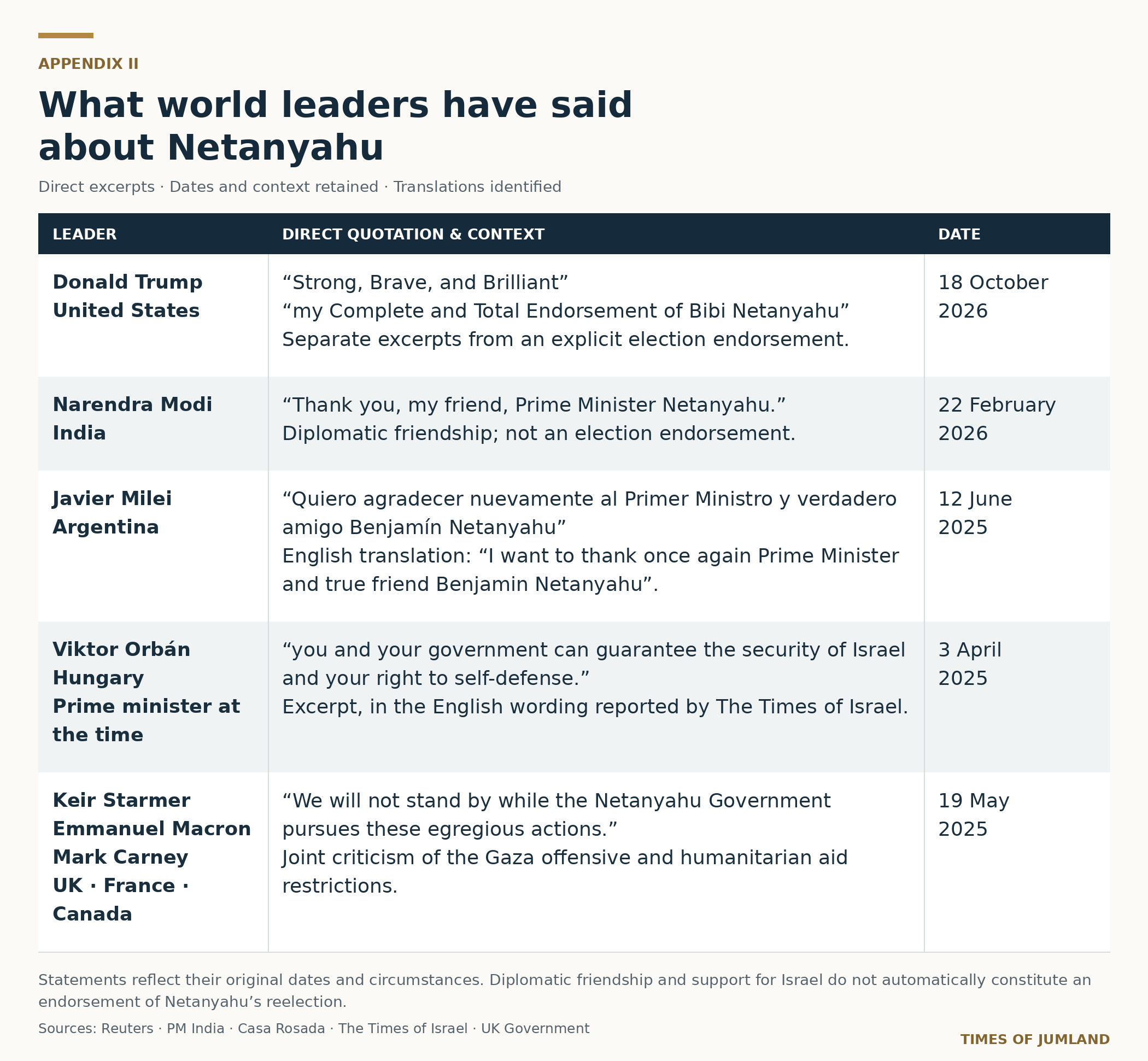
Donald Trump’s explicit endorsement gives Netanyahu an additional argument: an established relationship with the president of Israel’s most important international partner. Netanyahu can present that access as valuable while American security cooperation and regional diplomacy remain essential.
The endorsement does not guarantee additional votes. Analysts have questioned whether it will change many minds in an electorate already divided over Netanyahu. Its value is that it reinforces his wider argument about experience and established relationships.
International opinion remains divided. Some leaders express friendship and solidarity, while others strongly criticize his government’s conduct. Diplomatic friendship should not be mistaken for an election endorsement, and international criticism should not be assumed to determine how Israelis will vote.
October 7 remains his greatest obstacle
The strongest argument against Netanyahu cannot be avoided: the October 7 terrorist attack occurred under his premiership. Voters are entitled to demand an independent examination of the failures and evidence that Israel’s institutions have learned from them.
Subsequent military operations do not erase that responsibility. Nor does experience make any leader irreplaceable. Netanyahu must persuade Israelis that his future leadership offers greater security than the alternatives.
His route to reelection depends on voters distinguishing accountability for past failure from their judgment about the decisions ahead. Some will conclude that the catastrophe requires a change of leadership. Others may demand accountability while deciding that Netanyahu should remain responsible for confronting the threats that followed.
Why another Netanyahu government remains possible
Netanyahu needs stronger results than unfavorable polls suggest, successful parliamentary entry by potential allies or agreements that broaden his support after voting. His reputation for survival cannot substitute for the seats required to govern.
Nevertheless, continuing security threats give his campaign urgency, experience gives it substance and established relationships give him an opening in coalition negotiations. His opponents face the difficult task of converting public dissatisfaction into an agreed government.
That is the basis for predicting his return. Enough Israelis may decide that the unfinished security challenges demand continuity, while a divided parliament may reward his ability to negotiate.
The election will test whether those advantages outweigh the arguments for change. Netanyahu’s strongest message is that Israel’s enemies have not disappeared and the hardest decisions remain ahead. That is why another Netanyahu government remains a credible outcome—even when the polling headlines point elsewhere.
Appendix I: 38 submitted electoral Lists
Thirty-eight electoral lists originally submitted candidates. Blue and White withdrew from the campaign on October 19, although it remains on the ballot. English translations of some smaller lists vary.
B’Yachad
Yashar
Sharshar, for Love and National Unity
Partnership for Everyone
The Pirates
People of Israel
Israel First
Garden of Eden
Women’s Voice
Together We Will Succeed
Yisrael Beytenu
Just Law
Shema
Otzma Yehudit
New Order
The Reservists-Economic Party
The Democrats
Ra’am
Shas
The Haredi Public
You and Me, the Israeli People’s Party
Eternal Covenant
Fixing the Electoral and Governing System
The Biblical Bloc
Social Security
Dawn’s Light, a Party for Everyone
Personal Security
The Color Black, Guarding the World of Torah
Likud
Blue and White — campaign withdrawn October 19
Religious Zionism-Zehut
The Ahi Movement
The House of Israel Junction
Redemption
The Joint List
The Hakahal Party
United Torah Judaism
Noam
Source: The Times of Israel’s original electoral list report and its report on Blue and White’s withdrawal.