

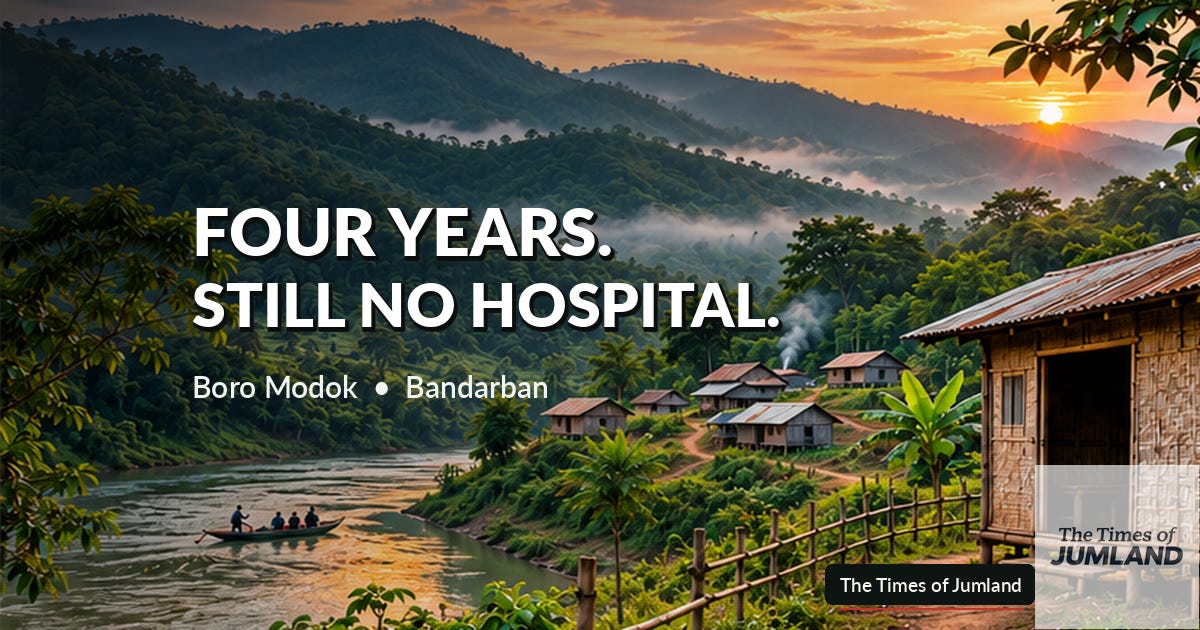
In June 2022, a deadly diarrhoea outbreak in the remote hills of Bandarban prompted authorities to establish a temporary hospital and announce plans for permanent medical services. More than four years later, Indigenous communities around Boro Modok are still demanding a government hospital, with no confirmed date for when a permanent facility will become operational.
The renewed demand affects an estimated 10,000 people living across approximately 60 villages in the border region of Thanchi upazila, including Boro Modok, Choto Modok and surrounding settlements. Residents continue to face difficult journeys lasting more than eight hours to reach emergency treatment, while recurring disease outbreaks expose the consequences of inadequate healthcare infrastructure.
The situation raises questions about what happened to the medical facilities discussed in 2022 and whether the government’s latest proposals will deliver the services these communities have been seeking for years.
A Hospital Plan That Began in 2022
The demand for a Boro Modok hospital gained urgency in June 2022, when a serious diarrhoea outbreak affected several Indigenous villages in Remakri Union. Health officials initially reported nine deaths between June 7 and June 15, while subsequent reports put the death toll at 10.
In response, the Bandarban Hill District Council financed a temporary 10-bed field hospital at Yonglong Para, using a local primary school as a treatment facility. The health department managed the operation, which was intended to provide emergency care until the outbreak came under control.
At the time, officials also outlined plans for a more permanent healthcare arrangement. Reports published by Ajker Patrika and Bangla Tribune described proposals for a 10-bed mini-hospital or community clinic, supported by an MBBS doctor, additional healthcare workers and essential medicines. Authorities also discussed installing 30 deep tube wells to improve access to safe drinking water.
The proposals addressed two interconnected problems: the lack of accessible medical services and the unsafe water conditions contributing to disease outbreaks. Both required long-term solutions because temporary medical assistance could not guarantee treatment or prevent future emergencies.
However, reports published in October 2026 continued to describe Boro Modok as lacking a permanent medical facility capable of serving its surrounding villages. The available reporting does not establish whether the original hospital proposal received final funding approval, what progress was made on construction or how many of the planned tube wells were installed.
Those unanswered questions are important because authorities had already recognised the need for permanent healthcare in 2022. Four years later, residents are again seeking a solution to essentially the same problem.
Another Outbreak Exposes the Healthcare Gap
The consequences of limited healthcare access became evident again in September 2026, when another diarrhoea outbreak struck Boro Modok. According to reports published by Jago News and other local outlets, a woman died on September 18, while more than 10 residents became ill.
The outbreak also exposed shortages of basic medical supplies. Local pharmacies reportedly lacked sufficient oral rehydration salts and essential medicines, leaving families struggling to provide immediate treatment. A critically ill patient was transported by motorboat to Thanchi Upazila Health Complex, while health authorities arranged an emergency medical team with medicines and water purification supplies.
Such emergency responses can provide essential assistance during an outbreak, but they do not ensure medical care throughout the year. For residents of remote settlements, the distance to a functioning hospital remains a major obstacle, particularly when a patient requires urgent treatment.
Boro Modok lies approximately 70 kilometres by river from Thanchi town, according to local reporting. Difficult terrain and dependence on river transport make the journey especially challenging for seriously ill patients, pregnant women, children and elderly residents.
The Times of Jumland previously examined these difficulties in its October 24 feature, Beyond the Beautiful Hills, Jumma Families Struggle to Reach Healthcare. That article described the journey of a patient from Boro Modok along the Sangu River and explored the wider barriers preventing Indigenous communities from reaching medical treatment.
The continuing demand for a hospital represents a specific unresolved part of that wider healthcare crisis. Although medical camps and emergency interventions have provided temporary relief, the affected villages still lack the dependable services required to manage serious illnesses locally.
In June 2026, Bolipara Nari Kalyan Samity organised a two-day medical programme at Remakri and Boro Modok markets, supported by the European Union and Manusher Jonno Foundation. The programme provided free consultations, medicines and health advice to 253 patients, while eligible children received measles vaccinations.
The initiative demonstrated the importance of bringing medical services directly to remote communities. Nevertheless, short-term programmes cannot replace permanent facilities staffed by qualified medical professionals and supplied with essential medicines.
New Proposals but No Confirmed Opening Date
The renewed demand for a government hospital has brought the issue back before local authorities and the health department. Reports published in October 2026 indicate that residents, traditional community leaders, elected representatives and young people have submitted applications seeking a permanent medical facility in Boro Modok or Remakri.
Local health officials have acknowledged the importance of Boro Modok as a central location for serving several remote settlements. A facility there could potentially provide healthcare to residents of Bulu Para, Andharmanik, Choto Modok, Boro Modok and neighbouring parts of Tindu Union.
However, the proposals now being discussed involve different locations and types of medical services. One proposal concerns a 20-bed hospital at Kombo Para in Tindu Union, while another seeks a health sub-centre or family welfare facility in Boro Modok.
A separate initiative involves establishing a midwifery healthcare centre through cooperation between the local organisation Green Hill and the World Health Organization. According to published statements from Bandarban Hill District Council representatives, infrastructure support has also been sought for the proposed facility.
These initiatives could improve access to healthcare, but their services would not necessarily be equivalent. A midwifery centre could provide important maternal healthcare, while a family welfare facility could offer primary and preventive services. Neither would automatically provide the emergency treatment or inpatient care available at a properly equipped hospital.
The distinction matters because the central demand of local residents is not simply for another healthcare building. They want a facility capable of treating seriously ill patients without requiring families to undertake a lengthy and difficult journey to Thanchi.
Bandarban health officials have reportedly discussed inspecting suitable locations and taking the necessary administrative steps. However, the published information does not establish a confirmed budget, construction timetable, staffing arrangement or opening date for a permanent hospital in Boro Modok.
These missing details make it difficult to determine whether the latest proposals represent significant progress beyond the plans discussed in 2022. They also leave residents without a clear indication of when dependable medical services might become available.
The experience of Boro Modok highlights a broader challenge facing remote Indigenous communities in the Chittagong Hill Tracts. Healthcare planning in mountainous regions cannot depend solely on hospitals located in administrative centres. It must account for difficult geography, seasonal transport conditions, safe drinking water and the practical needs of communities living far from government services.
A lasting solution would require more than construction. Qualified doctors, trained nurses, essential medicines, maternal and child healthcare, emergency treatment and reliable arrangements for transferring critically ill patients would all be necessary to make a permanent facility effective.
In 2022, a deadly outbreak prompted emergency medical services and plans for long-term improvements. In 2026, another outbreak brought renewed medical intervention, while residents continued demanding a hospital.
For approximately 10,000 people living across the surrounding border villages, the question is no longer whether accessible healthcare is necessary. It is whether the latest government proposals will finally deliver the permanent medical services that earlier plans have yet to provide.
Further reading sources:
Dhaka Mail — May 22, 2026
Diarrhoea outbreak in remote Remakri villages exposes shortages of medicines and healthcare services.
https://dhakamail.com/country/305784Ajker Patrika — June 17, 2022
Temporary hospital established following a deadly diarrhoea outbreak in Bandarban.
https://www.ajkerpatrika.com/epaper/ajp8b763jrzorThe Daily Star — June 14, 2022
Diarrhoea outbreak in remote Bandarban villages exposes healthcare shortages.
https://www.thedailystar.net/health/healthcare/news/two-die-diarrhoea-breaks-out-bandarban-3047496Jago News — September 19, 2026
Another diarrhoea outbreak claims a woman’s life in Boro Modok.
https://www.jagonews24.com/country/news/1158815Ajker Patrika — October 13, 2026
Thousands of residents in remote Bandarban villages struggle to access medical treatment.
https://www.ajkerpatrika.com/bangladesh/bandarban/ajpossws9l39k
Related Story
The Times of Jumland — October 24, 2026
Beyond the Beautiful Hills, Jumma Families Struggle to Reach Healthcare
https://www.timesofjumland.com/p/chittagong-hill-tracts-healthcare-jumma-communities