

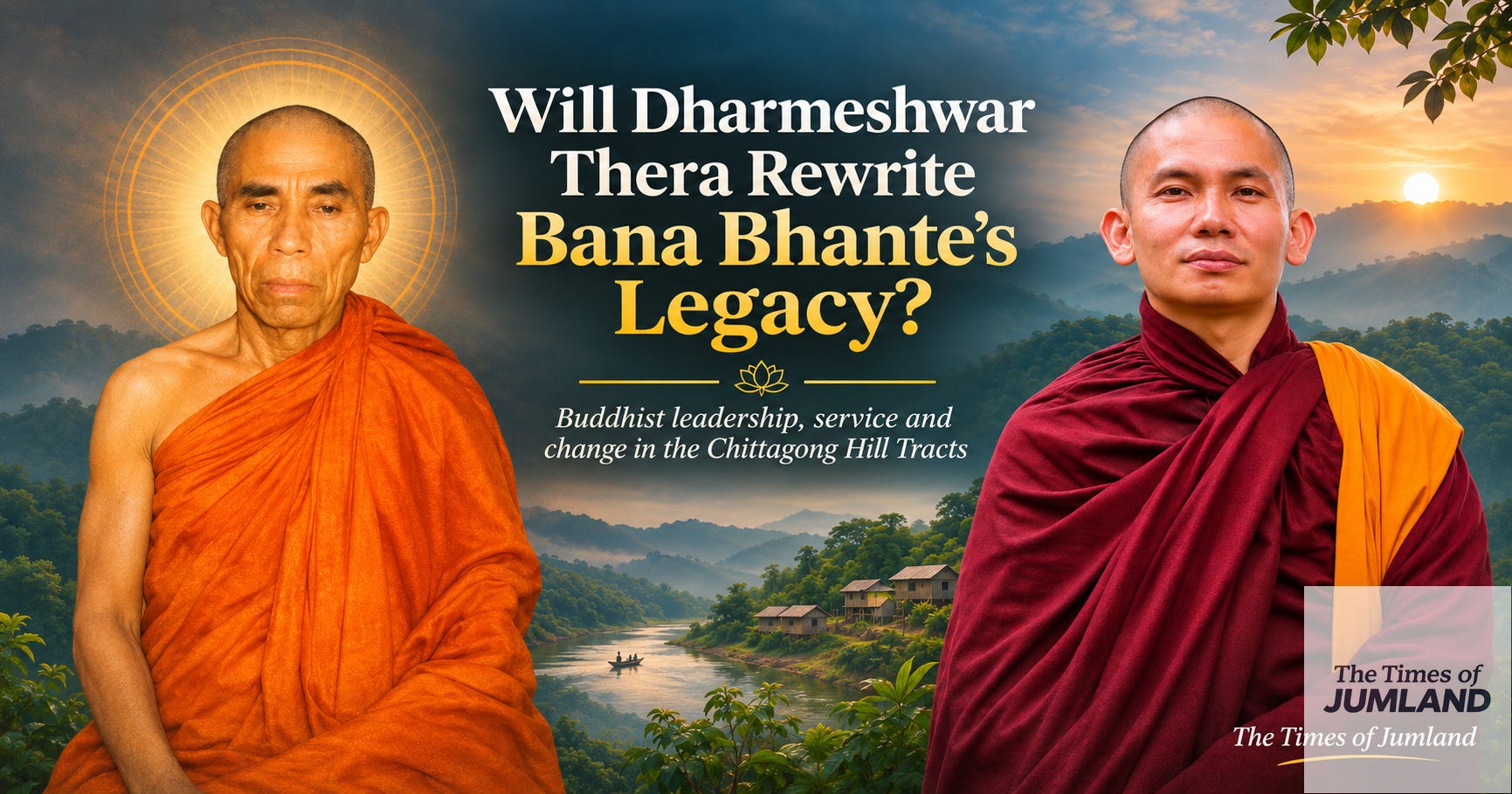
I have lived through and observed many changes in the religious life of the Chittagong Hill Tracts. I have seen the extraordinary influence of Bana Bhante, the rise of his disciples and the enormous devotion surrounding Buddhist religious institutions. But in all these years, I cannot remember witnessing a monk from the hills receive the kind of enthusiastic public praise that Venerable Dharmeshwar Thera is now attracting on social media.
Facebook has been flooded with posts celebrating his humanitarian initiatives. People are sharing photographs, writing messages of appreciation and expressing admiration for a monk whose recent work has turned religious generosity into practical services for ordinary people. The excitement surrounding him is remarkable, but what interests me most is not his sudden popularity. It is what people are choosing to celebrate.
Dharmeshwar Thera has not attracted this attention through the construction of a magnificent monastery or an extravagant religious celebration. His supporters have contributed toward an ambulance intended for public use, while a healthcare centre developed through his efforts has begun offering medical services. These initiatives have received an enthusiastic response from people who understand the difficulties of obtaining healthcare in the hills.
I believe something important is happening. For decades, large sections of Chakma Buddhist society have measured religious greatness through spiritual reputation, devotion, ceremonies and offerings to respected monks. Now people are enthusiastically celebrating a different expression of religious leadership, one that gives greater importance to healthcare, education and practical assistance to those in need.
This raises a question that may become historically significant. Could Dharmeshwar Thera help change the religious thinking that developed around Bana Bhante and his disciples? Could the current enthusiasm become the beginning of a movement in which ordinary people judge religious institutions not only by their spiritual influence but also by what they contribute to society?
The Legacy of Bana Bhante and the Questions Left Behind
Bana Bhante, whose monastic name was Sadhanananda Mahasthavir, was unquestionably one of the most influential Buddhist monks in the modern history of the Chittagong Hill Tracts. His teachings on meditation, moral discipline and spiritual liberation attracted enormous devotion, particularly among Chakma Buddhists. Rajban Vihara in Rangamati became a powerful religious centre, and his disciples continued spreading his teachings long after his death in January 2012.
His influence helped strengthen Buddhist religious identity among generations of followers. Many people found spiritual guidance through his teachings, and his emphasis on meditation and moral conduct shaped religious practices across the hills. These contributions belong to the history of Buddhism in the region, but they do not mean that his social and political influence should remain beyond criticism.
In my October 8, 2026 article, “Banabhante Chittagong Hill Tracts: Religion and the Political Cost,” I examined the consequences of the religious authority that developed around him. One concern was how admiration for a spiritual teacher became intertwined with ethnic identity, institutional power and unquestioning loyalty. The popular expression “Ama Bhante,” meaning “our monk,” reflected a sense of belonging that, in some circles, made criticism of Bana Bhante appear almost equivalent to criticism of Chakma society itself.
That mentality created a problem. When a religious leader becomes a symbol of collective pride, his followers may become more interested in defending his reputation than examining the consequences of his decisions. Religious devotion can then discourage the very questions that society needs to ask about leadership, education, public responsibility and the use of collective resources.
The historical circumstances make these questions especially serious. During the decades when Bana Bhante exercised enormous influence, Indigenous communities in the Chittagong Hill Tracts experienced armed conflict, displacement, land dispossession, military operations and repeated threats to their security. Families struggled to survive, children needed educational opportunities, and communities faced continuing uncertainty over their land and political rights.
Yet I have long questioned how much of Bana Bhante’s extraordinary religious influence was directed toward these difficulties. He inspired thousands to practise Buddhism and support religious institutions, but his legacy was not built around a comparable movement for orphanages, education, healthcare or the public defence of Indigenous rights.
Rajban Vihara’s own historical chronology records that a 10-bed hospital was constructed there in 2000 through government funding implemented by the Chittagong Hill Tracts Development Board. That fact deserves recognition. But a government-funded hospital building within a monastery complex is different from a sustained, monk-led movement that places community healthcare, disadvantaged children and public welfare at the centre of religious leadership.
The same chronology records that followers purchased a Russian jeep for Bana Bhante in 1989 at an approximate cost of Tk 600,000. It also records that he travelled to religious events in a Bangladesh Army helicopter in 1991, during a period when relations between the military and Indigenous communities were shaped by the armed conflict.
These details illustrate the public resources and institutional relationships associated with his religious influence. They also raise questions about priorities. When a revered monk could receive expensive transport and military assistance for religious activities, why did comparable efforts to create community welfare institutions not become a defining feature of his movement?
The military relationship carries another historical dimension. In a region where ordinary Indigenous people lived through conflict and military operations, the public acceptance of military assistance by an enormously respected religious figure could influence how followers viewed the military’s involvement in civilian life.
My assessment is that Bana Bhante’s public acceptance of such assistance contributed to the normalisation of military participation in religious and social affairs. His followers may interpret these relationships differently, but the political consequences of religious influence cannot be separated from the historical circumstances in which it developed.
Another question concerns his position during periods of violence and oppression. I have not seen in his public legacy a comparable record of leading protests against abuses affecting Indigenous communities. His teachings may have offered spiritual comfort, but I believe the people who revered him also needed religious leadership prepared to defend their dignity, security and collective rights.
A monk does not have to become a politician to stand against injustice. Condemning violence, supporting displaced families, helping disadvantaged children and demanding protection for vulnerable communities are not departures from compassion. They are ways of expressing it.
The more troubling development came through parts of the religious culture surrounding his disciples. Elaborate celebrations, expensive gifts, grand monastery buildings and the glorification of individual monks have often attracted considerable attention. Meanwhile, ordinary families continue struggling to finance medical treatment, educate their children and meet basic living expenses.
I am not opposed to religious ceremonies or beautiful monasteries. They have cultural and spiritual importance. But when the people who sustain these institutions cannot afford essential services, religious leaders and their followers must ask whether their priorities reflect the needs of society.
This is where the example of Dharmeshwar Thera becomes particularly significant.
The Buddhist Tradition That Put People First
The history of Buddhist leadership in the Chittagong Hill Tracts did not begin with Bana Bhante, nor was his approach the only religious tradition available to Indigenous communities. A different model of leadership had already emerged through Rajguru Agravamsa Mahathera, Jnanashree Mahathera and the Parbatya Bhikkhu Sangha.
Rajguru Agravamsa, a Tanchangya monk who served as Chakma Rajguru, represented a tradition that connected religious leadership with education, social development and the wider concerns of Indigenous society. His approach placed importance on preparing communities to face the changing world rather than limiting religious responsibilities to ceremonies and spiritual instruction.
Jnanashree Mahathera made a particularly important contribution by establishing the Parbatya Chattal Buddhist Orphanage in Dighinala in the early 1960s. At a time when many Indigenous families were struggling with displacement and poverty, the institution provided shelter and educational opportunities for disadvantaged children.
That tradition later developed through the Monoghar movement in Rangamati, established in 1974 through the efforts of Buddhist monks including Prajnananda Mahathera and Bimal Tissya Mahathera. Monoghar became an important centre for education and social development, creating opportunities for children who might otherwise have remained outside formal education. Its services eventually expanded to include vocational training and a small healthcare facility.
These institutions demonstrate something essential about religious leadership. A monk’s contribution can extend beyond his lifetime when his efforts produce schools, children’s homes and organisations that continue serving society. Religious generosity can become a lasting investment in the future of a community.
Venerable Bimal Bhikkhu represented another important dimension of this tradition. He brought international attention to the difficulties facing Indigenous peoples of the Chittagong Hill Tracts, including through his address at the United Nations on December 10, 1992. He spoke about the loss of land, culture and rights, demonstrating that Buddhist religious leadership could also defend human dignity in international forums.
After Bimal Bhikkhu left the Chittagong Hill Tracts, I increasingly felt the absence of religious figures willing to combine spiritual authority with practical concern for the people. The need was never merely for another respected monk. It was for leadership capable of inspiring people to address poverty, injustice, education and healthcare while remaining connected with the communities experiencing those problems.
Dharmeshwar Thera’s recent initiatives remind me of that older tradition. He is not creating the idea of socially engaged Buddhism from nothing. Rather, his work has the potential to bring renewed public attention to a tradition that has existed in the hills for decades but has not always received the recognition it deserves.
Dharmeshwar Thera belongs to a long tradition of educated Buddhist monks who have combined religious scholarship with social responsibility in the Chittagong Hill Tracts. A former student of Monoghar, he pursued higher Buddhist studies in Myanmar and Sri Lanka, including studies at the Buddhist and Pali University of Sri Lanka. He now serves as deputy abbot of Ananda Vihara in Rangamati and abbot of Dhammankur Buddhist Vihara at Boradam in Baghaichhari. His educational background and humanitarian initiatives reflect the tradition established by Rajguru Aggavamsa Mahathera, Bimal Tissya Mahathera and other socially engaged Buddhist leaders.
Rajguru Aggavamsa was a respected scholar of Pali and Buddhist scriptures who pursued advanced religious studies in Myanmar and participated in the Sixth Buddhist Council. Bimal Tissya Mahathera earned honours and master’s degrees from the University of Dhaka and became deeply involved in education and humanitarian service. Their contributions demonstrate that Buddhist leadership in the hills has long included scholarship, institution-building and responsibility toward disadvantaged communities. Dharmeshwar Thera’s work can be understood as a continuation of this tradition rather than an entirely new approach to Buddhism.
The contrast with Bana Bhante lies in their educational paths and the priorities of their religious leadership. Bana Bhante received limited formal schooling and built his spiritual reputation primarily through meditation, ascetic discipline and religious teaching. Rajguru, Bimal Tissya and now Dharmeshwar Thera represent a tradition that places greater emphasis on organised Buddhist scholarship, modern education and the practical needs of society. Their example raises an important question: should the greatness of a Buddhist monk be measured only by spiritual attainment and the devotion of followers, or also by the knowledge, institutions and opportunities he leaves for future generations?
On October 30, 2026, during a Kathina ceremony at Ananda Vihara, an ambulance purchased through the collective contributions of supporters was inaugurated in honour of his recognition as a Mahathera. Instead of limiting the occasion to ceremonial gifts, the contributors helped create a service intended to transport people requiring medical treatment.
The ambulance was not purchased entirely from Dharmeshwar Thera’s personal funds, and that is precisely why the initiative is so meaningful. It represents a collective decision to use religious generosity for the benefit of ordinary people. The honour given to a monk has been transformed into something that can serve families facing medical emergencies.
On November 3, the Second Sangharaja Sugatpriya Healthcare Centre was inaugurated at Boradam through Dharmeshwar Thera’s efforts, including funds he personally contributed. A free medical programme accompanied the opening, adding another practical dimension to the growing recognition of his work.
These initiatives may appear modest beside the enormous religious buildings and elaborate ceremonies found across the hills. But they introduce a different measure of achievement. A magnificent monastery demonstrates the ability to mobilise resources for religion, while an ambulance or functioning healthcare centre demonstrates how those resources can directly relieve human suffering.
This difference is not difficult for ordinary people to understand. A family carrying a seriously ill patient needs transport and medical treatment. A child who has left school because of poverty needs educational support. A widow struggling to support her family needs assistance that can improve her daily life.
The significance of Dharmeshwar Thera’s initiatives lies in connecting religious generosity with these practical needs. That connection may help explain why his recent work has generated such extraordinary public enthusiasm.
Is a New Religious Thinking Emerging?
I believe the social media reaction to Dharmeshwar Thera deserves attention as a possible turning point in the religious culture of the Chittagong Hill Tracts. People are not simply praising another monk for his teachings or monastic seniority. They are celebrating services that could benefit the communities in which they live.
The distinction matters because religious influence has historically been measured through numbers of followers, large gatherings, elaborate ceremonies and the prestige of religious institutions. Dharmeshwar Thera’s popularity suggests that another measure is becoming increasingly important: what has a religious leader actually done for ordinary people?
An expensive vehicle presented to a monk may support his personal transport and religious duties. An ambulance dedicated to public service can transport sick people from many families. A grand celebration brings people together for an occasion, while a well-managed healthcare centre can continue treating patients long after the celebration has ended.
The current enthusiasm suggests that many people are beginning to recognise the social value of this difference. They may still respect the teachings of Bana Bhante, but that does not prevent them from questioning the priorities of the institutions and religious culture developed around his legacy.
This is the ideological change that interests me. It does not necessarily involve abandoning meditation, Buddhist precepts or traditional religious observances. It involves reconsidering what religious devotion should produce and whether the resources entrusted to religious institutions should play a greater role in improving people’s lives.
If this thinking continues to spread, it could challenge the personality-centred culture that has influenced sections of Chakma Buddhist society for decades. Devotion would no longer be measured primarily by how generously a respected monk is honoured, but also by how much that generosity contributes to education, healthcare and community welfare.
The potential is enormous. Buddhist communities in the Chittagong Hill Tracts regularly contribute money, materials and voluntary labour to religious institutions. Indigenous people living abroad also support monasteries, ceremonies and religious activities. If even part of these resources were directed toward lasting welfare institutions, the benefits could reach thousands of families.
Imagine major religious celebrations helping establish rural healthcare centres, children’s homes, scholarship programmes and emergency transport services. Imagine the annual honouring of a respected monk becoming an occasion to finance a school or provide medical care to disadvantaged families. Such initiatives would make Buddhist generosity visible in the everyday lives of the people who sustain religious institutions.
But the growing admiration for Dharmeshwar Thera also carries a serious responsibility. His supporters must not allow the movement to become another personality-centred religious institution where public praise matters more than practical achievements. Replacing the unquestioning devotion directed toward one monk with identical devotion toward another would not represent meaningful change.
The real achievement would be building institutions that continue functioning regardless of who leads them. The ambulance needs a driver, fuel, maintenance and a dependable system for providing assistance. The healthcare centre needs qualified personnel, medicines, equipment and sufficient funds to operate throughout the year.
These responsibilities should not rest entirely on Dharmeshwar Thera. A capable management team, transparent financial arrangements and clear operating rules would allow supporters, professionals and volunteers to contribute their knowledge and resources. Indigenous communities living abroad could play an important role by providing financial assistance, medical expertise and organisational support.
There must also be safeguards against the financial pressures sometimes associated with religious giving. Poor families should never feel compelled to contribute money they cannot afford, and wealthy donors should not gain excessive influence over institutions intended to serve everyone. A person’s dignity must not depend on the size of a donation.
The institutions should also serve people according to their needs, without discrimination based on religion or ethnic identity. Buddhist compassion should not stop at the boundaries of the Buddhist community. A humanitarian initiative becomes more meaningful when anyone facing suffering can seek assistance.
These expectations should apply to every religious institution, including those associated with Dharmeshwar Thera. Public admiration should never place leaders above questions about financial management, institutional decisions or the quality of services delivered.
At the same time, religious charity must not become an excuse for government neglect. Providing healthcare, education, security and equal protection remains the responsibility of the state. Religious organisations can provide valuable assistance, but their work should strengthen the ability of communities to claim their rights rather than encourage acceptance of inadequate government services.
Dharmeshwar Thera’s greatest opportunity is therefore not simply to attract more followers. It is to inspire a different understanding of religious responsibility among younger monks, donors and ordinary people.
The legacy of Bana Bhante demonstrated the enormous power of spiritual influence in the Chittagong Hill Tracts. Yet the history of Jnanashree Mahathera, Bimal Bhikkhu and the Parbatya Bhikkhu Sangha also demonstrates that religious leadership can produce schools, children’s homes, social movements and public advocacy for Indigenous rights.
Dharmeshwar Thera now stands at an important point between these traditions. He can help bring the public influence associated with great religious leaders closer to the practical service that Indigenous communities have needed for generations.
I have rarely seen such enthusiastic online praise for a monk from the Chittagong Hill Tracts. But the importance of this moment will not ultimately be determined by Facebook posts, photographs or messages of admiration. It will depend on what the people celebrating him decide to do with their enthusiasm.
If they return to competing over expensive offerings, grand celebrations and personal glorification, the present excitement will eventually become another chapter in the familiar history of religious devotion. If they instead build lasting institutions that educate children, treat the sick and support vulnerable families, the change could become historically significant.
That is why I believe Dharmeshwar Thera has the potential to challenge the religious culture that developed around Bana Bhante. He does not need to erase Bana Bhante’s spiritual contributions or compete with his popularity. He needs to help establish a different standard of greatness, one that gives equal importance to what religious institutions contribute to society.
The real question is not whether Dharmeshwar Thera will become more famous than Bana Bhante. It is whether the people who once measured religious greatness mainly through spiritual devotion will increasingly measure it through service to humanity.
If that change takes root, Dharmeshwar Thera may help write an important new chapter in the religious history of the Chittagong Hill Tracts.
Bana Bhante taught generations how to seek spiritual liberation. Dharmeshwar Thera now has an opportunity to show how religious devotion can also help liberate people from suffering in their everyday lives. That would be a legacy worth building.
Further Reading Sources:
Purna Lal Chakma — Bana Bhante and the Political Cost of Religious Leadership (October 8, 2026)
An earlier analysis examining Bana Bhante’s religious influence, ethnic identity, military relationships and their consequences for Indigenous society. Published in Bengali.
https://purnalal.com/2026/10/08/বনভান্তে-যে-প্রশ্নগুলো-ভ/Rajban Vihara — Bana Bhante’s Official Biography and Chronology
A historical record of Bana Bhante’s life, religious activities, institutional development and relationships with government and military authorities.
https://www.rajbanavihara.org/p/banabhante-info-at-glance.htmlBuddhistdoor Global — The Legacy of Bana Bhante at Rajban Bihar
Examines Bana Bhante’s meditation practices, teachings and lasting influence on Buddhist religious life in the Chittagong Hill Tracts.
https://www.buddhistdoor.net/features/the-legacy-of-bana-bhante-at-the-monastery-of-rajban-bihar-in-rangamati-bangladesh/Parbatya Bhikkhu Sangha — Rajguru Aggavamsa Mahathera
Documents the religious leadership, Buddhist scholarship and institutional contributions of Rajguru Aggavamsa Mahathera.
https://pbsb-cht.org/rajguru-aggavamsa-mahathera/Parbatya Bhikkhu Sangha — A Brief Biography of Jnanashree Mahathera
Explores Jnanashree Mahathera’s contribution to Buddhist education, orphanages and the development of Monoghar.
https://pbsb-cht.org/a-brief-biography-of-saddhammaditya-dr-jnanashri-mahathero/Georgetown University — A Discussion with Venerable Prajnananda Mahathera (2014)
A detailed interview about Monoghar, Buddhist social responsibility and the education of disadvantaged Indigenous children.
https://berkleycenter.georgetown.edu/interviews/a-discussion-with-venerable-prajnananda-mahathera-chairman-banophool-adibashi-green-heart-college-84616c43-dfc4-490c-8139-7139fd2e60a3The Daily Star — Illuminating the Hills of Chittagong (2010)
A feature on Monoghar and the contributions of Buddhist monks to education and social development in the Chittagong Hill Tracts.
https://archive.thedailystar.net/magazine/2010/12/04/education.htm