

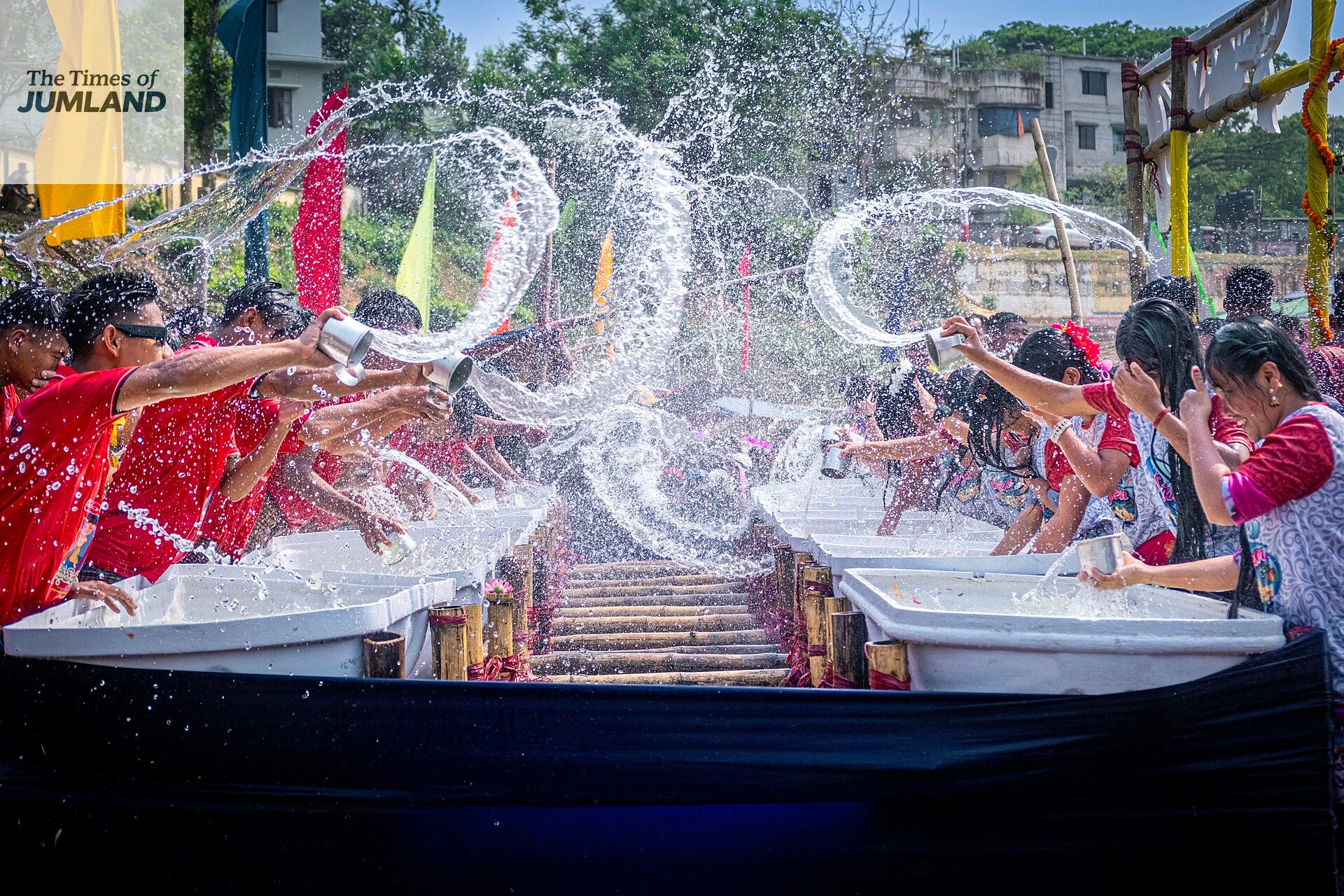

When photographs of the Marma Sangrai festival appear every April, water usually dominates the scene. Young men and women in colourful traditional clothing splash water on one another while crowds gather to celebrate the New Year. To an outsider, Sangrai may appear to be a joyful water festival similar to celebrations in Thailand or Myanmar.
But the water seen in those photographs tells only part of the story. In Marma tradition, water is used to honour the Buddha, show respect to elders and renew friendship between people. Each practice carries a different meaning, revealing a festival shaped by religious devotion, social relationships and centuries of cultural development.
Perhaps the most surprising historical detail is that the large, organized water-pouring ceremony familiar in Bandarban today is relatively recent. According to Marma elders and cultural researchers, an organized public celebration was introduced there in 1974. The festival itself, however, existed long before that event.
Understanding this distinction is essential to understanding Sangrai. It raises questions rarely explored in ordinary festival reporting: What did earlier generations celebrate? Why was water considered sacred? How did people express respect and friendship? And what happens when a community’s traditions become public entertainment?
The Marma Sangrai festival, also written Sangrain or Sangraing, celebrates the traditional New Year of the Marma people, one of the Indigenous communities of the Chittagong Hill Tracts in southeastern Bangladesh. It takes place around mid-April, particularly in Bandarban, Rangamati and Khagrachhari, marking the transition from the departing year to the new one.
Sangrai is connected to the Marma community’s traditional calendar, which shares historical relationships with the calendar systems of Myanmar. Its timing should not automatically be equated with the Bengali New Year. For example, Marma writer Milinda Marma recorded that in 2026, Sangrai observances ran from April 13 to 16, while the new Marma and Rakhine year began on April 17.
The historical connections of the Marma people help explain the festival’s wider cultural background. Marmas share linguistic, religious and historical ties with the Rakhine people of western Myanmar, formerly known as Arakan. These connections developed through migration, settlement and interaction across the region over several centuries.
Historian Kyaw Minn Htin examined this relationship in a 2015 academic study, describing how communities of Arakanese origin developed a distinct Marma identity in the Chittagong Hill Tracts. The study helps explain why Marma cultural traditions resemble those of neighbouring societies without being identical to them.
Sangrai belongs to a wider family of traditional New Year celebrations across Southeast Asia. Myanmar observes Thingyan, Thailand celebrates Songkran, Laos celebrates Pi Mai and Cambodia marks its traditional New Year during a similar period. Water, religious observances and respect for elders appear in several of these celebrations.
Yet such similarities should not obscure Sangrai’s own history. The Marma people have preserved a festival shaped by their particular social institutions, religious practices, language and local environment. Although its precise date of origin remains unknown, its traditions are older than the modern public ceremonies through which many people now recognize it.
In traditional descriptions, preparations for Sangrai involve cleaning homes, gathering flowers, preparing food and making arrangements for religious observances. Families welcome the new year not simply through entertainment but through actions intended to express renewal, generosity and respect.
The bathing of Buddha images is among the festival’s most important religious practices. Community members respectfully carry Buddha images to a riverbank or another ceremonial location, where water is poured over them before they are returned to monasteries or household shrines.
Bangladesh’s intangible cultural heritage documentation describes the use of water mixed with sandalwood or milk in some of these ceremonies. The precise arrangements vary, but the purpose is devotional. The ritual expresses reverence for the Buddha and the wish to begin the new year with wholesome intentions.
This ceremony remains an important part of Sangrai in Bandarban. During the 2024 celebrations, for example, a procession was arranged to carry a Buddha image from Rajguru Buddhist Vihar to Kheya Ghat at Ujani Para, where it would be ceremonially bathed.
The location is significant because rivers have long been part of life in the hills. They provide water, support livelihoods and connect settlements. In the ceremonial context, water becomes a medium through which people express reverence and hopes for spiritual renewal.
For Marma Buddhists, however, spiritual renewal involves more than the symbolic act of washing. Traditional observances also include visiting monasteries, making offerings, listening to Buddhist teachings and observing religious precepts. Sangrai therefore provides an opportunity to reflect on personal conduct as well as welcome a new calendar year.
The second important relationship expressed through water is the relationship between younger and older generations. Traditional accounts describe younger people visiting respected elders, offering gifts, seeking blessings and sometimes washing their hands or feet.
During Sangrai in 2024, elderly Marma community members in Bandarban were honoured with candles, clothing and other gifts, followed by the ceremonial washing of their feet. This public observance reflected a much older cultural expectation that younger generations should show gratitude and respect to those who came before them.
Marma researcher Mongkya Shoenu Marma, interviewed by Prothom Alo in 2025, described earlier practices in which young people respectfully bathed elderly Buddhist devotees observing religious precepts. In return, elders offered blessings and sometimes gave small amounts of money that young people used for preparing festival food.
The exchange illustrates how Sangrai connected generations through responsibility and affection. Younger people acknowledged the care and experience of their elders, while older people offered encouragement and blessings. The ceremony preserved a relationship that extended beyond the festival itself.
The third expression of water is the friendship-water-pouring ceremony, known as Maita Rilong Pwe, with variations in English spelling. This is the colourful celebration that attracts considerable public attention today.
Its central meaning is friendship rather than competition. Water is sprinkled or poured between participants as an expression of goodwill, the renewal of social bonds and the wish to leave behind disagreements and misfortunes associated with the previous year.
Yet the traditional etiquette surrounding the ceremony is rarely explained. According to Mongkya Shoenu Marma, earlier practices involved familiar young people, friends and neighbours sprinkling water on one another. Age differences and personal relationships mattered, and participants were expected to behave respectfully.
He also described circumstances in which sprinkling water without permission was considered discourteous. Another Marma elder, educator Thwaingcha Pru, explained that an unwelcome reaction could reveal tension in a relationship, because the ceremony was intended to demonstrate mutual goodwill.
This is a valuable part of Sangrai’s cultural meaning. Water was not simply something to throw at another person. It represented a relationship that participants were expected to respect.
Some Marma cultural figures therefore object to describing Maita Rilong Pwe merely as a water fight or water game. In their view, those descriptions remove the ethical and religious significance of a ceremony intended to strengthen friendship.
The distinction becomes even more interesting when examining how the modern public celebration developed.
According to Mong Nu Ching Marma, a former director of the Small Ethnic Groups Cultural Institute in Bandarban, several young Marma men visited Myanmar around 1973–1974 and observed organized New Year water-pouring events there.
After returning, they reportedly introduced a comparable public celebration in Bandarban in 1974. This account, preserved through interviews with community elders, concerns the development of the organized public event rather than the beginning of Sangrai or the older practice of sprinkling water between acquaintances.
The difference matters. A community may practise a tradition for generations before turning it into a large public celebration. Such changes are part of cultural history, but they should not be confused with the origins of the tradition itself.
The organized event was not immediately held every year without interruption. Marma cultural representatives interviewed by Prothom Alo recalled that regular public celebrations became more established during the mid-1980s.
Music also became part of this development. In 1984, Buddhist monk Upannya Jota Mahathera reportedly composed a Sangrai song inviting people to join the friendship-water-pouring celebration. The song subsequently became strongly associated with the festival.
The history of this composition illustrates how cultural traditions develop. A relatively modern song can become so familiar that later generations regard it as an inseparable part of an older celebration.
Other public features, including larger processions, developed over subsequent decades. Community representatives have associated the expansion of organized New Year processions with the period following the 1997 Chittagong Hill Tracts Accord.
These developments created new opportunities for cultural visibility. They also changed the appearance of Sangrai, particularly in towns where the festival increasingly attracted spectators, photographers, tourists and government-sponsored programmes.
But the history of Sangrai extends beyond Buddhism and modern public events. Ethnographic research on Marma religious life has documented older local rituals involving reverence for rivers, trees and protective spiritual figures.
In a study of Marma Buddhist rituals, researcher Jyotiswi Chakma described a village practice involving offerings to an old tree and a river on a selected day after Sangrai. According to accounts gathered from villagers, the observance was associated with hopes for protection against illness, natural disasters and other misfortunes.
The study records villagers bringing offerings that could include bananas, molasses, rice, flowers, candles and other materials. Prayers expressed hopes for safety, good health and successful crops. The old tree and the nearby water source were regarded as protectors of the settlement.
This particular practice should not be presented as universal across Marma communities. It was documented in the context of local village religious life, and its prevalence elsewhere requires further research.
Nevertheless, it offers an important insight into Marma cultural history. Theravada Buddhist devotion existed alongside local beliefs concerning rivers, trees, protective spirits and agricultural wellbeing. These practices reveal how communities understood their relationship with the natural environment.
Sangrai also carries a mythological dimension. Marma writer Milinda Marma discussed a traditional narrative involving Indra, a Brahma king and a dispute about the calculation of time. The story includes a severed head carried in rotation by seven divine daughters and the symbolic importance of sacred water.
Milinda Marma connected this account to a Burmese-language religious text published in 1931. Such narratives should be understood as mythology, not documentary evidence of the festival’s founding. Their importance lies in the ideas they communicate about cyclical time, change, responsibility and renewal.
Agricultural life provides another context for understanding these traditions. Earlier Marma communities depended heavily on farming and the seasonal rhythms of the hills. The New Year period offered an opportunity to leave behind the previous year’s difficulties and express hopes for future prosperity.
The festival also involved preparing food, visiting relatives and sharing meals. Rice cakes and other traditional dishes brought family members together, while their preparation allowed younger people to learn household skills and culinary customs from older generations.
Traditional music, dance and games contributed to community participation. Reports from Bandarban identify musical instruments such as the bung, pai and hnyeh, alongside folk performances, wrestling and other competitions organized during contemporary celebrations.
These activities may appear secondary to the water-pouring ceremony, but they preserve knowledge of traditional entertainment and community relationships. A festival is not sustained through religious observance alone; songs, food, language and shared activities also help carry its identity across generations.
Modern Sangrai celebrations now attract visitors from different communities and countries. This greater visibility can encourage cultural pride and introduce Marma traditions to people who might otherwise know little about them.
At the same time, cultural preservation organizations have identified tourism and commercialization as potential threats to the character of the festival. Their concern is that the celebration may increasingly be understood through spectacle rather than the values and practices it was intended to express.
This does not mean that public celebrations should stop or that outsiders should be excluded. Cultural exchange can enrich community life. The important question is whether Marma participants retain the ability to explain, practise and shape their own traditions.
It is also necessary to distinguish Sangrai from the collective term Boisabi, which is widely used for the New Year celebrations of several Indigenous peoples in the Chittagong Hill Tracts. Although these communities share the season and participate in joint events, Chakma Biju, Tripura Baisuk and Marma Sangrai have distinct histories and practices.
Recognizing those differences does not weaken Indigenous solidarity. It allows each community’s cultural knowledge to be preserved accurately, rather than presenting the peoples of the hills as though they all follow one identical tradition.
The future of Sangrai will depend partly on what younger generations are taught about its meanings. A child may recognize the colourful water-pouring ceremony without understanding why elders are honoured or why Buddha images are bathed.
Someone growing up outside the Chittagong Hill Tracts may hear Sangrai songs without knowing their history. Another may watch a procession without realizing that some of its most familiar public features developed within living memory.
These gaps cannot be filled through photographs alone. Community elders, religious practitioners, musicians, researchers and cultural organizations hold knowledge that should be recorded with names, dates, locations and explanations in the Marma language.
Such documentation should preserve differences between villages and generations rather than forcing every account into one standardized description. A tradition becomes historically meaningful when people can explain not only what happened but also why it mattered.
The Marma Sangrai festival demonstrates that cultural heritage is not something frozen in the distant past. Its religious practices, household customs, songs and organized public celebrations have changed over time while maintaining connections with older ideas about friendship, respect and renewal.
Understanding Sangrai therefore requires looking beyond the water that dominates modern photographs. The same festival invites devotion to the Buddha, respect for elders, goodwill between friends and reflection on the relationship between people and their environment.
The water of Sangrai may disappear from the streets within minutes, but its deeper meanings belong to generations of Marma history. The responsibility of the present generation is not simply to keep celebrating the festival, but to preserve the knowledge that explains why their ancestors celebrated it.
Sources and Further Reading:
Buddhyajyoti Chakma, মারমাদের মৈত্রী পানিবর্ষণ উৎসব যে কারণে হয়, যেভাবে এল, Prothom Alo, April 16, 2025.
https://www.prothomalo.com/bangladesh/district/86ccr2u32rKyaw Minn Htin, The Marma from Bangladesh: A ‘de-Arakanized’ Community in Chittagong Hill Tracts, SUVANNABHUMI, 2015.
https://journal.kci.go.kr/svn/archive/articleView?artiId=ART002533259Jyotiswi Chakma, A Case Study on the Popular Rituals of Marma Buddhists in Bangladesh, Social Science Review, University of Dhaka, Vol. 39, No. 1, 2022.
https://doi.org/10.3329/ssr.v39i1.64920Milinda Marma, বর্ষবরণের পৌরাণিক গাথার শিক্ষা কেন গুরুত্বপূর্ণ, Prothom Alo, April 11, 2026.
https://www.prothomalo.com/opinion/column/h9ifxkue57ICH Pedia Bangladesh, Sangrain ‘Relong Pwe’ (Water Pouring).
https://shadhona.org/ich/Details/CONT00001/Sangrain%2B%2527Relong%2BPwe%2527%2B%2528water%2Bpouring%2529/The Business Standard, Sangrai Festival: Marma People Begin New Year Celebration, April 13, 2024.
https://www.tbsnews.net/bangladesh/sangrai-festival-marma-people-begins-new-year-celebration-827591The Daily Star, New Year Festival ‘Sangrai Powe’ Begins in Bandarban, April 13, 2025.
https://www.thedailystar.net/culture/news/new-year-festival-sangrai-powe-begins-bandarban-3870716