

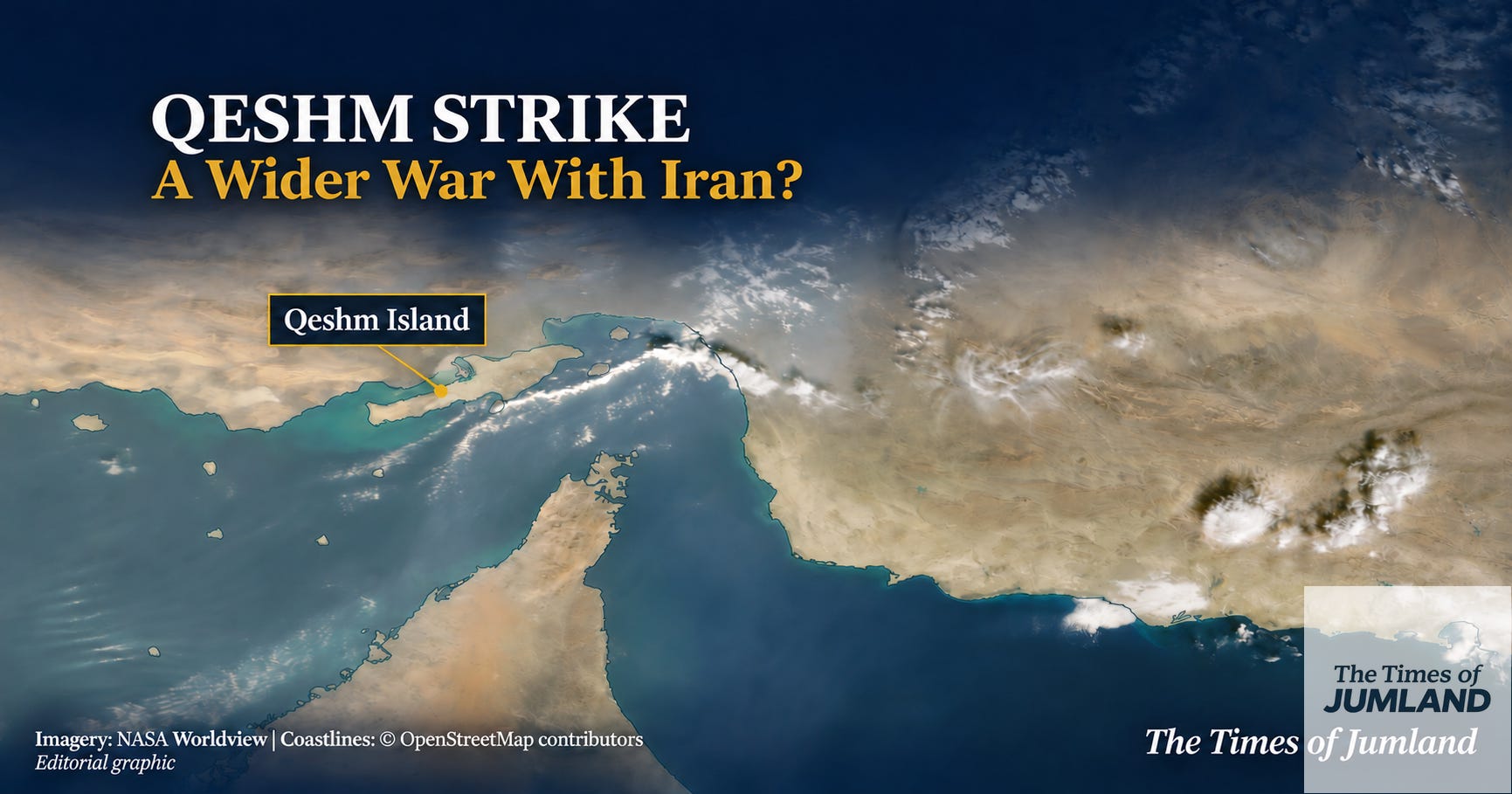
The United States has struck Iran’s Qeshm Island while diplomatic efforts to end the conflict continue. American officials describe the operation as limited and defensive. Yet an attack beside a vital shipping route raises a larger question: will it remain a contained exchange, or become another step towards wider fighting?
The answer begins with Qeshm itself. The island supports fishing communities, trade, tourism and educational institutions. Its position near the Strait of Hormuz also places it close to the military confrontation and the movement of energy supplies through the Gulf. Understanding both sides of that geography helps explain the stakes.
Qeshm lies off southern Iran, near Bandar Abbas in Hormozgan Province. It stretches along the Iranian coast near the western approaches to the Strait of Hormuz, which connects the Persian Gulf with the Gulf of Oman and the wider ocean. It is the largest island in the Persian Gulf.
The local geopark authority gives its length as approximately 130 kilometres and its area as about 1,565 square kilometres. This is a substantial inhabited island. Reports that simply describe an attack “on Qeshm” do not identify how much of the island was affected or which communities were close to the targets.
Read More:
1) Why the Two-State Solution Is Becoming Impossible
2) Netanyahu’s Nuclear Warning Raises Stakes for Trump’s Iran Decision
Trading and fishing are important local occupations. Towns and villages contain homes, schools and businesses, while the island also has higher education institutions. The sea provides livelihoods and connections with the surrounding region. Military activity takes place within this wider civilian setting, making precise reporting about targets and damage essential.
Qeshm’s natural attractions include mangrove forests, coral habitats, beaches and dramatic geological formations. The Valley of Stars contains eroded sandstone formations, while Chahkuh Gorge offers narrow passages between steep rock walls. The area received its UNESCO Global Geopark designation in 2017.
At Laft, traditional wooden boatbuilding and windcatcher architecture reflect the island’s maritime heritage. The Namakdan salt cave is another important attraction: the International Union of Geological Sciences describes a surveyed length of about 6.58 kilometres. Nearby Hengam, associated with dolphin-watching excursions, is a separate island.
UNESCO lists approximately 180,000 people within the wider geopark territory, which includes surrounding areas. The figure gives a sense of the human scale of the region. Behind the strategic maps are families whose income, travel and daily security can be affected when military confrontation reaches their surroundings.
Qeshm’s strategic importance comes largely from the waters beside it. CNN reports that approximately 20 million barrels of oil passed through the Strait of Hormuz each day before the war. That historical figure illustrates the route’s importance; it does not describe current traffic through the conflict-affected waterway.
Its location helps explain why operations around Qeshm can attract international attention. Threats to aircraft and vessels near the strait can affect military decisions and commercial confidence. However, geography alone cannot establish the purpose of every facility on the island or identify what American forces struck.
According to Reuters, U.S. officials confirmed the 2 November operation and described it as a response to Iranian forces using surface-to-air missiles against American assets. Iranian state media reported explosions. Confirmed casualty figures and a detailed damage assessment were not available in the Reuters report reviewed for this article.
Officials told ABC News that the immediate trigger was an Iranian attack on a U.S. aircraft. ABC also reported that recent limited strikes had not been publicised to avoid signalling a return to major combat. U.S. Central Command had not responded to its requests for comment when that report appeared.
Washington’s description gives its stated justification, but the publicly available account remains incomplete. The precise sequence of events, full target list and consequences on the ground require further confirmation. The scale of any Iranian response will also matter in determining whether the exchange remains contained.
Diplomatic efforts provide another part of the picture. AP reports that Qatari mediators are pursuing a framework involving an end to Iranian attacks in the strait and the lifting of the American blockade of Iranian ports. More talks are planned, according to officials familiar with the discussions.
Meanwhile, Netanyahu has been pressing Washington for another wave of attacks, AP reports, citing regional officials and a person familiar with the discussions. The Israeli government had not immediately commented. These reports concern pressure for further action; they do not establish Israeli participation in the Qeshm operation.
The danger is that another strike or retaliation could change the calculations of both governments. Regional officials told AP that further attacks could also encourage Iran-aligned groups elsewhere to become more involved. Such warnings describe a possible path to escalation, rather than an outcome that has already occurred.
For Bangladesh, Japan and other trading economies, sustained disruption could affect energy deliveries, freight costs and household budgets. The extent would depend on shipping access, the duration of disruption and market responses. For Qeshm’s residents, the immediate concerns are closer: personal safety, damaged property and the ability to continue working and travelling.
The Qeshm strike does not, by itself, establish that a wider offensive has begun. The clearest warnings would be sustained attacks, a broader target list or retaliation drawing more countries into the fighting. Negotiations still offer a route away from that outcome. For now, Qeshm marks a dangerous confrontation whose next stage remains uncertain.
Sources and Further Reading:
Reuters — US carries out ‘defensive’ strikes on Iran’s Qeshm Island, officials say, 3 November 2026.
https://www.reuters.com/world/middle-east/us-struck-irans-qeshm-island-wall-street-journal-reports-2026-11-03/Associated Press — US strikes Iranian targets in Strait of Hormuz, and other Mideast news.
https://apnews.com/article/8722c8b5a9deb228e7a188d4760ea8edABC News — US carries out defensive airstrikes on Iran’s Qeshm Island: Officials.
https://abcnews.com/International/us-carries-defensive-airstrikes-irans-qeshm-island-officials/story?id=137792518UNESCO — Qeshm Island UNESCO Global Geopark.
https://www.unesco.org/en/iggp/qeshm-island-unesco-global-geoparkQeshm Island Geopark — Geopark Territory.
https://qeshmgeopark.ir/pages/about/geopark-territoryInternational Union of Geological Sciences — Namakdan Salt Cave.
https://iugs-geoheritage.org/geoheritage_sites/namakdan-salt-dome/