

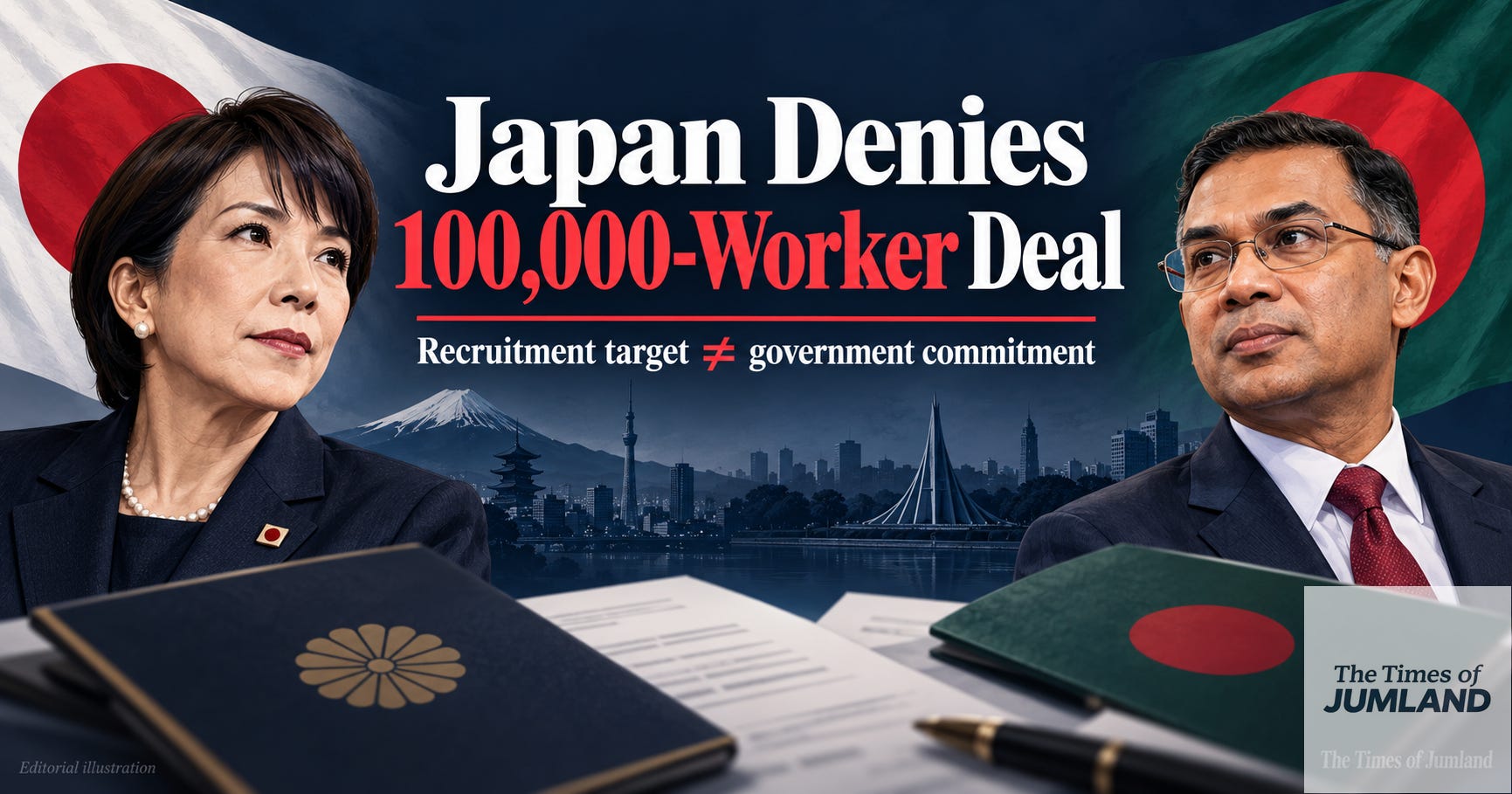
Japan has denied agreeing to accept 100,000 Bangladeshi workers, rejecting claims circulating after Prime Minister Tarique Rahman’s October 27 meeting with Japanese Prime Minister Sanae Takaichi in Tokyo. The clarification leaves prospective workers facing a practical question: which announcements represent employment opportunities, and which remain targets?
Foreign Ministry spokesperson Toshihiro Kitamura issued the denial on October 29. He said no such government agreement existed, including in the discussions during the summit. His statement was reported by bdnews24.com and other news organisations.
The denial challenges a claimed recruitment commitment. It does not announce a ban on Bangladeshi workers or establish that existing recruitment routes have closed. For applicants, the distinction is essential: rejecting a numerical promise is different from ending employment opportunities.
Much of the confusion involves three separate figures. An earlier business-led initiative envisaged recruiting 100,000 Bangladeshis over five years. Reports around the recent visit described an annual intake of 100,000. Meanwhile, the summit produced a projection of 200,000 jobs in Bangladesh through Japanese investment.
Those figures cannot be used interchangeably. They refer to different periods, different arrangements and, in the case of the investment announcement, employment in a different country.
Japan’s official account of the October 27 summit says Japanese businesses’ upcoming private investment in Bangladesh is projected to reach approximately one trillion yen over five years, with an expected 200,000 jobs created. These are jobs associated with investment inside Bangladesh, rather than offers to bring 200,000 workers to Japan.
Read More:
What Bangladesh Gained From Tarique Rahman’s Japan Visit
Why Islam Is Becoming a Flashpoint in Japan
Japan–Bangladesh Worker Pact Draws Hostile Replies on X
Who Is Accompanying Bangladesh’s Prime Minister on His Japan Visit?
The investment is also a projection. It should not be described as money already delivered or employment already created. A Japanese-backed business employing workers in Bangladesh does not, by that fact, provide those workers with a route to live or work in Japan.
The 100,000-worker figure has a separate history. On October 27, 2025, Bangladesh’s state news agency BSS reported that a delegation from Japan’s National Business Support Combined Cooperatives, or NBCC, had met then chief adviser Muhammad Yunus in Dhaka.
Citing the chief adviser’s press wing, BSS described a memorandum of intent supporting training, certification and employment. More than 100,000 Bangladeshis were expected to find work over five years through programmes including technical training and Specified Skilled Worker arrangements.
The delegation outlined proposed recruitment of 2,000 workers in 2026, 6,000 in 2027 and 18,000 in 2028. These were plans presented by a business federation. The announcement did not establish a Japanese government guarantee to admit those numbers, nor did it demonstrate that the proposed recruitment had been completed.
The annual claim goes considerably further. Accepting 100,000 workers every year would mean 500,000 over five years. The earlier five-year initiative cannot substantiate that claim.
A Bangladesh-side ambition to increase overseas employment must also be distinguished from a Japanese commitment. A sending-country target, a recruitment organisation’s forecast and a receiving government’s binding agreement are separate things. Reporting should identify which one a particular announcement represents.
That distinction matters to families deciding whether to pay for language classes, training or recruitment services. A broad announcement does not establish that an individual has secured employment. Applicants still need to know the recruitment route, the employer, the written employment terms and the official requirements that apply to their case.
Training may improve someone’s prospects. It should not be mistaken for a guaranteed job, visa or departure date. Likewise, an organisation’s recruitment target should not be presented to applicants as evidence that places have already been allocated to them.

The documents behind the announcements would help resolve the uncertainty. They should show who signed, what responsibilities each party accepted, whether a recruitment number appears and whether that number is a target or a commitment.
Progress also needs to be measured through results. How many people have entered training under the initiative? How many have obtained employment contracts? How many have arrived in Japan? The sources reviewed for this report do not establish those totals, so they cannot support a conclusion that the initiative has either achieved its target or failed.
Japan’s clarification therefore requires a precise response. It should not be exaggerated into a claim that every opportunity has disappeared. Equally, the earlier recruitment ambition should not continue to be presented as a guaranteed government intake.
What is established is narrower and clearer: Japan has denied a government agreement to accept 100,000 Bangladeshi workers. The earlier five-year initiative does not prove an annual commitment, and the summit’s projected 200,000 jobs concern Bangladesh.
For prospective workers, the most useful next announcement would be a documented account of actual vacancies, completed recruitment and applicant costs. A headline number can generate hope. A verified job offer tells a worker what that hope is worth.
Further reading sources:
Japan’s Foreign Ministry — Official summit account
https://www.mofa.go.jp/s_sa/sw/bd/pageite_000001_00004.htmlbdnews24.com — Japan refutes reports of recruiting 100,000 Bangladeshi workers
https://bdnews24.com/bangladesh/6b62lx3busBSS — Earlier five-year recruitment initiative
https://www.bssnews.net/news-flash/325482Daily Sun — Japan denies annual recruitment agreement
https://www.daily-sun.com/diplomacy/906187/japan-denies-talks-on-recruiting-100-000-bangladeshi-workers-annuallyMoneycontrol — Japan denies deal to accept 100,000 Bangladeshi workers
https://www.moneycontrol.com/world/japan-denies-deal-to-accept-1-lakh-bangladeshi-workers-says-viral-claims-are-false-article-14063760.html